Occult systems emphasise silence as important. Silence is identified not particularly with noise in the physical sense but rather the lack of conceptual interaction -mostly thought (accretions of pneuma). Hence one can be in a noisy environment and still tune into silence. Of course persons with highly developed concentration can be in talkative environments and still tune into silence; it’s just trickier.

Noisy here though simply means loud sounds, either natural or man made. Their possibility of inhibiting silence comes from their accretive nature (which of course is what thought and talk do). If we tune into our conceptual arrangement of the meaning of noises, we do not hear silence, we hear accretive noise.

Silence is about tuning out the accretions. Mystics may talk about the silence of existence. However some modern scientific revelations e.g. complex fungal networks point out the vast amount of communication that goes on in the seeming silent world. Complex chemical conversations take place all the time between organisms – is this not noise?

There are two points here. One is simply to say that we do not hear this noise and hence it does not impinge upon our silence. This though is somewhat anthropocentric, since what we are after is understanding the general silence of existence, it is however relevant as silence-to-us is a key factor (phenomenological).

The second is to say that thought/communication exists on a continuum that nevertheless has a threshold, after which the phenomena we have identified as accretions appears. Communication and thought develop in organisms. The more complex the conceptual system the more neurotic the organism can become. Noise is the development of accretions. The chemical conversations have not crossed the accretive threshold and hence do not fill the world with accretive chatter. Some animals’ (other than ourselves) thought and chatter no doubt is accretive, but equally may be interpreted as silence (just like our own chatter can be). However on an ontological level it contributes to the accretive interference that obstructs silence.

Leaving Sabatier’s office, Stephen’s mind was consumed with the weight of the task ahead. He knew he had to act swiftly and cautiously to uncover the secrets hidden within Derleth McKenzie’s will. As he walked through the clinic’s bustling hallways, he considered his options.

Stephen decided to start by gathering information discreetly. He headed towards the clinic’s records department, hoping to find any relevant details about McKenzie’s medical history or connections. Martha, the nurse he had spoken to earlier, might have access to valuable insights.

Entering the records department, Stephen found Martha meticulously organizing patient files. She glanced up, noticing him approach. “Stephen, back so soon? Is everything alright?”

Stephen put on a reassuring smile. “Everything’s fine, Martha. I just need your expertise. Do you have any additional information on Derleth McKenzie, his medical records, or any peculiarities surrounding his treatment?”

Martha paused, considering his request. She leaned closer and lowered her voice. “Well, I can’t disclose specific patient details without proper authorization, but I can tell you this: McKenzie’s medical history was certainly… unusual. He had a long-standing association with a renowned neurosurgeon who operated on him periodically.”

Stephen’s curiosity piqued. “A neurosurgeon? Do you happen to know the name?”

Martha hesitated for a moment, seemingly assessing the situation. Finally, she whispered, “Dr. Evelyn Sinclair. She’s quite renowned in certain circles, known for her groundbreaking research in neurological disorders.”

Stephen jotted down the name in his notebook, grateful for the lead. “Thank you, Martha. This information could be crucial. I appreciate your help.”

With newfound determination, Stephen left the records department and headed back to his office. He needed to dig deeper into Dr. Evelyn Sinclair’s background and any potential connections to the Ouroboros Syndicate or Phytocorp. He fired up his computer and began a meticulous search, hoping to uncover any leads that would shed light on the mysterious circumstances surrounding Derleth McKenzie’s involvement.

As the search progressed, Stephen’s excitement grew. He stumbled upon fragments of information linking Dr. Sinclair to clandestine medical experiments and rumors of her involvement with secretive organizations. It appeared that she operated in the shadows, much like the Ouroboros Syndicate itself.

Just as Stephen delved deeper into his research, the clinic’s emergency alarm suddenly blared through the halls, interrupting his concentration. Startled, he rushed out of his office and joined the commotion.

“What’s happening?” Stephen asked a fellow phyctor, struggling to be heard over the chaos.

“It’s Gary Hyle, the patient with the odd shoes!” the phyctor exclaimed, his face pale with urgency. “He’s experiencing a severe relapse. We need to stabilize him immediately!”

Stephen’s heart sank. Gary Hyle’s deteriorating condition was the reason for his rush to the clinic in the first place. He couldn’t help but wonder if there was a connection between the escalating symptoms and the enigmatic clues from his dream.

Determined to find answers, Stephen sprang into action, offering his expertise and support in the urgent situation. Amidst the chaos, he couldn’t shake off the nagging feeling that there was a hidden puzzle waiting to be solved—one that held the key to both Gary Hyle’s well-being and the secrets buried within Derleth McKenzie’s will.

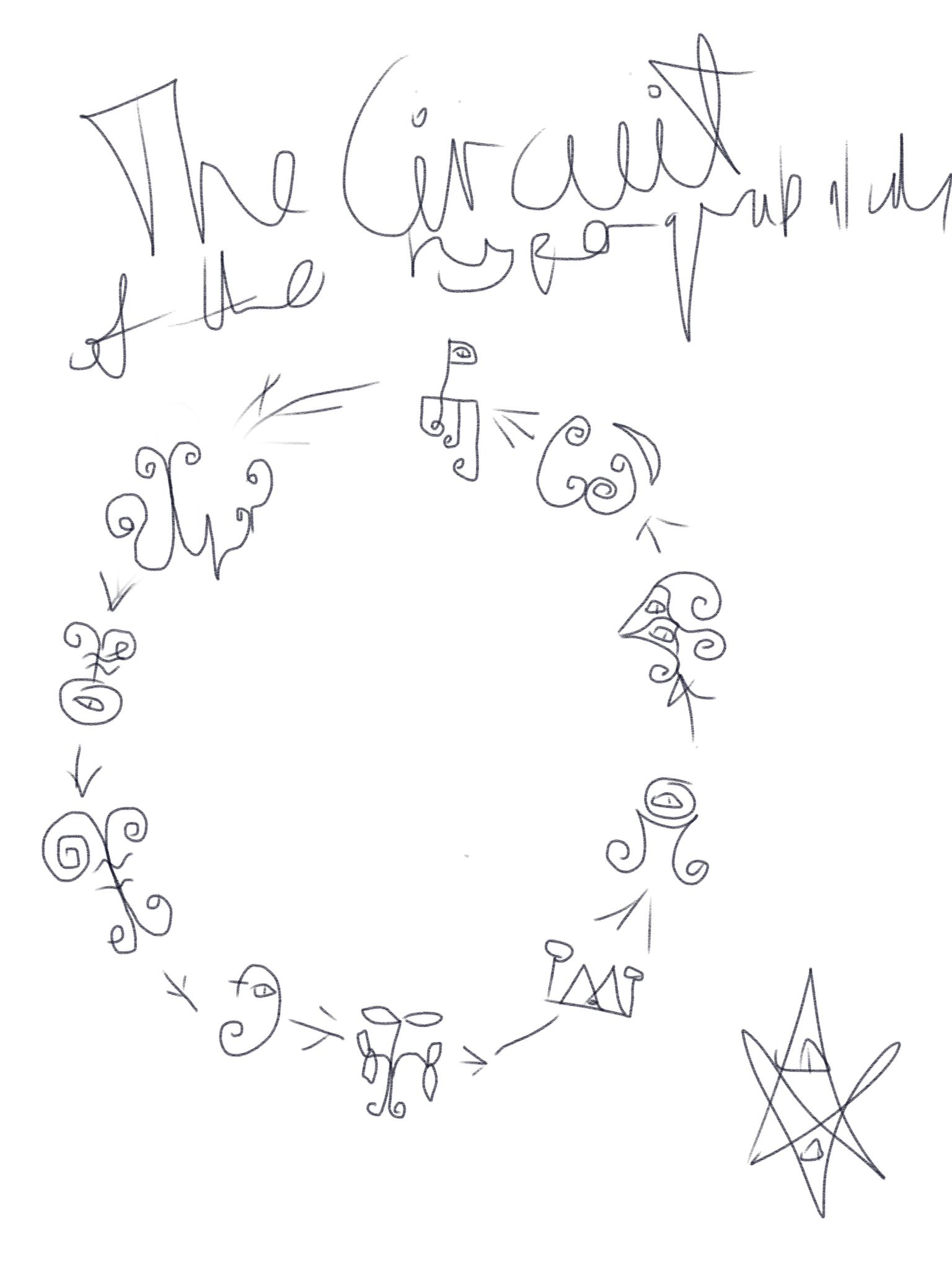
The path/relationship between the node Kirolgnu (f) and Pnasloskied (j) within the context of the Hyperqabalah is a profound exploration of the interplay between primal energy and intense passion. These two nodes represent distinct aspects of the human experience and offer insights into the transformative power of desire.

Kirolgnu, symbolized by the enigmatic figure of Urlkonig, embodies raw and untamed energy. It represents the primal forces within us, the instinctual drives and potent desires that shape our being. Kirolgnu calls us to embrace our authentic nature, urging us to tap into our deepest passions and unleash our creative potential.

On the other hand, Pnasloskied delves into the realm of intense passion and pulsating emotions. It is a realm where desires are magnified, and the fires of passion burn brightly. Pnasloskied represents the crucible of our deepest longings, where we confront the raw intensity of our emotions and delve into the depths of our vulnerabilities. It is within this realm that we face the transformative power of passion and experience its potential for both ecstasy and suffering.

The path between Kirolgnu and Pnasloskied invites us to navigate the delicate balance between our primal instincts and our conscious awareness. It urges us to explore the depths of our desires, to confront our shadows, and to integrate our passions into our overall sense of self. It is a path of self-discovery, where we learn to harness the transformative energy of passion and channel it into creative expression and personal growth.

By journeying along this path, we embark on a profound exploration of our own desires, vulnerabilities, and transformative potential. It is a process of self-integration, where we embrace the full spectrum of our human experience and come to understand the profound interplay between our primal nature and our conscious awareness.

In summary, the relationship between Kirolgnu and Pnasloskied within the Hyperqabalah represents a deep exploration of primal energy and intense passion.

The Hyperqabalah: A Convergence of Numbers and Archetypes Rooted in the mystical traditions and symbology of the Kabbalah, the Hyperqabalah takes inspiration from the enigmatic numbers 47 and 23. These numbers hold significant meaning and have deep historical and esoteric roots. The number 47, with its connections to the Roman goddess Pomona and Star Trek, weaves a mysterious thread into the fabric of the Hyperqabalah. Meanwhile, the sacred number 23, associated with the Discordian goddess Eris, adds another layer of symbolic depth.

Paths and Nodes: A Journey Through the Hyperqabalah At the heart of the Hyperqabalah lies a network of paths and nodes that offer a glimpse into the interconnected nature of our collective unconscious. Let us explore some of the key nodes and their associated aspects:

  1. Vaendt – Advent: This node represents the beginning of a transformative journey, echoing the archetype of the Hero’s Quest. It calls upon us to embark on a path of self-discovery, facing challenges and embracing personal growth.
  2. Zirnstaai – Eris: Symbolizing chaos and discord, this node delves into the shadow aspects of our psyche. It invites us to explore the interplay between order and chaos, embracing the transformative power of disruption.
  3. Neutimicis – Isis: Reflecting the nurturing and healing qualities of the Great Mother archetype, this node guides us to explore our emotions and cultivate compassion. It offers a path towards inner harmony and deep connections with others.
  4. Xiset – Ethics: Rooted in the ethical dimensions of our existence, this node prompts us to contemplate our values and actions. It encourages personal integrity, aligning our choices with our inner compass.
  5. Bnasupach – Pan: Representing the primal forces of nature, this node reconnects us with our instinctual selves. It invites us to embrace our wild and untamed nature, celebrating the interconnectedness of all living beings.
  6. Daagolenyfo – Eschatology: Contemplating the mysteries of life and transcendence, this node invites us to reflect on our mortality and seek meaning beyond the physical realm. It encourages a deeper understanding of our existence and purpose.

Unveiling the Esoteric Tapestry: As we navigate the Hyperqabalah with its rich historical and esoteric influences, we embark on a profound journey of self-discovery and integration. By engaging with the archetypal energies represented by each node, we unlock hidden potentials and establish a deeper connection with our collective unconscious. This convergence of numerology, symbolism, and psychological insights offers a gateway to profound self-realization and transformation.

As we venture into the realm of the Hyperqabalah, guided by the interplay of numbers, archetypes, and esoteric wisdom, we embark on a transformative quest of self-discovery. Drawing inspiration from the works of Henry Corbin, Carl Jung, and the mysteries of the numbers 47 and 23, we unravel the intricacies of the Hyperqabalah’s pathways.

For just one example, let us look at how Lygtwyth and Pnolodolia resonate (for there is a path between them).

The resonance between Lygtwyth and Pnolodolia in the context of the Hyperqabalah offers a fascinating exploration into the interplay of twilight and the sun. Lygtwyth, representing twilight, embodies the liminal space between light and darkness, where the boundaries blur and the veils between realms become thin. It symbolizes a state of transition, mystery, and potential.

On the other hand, Pnolodolia resonates with the energy of Sol, the sun. It represents the radiant and illuminating aspects associated with the solar archetype. Pnolodolia embodies vitality, life force, and conscious awareness. It speaks to the transformative power of the sun, the source of light and warmth that sustains and nurtures life.

The resonance between Lygtwyth and Pnolodolia can be seen as a dynamic dance between twilight and sunlight, shadow and illumination, and the cycles of life. It reflects the inherent balance and interdependence of opposites within the Hyperqabalah system. This resonance invites us to explore the interplay between light and darkness, acknowledging the transformative potential that arises during times of transition and embracing the wisdom and growth that comes from navigating both realms.

By delving into the resonance between Lygtwyth and Pnolodolia, we deepen our understanding of the archetypal forces at play within the Hyperqabalah. It encourages us to explore the intricate relationship between the twilight aspects of our psyche, where mysteries lie hidden, and the solar energies that bring clarity, consciousness, and vitality to our lives. Embracing both aspects allows us to navigate the realms of shadow and illumination, fostering wholeness, and unlocking the transformative power that resides within us.

List of Hyperqabalah Nodes and Aspects:

  1. Vaendt – Advent
  2. Gramier – Image
  3. Asnerist – Artemis
  4. Zirnstaai – Eris
  5. Kirolgnu – Urlkonig
  6. Rahimaot – Mithras
  7. Jincdotec – Incest
  8. Neutimicis – Isis
  9. Pnasloskied – Passion
  10. Hzrislohoepp – Philosopher
  11. Lehe – Freedom
  12. Xiset – Ethics
  13. Teufos – Foetus
  14. Yiwathd – Death
  15. Maugnyep – Pneumatology
  16. Bnasupach – Pan
  17. Lygtwyth – Twilight
  18. Eilduour – Superman/Boudica
  19. Netahucla – Luna
  20. Pnolodolia – Sol
  21. Daagolenyfo – Eschatology
  22. Triebnegesin – Being
  23. Orabu – Umbra

This is a somewhat convoluted observation that I had the other day that, to me at least, makes some sense of my (largely erstwhile but still slightly lurking) Twin Peaks obsession. I’ve been reading quite a lot of Gurdjieff/Ouspensky and have been struck frequently by their characterisation of humankind as largely asleep. They constantly write that such sleep is not easy to understand but equally that it is in fact possible to do so. With the help of another writer (one E J Gold), I think I may understand some of this now.

Understanding here is a curious thing, it’s not a cognitive understanding, it’s an entirely practical or at least an experiential one. The first understanding I had of sleep was the obvious way in which one cannot really be aware of everything that is happening as it happens, one can try to keep a track of events in a more aware (awake) state, but it is, as Gurdjieff admits, nearly impossible to do (unless apparently one has had some level of esoteric training). This is ‘sleep’; it’s a fair characterisation of it, however it is not all of it. Furthermore thinking of sleep in this way encourages one to think of it as something almost simple, that if one simply could keep track of events, one would be ‘awake’.

In fact sleep is far more entrenched than this. Sleep is also your patterns and emotional responses. If you observe yourself accurately you will come to see that your organism almost entirely runs itself. This brings into play a curious kind of separation. One can kind of see that there is part of us that can observe that your organism including its thoughts and feelings is indeed quite machinic. Certain jokes arise in you, to make certain people laugh, certain situations irritate you without any action on your part. You, this other part of whatever we are, are entirely unnecessary to this process, it will run entirely without you.

So what is awakeness? Awakeness is also a natural occurence that we do have some limited access to. Strange moments of clarity that may just occur or be induced by drugs, stress, or meditation etc, are actual experiences of awakeness. Awakeness is often characterised by the absence of any sense of irritation or indeed enthusiasm towards anything. But these are just the foothills of awakeness. Esoteric systems generally are about trying to cultivate this sense. Pretty much all of the activities of these systems are designed to try to put you in some form of awake state and try to do something whilst you are in it, to work with it.

Awakeness/sleep is also very clearly not a binary on/off system. Furthermore it is simply a grammar that helps explain something. To be partially awake can be, as mentioned, a normal but fleeting thing. However, being more like a sliding scale than an on/off switch one can be more awake still (or less awake still). Indeed many of the normal more awake states are in fact still highly automatic but simply have an increased awareness of the automation.

The sliding scale in some sense though is confusing, for it can conflate the awakeness with the weird reality interference. The two are related, though not necessarily correlated. The weirdness will probably activate waking and being awake will also bring about weirdness but its not a precise relationship. We can (sort of) think of these as two axes. That is, we might find our selves somewhat entangled with events that emanate from the higher dimensions/other world/pneuminous realm whatever you want to call it and/or we may find ourselves with an increased sense of presence, awareness ability to perceive and override our automatic actions and words. Extensive ability to do the latter will likely increase the former but an increase in the former may only negligibly increase the latter, as we will often marvel and forget or obsess over the weirdness in unproductive ways e.g. by reifying and attempting to place weirdness within the scope of regular reality (which it will totally resist). Ghost hunters and UFO obsessives may fall into this category.

Gurdjieff famously disavowed his magickal abilities in favour of a pure focus on something like will and attention. This was his sacrifice. We could place our axes precisely on his decision, saying that he restricted his access (and control) over weirdness (axis 1) in favour his concentration and will (axis 2) believing this to be the important part of his spirituality. This makes sense since, as discussed, it is perfectly possible to continue to have sleep like responses and be interested in weird phenomena.

The other world is a strange thing. From sleep you can kind of intuit its presence. This intuition is going to be supplied by clues like manifestations of phenomena that either are or resemble synchronicity, telepathy, entity interaction, precognition etc. Personally I was prone to one of those number synchroncities and can still remember the moment when one of my friends finally had access to the internet so we could look it up. It is an understatement to say I was suprised that my very number (47) was right there on the net as ‘the mysterious number that connects all things’ or some such. Indeed the state the phenomenon put me in something close to a waking state. This was one of the ‘shocks’ that Gurdjieff says we need to experience. Occult phenomena are good at this because they either scare the bejeesus out of us or they imbue us with a sense that reality is actually bigger that the spatio-temporal kind of layer we seem to live in.

What has Twin Peaks got to do with this? I would contend that Twin Peaks was extremely good at putting me into some kind of waking state (albeit it temporarily and certainly not for all of the show whilst it was on). I might extend this claim to say that a lot of Twin Peaks cult popularity was because it was quite good at doing this generally. This is also responsible for the sensation that some watchers get that the show is somehow more than just a TV show.

As mentioned, being awake is a smooth curve, the lower reaches of which we are familiar with (sleep) and the rising of the curve is also accessible for free sometimes. Twin Peaks and other cultural experiences sometimes move us up the curve by their ability to powerfully demonstrate a kind of recognisable world that simultaneously blends with esoteric manifestations. Whilst this is true of it, it is also true of many other kinds of supernatural shows. However, straightforward fear in this sense is not so productive of waking states (at least from cultural products) so shows that produce this kind of response only put the organism in a state in which it is afraid and not in which it is jarred by ontological dissonance.

How does Twin Peaks achieve the ontological dissonance that I ascribe to it? I would say it is i) by its seamless fusion of the competence and rational clarity of its hero (Agent Cooper) combined with his rapidly disclosed belief in divination/synchronicity as valuable guideposts to his enquiry and ii) by the way show unambiguously contains the existence of other than human powers and places that have some sense of existence external to human reality iii) the way in which the other world is depicted in a manner never before thought of (at least in anything mainstream that I have seen). By this I mean the famous red room. With its red velvet curtains, art deco decor and black and white zig zag floor (all set to various jazz like themes), the black lodge is/was one of the most amazing/strange characterizations of the other world that has ever been.

The show makes it clear that some of the spirits work to help Cooper whereas others do not, others still are unclear in their alliances (e.g. the man from the other place). As such the favourable synchronicities can be interpreted as clues from these beings. Whilst there are direct manifestations of entities, the communication of clues through reality (synchronicity) suggests the curious sideways on interaction with the normal real that so often characterizes the phenomenology of such events. That is, the paranormality does not occur from powers that act on the level of regular reality (like a poltergeist might move a plate) rather the interaction alters the elements of reality themselves (or potentially our perception of them) to produce the clue. This of course is a little too ontologically simplistic and needs (in my opinion) the help of something like pneuminous accretive theory to complete it. That is, we cannot talk about things of the world as ontological simples themselves, for they are each informational/conceptual structures and thus capable of being different vectors of meaning.

Twin Perfect’s famous explanation of Twin Peaks as expressing TV itself or maybe rather TV’s slide from authenticity into impoverished entertainment is extremely convincing. I’ve no need to disagree with it and I don’t particularly want to. However, correct as it may be, the phenomenology of Twin Peaks does not show this level of it. Twin Peaks is generally watched as if it were a TV show and not a meta-indictment on TV itself. As such it is interpreted through these rules. The Red Room may well be code for TV signals and stage curtains but without this realisation it hits a level of perfect surrealism that disarms all regular expectations of paranormal interaction. This, I would say is a key factor that colours all the other weirdness that goes on in the show. That is, if this other dimension of ‘evil in the woods’ were given a more conventional representation of evil spirits with their realm looking suitably gothic (or some other cliche) then the power of the show to disturb/shock would be considerably diminished.

By shock, I don’t mean the ordinary kind of shock of fear necessarily (though this can do it), but rather the Gurdjieffian shock which can suddenly place us in a heightened/weirdified state to some degree. Twin Peaks by its very ongoing presence (whilst watching it) can give this shock. This is because the ontology is necessarily embedded in the world. Of course many elements of the show do not deal with the weird, however as long as the thread to Laura remains, we can know a priori that the rest of the madness is entailed.

Another layer to the shock/awakeness inducing phenomena is the resonance people feel to the weird realism. Whilst one end of Twin Peaks is totally off the deep end, the other end exists at the totally relatable level of synchronicity. Soft esoteric experience like synchronicity are something that make even hardened materialists pause, even if only for a second or two. This is because (as I have spent more words than is necessary elsewhere explaining) the interpretation of the synchronicity as the weird reality intruding phenomenon is epistemically equivalent to its interpretation as coincidence of pure chance.

The point is, whether they give it much thought or not, almost everybody knows this kind of potentially paranormal experience. Twin Peaks takes that experience and shows you that a highly intelligent agent of the state uses and believes in this as a method and furthermore is not wrong to do so. This means the show unambiguously comes down on the weird reality intrusion version of synchronicity. Subliminally or otherwise, the display of this capable, highly likeable protagonist using this intuitive method (and it being ‘true’) facilitates a certain feedback with the viewer that lifts them into a space where they too (given probably a certain psychological disposition) engage/believe deeper in this weltanschauung.

This is more of what makes Twin Peaks have the sensation of being more than just a program i.e that it is in some sense a coded message about how things actually are. The aforementioned implication from synchronicity to entities and other dimensions also escapes the screen, travelling along the legitimised synchronicity path. That is, because the show supplies a ‘cause’ of the synchronicities (the sideways interference into reality by the spirits), buying into the show’s ontology comes almost as a whole. Again, this is a sliding scale type effect, however because an answer as to how these phenomena occur is given, the sense of possible coded revelation that the show presents carries through, therefore the more extreme weird end of the show’s ontology is also displayed as possible.

To briefly return to Twin Perfect’s analysis we can again agree but with a slightly different twist. Because Twin Peaks is Television, the reality manipulations in it are identical to what we think of as paranormal in this world. The scriptwriters (spirits) can insert any synchronicity into events that they wish and it will be meaningful because it was exactly written to be so. We can bounce back the paranormality as television back to the real world and feel another angle of the well-known show’s epithet ‘we live inside a dream’. The Twin Peaks characters do live inside a dream, but somewhat trite though it is to say, from the Gurdjieffian perspective so do we. When defined as asleep (and it is not the least fair characterisation of our repetitive automatic characters) we can be seen to be dreaming, only drifting occasionally into anything resembling a cognizance of what is going on.

Twin Peaks, through these various loops, appearances and reflections can partially drag us out of this somnambulance into a slightly heightened state. The problem with this state (through this means) is that the usual path it takes is not the development of the state itself (to be fair, why would you notice this or engage with it, I mean you just thought you were watching a TV show that made you feel a bit strange) but rather a fascination with the other axis of weirdness we described. By plugging into various quasi ‘real’ phenomena (synchronicity (which is real phenomenologically at least), project bluebook etc.) it pulls the Lovecraftian trick of blurring the lines between fiction and reality. This can make us feel the pull of the weird and end up obsessing about these aspects on the wrong ontological level (a kind of taxonomisable or contactable real), which, whilst fascinating, are dead ends of paranoia, madness and disappointment.

This doesn’t mean the weird stuff isn’t real in some sense and it doesn’t mean we can answer the question about whether entities are inside or outside of us or even if it really makes any sense to ask this. What it means is that occult value is not in obsessing about a kind of weird science of this stuff that never gets anywhere, it’s more about the ability to develop a kind of awareness that escapes the regular sleeping state. Engaging only with the weirdness on this level of fascination is a return to sleep. This is kind of the tightrope that Erik Davis talks about (in High Weirdness) or at least similar. Weirdness provides shocks but is also fascinating. Fascination brings sleep. Staying awake though, increases weirdness even if only in the way things sometimes look different (though it can also trigger synchronicity and other things). More weirdness increases the fascination obsession temptation and so on.

There is of course the possibility (I admit slim) that Twin Peaks even overtly refers to all of this. By this I am referring to coffee. Let’s ask ourselves ‘what does coffee do?’ The answer is ‘it wakes you up?’ What does the intelligent, capable, likeable FBI agent do? He drinks coffee. Cooper can easily be identified with someone in the waking state and his love of coffee is part of what identifies this. He doesn’t want to fall asleep and he loves coffee (Gurdjieff is often referred to as drinking coffee). He unambiguously is shown as someone who engages with meditation and who is two steps ahead of everyone else by sheer awareness of what’s going on. This is an at least partially awake human being whose awakeness is partially fuelled by coffee. Furthermore, it is only Cooper who is capable of receiving the messages from the other world (awakeness increases weirdness). As if to reinforce this trope of the ‘awakeness of Cooper’, ‘Twin Peaks: The Return’ features largely an entirely asleep Cooper, this time in a state even lower than that of the regular human sleep.

In a way it is nothing to say this, Lynch knows lots about meditation and will definitely be familiar with terms like ‘awakeness’. His usage of coffee as symbolic/connected to Cooper’s awakeness could indeed be entirely deliberate. The interesting possibility would be if Twin Peaks was actually designed to wake people up. Twin Perfect’s argument would sort of agree with this insofar as Twin Peaks exists to symbolically point out the dire state of TV (at least back in the 80s) and act as a wake-up call against it (though this is hardly an esoteric point). Is it designed to wake people up esoterically by identification with a synchronicity legitimator (amongst other things)? Probably not. However, I would say that regardless of intent, even though it may also open up weird fascinations (and hence sleep) it does contain certain shock-keys that can facilitate some access to altered consciousness.