A lad lived in a desolate village where the wind howled and litter was always strewn. As he walked around his village there was naught but abandoned petrol stations and lots with concrete ruins and heavy chain link fencing. So one day he says to his parents, ‘Mum, Dad, I’m off to walk to world, for sure as sure there’s nothing for me here’. Well they were sad, but they were understanding, for certainly he told the truth, there was no life here for him. So his mum packs a bag of food for him and his dad gives him a swiss army knife and it was goodbye mum and dad.

So our lad walks and walks. His village is one long road in some strange flat fen. He walks past the single roomed school and hears no happy cheers of play. He walks past the Wesleyan chapel and hears no hymns of praise, he walks past the small library and sees only one blind man who cannot even gain entry to the building. Our lad stops and watches the old fellow. The blind man wanders this way and that, he taps on the library door, he taps on a nearby statue (of a young child reading a book as it happens) and he shouts something our lad cannot make out. So though the lad wanted to leave the village, he was good by nature and went to see if he could help the old man.

‘Hi hi, old man’ says the lad ‘What’s to do? ‘Who’s there?’ says the old man ‘Just a lad’ says the lad ‘And do you have a name my lad?’ says the old man ‘That I do old man, folks may call me Alex’ ‘Well Alex, I’m in a bother here, for the library is closed and I must retrieve a book.’ ‘Well now let’s see’ says Alex. He wanders round the library, rattling this door, rattling that door. Will they open? They will not. ‘The doors are locked.’ says Alex ‘But I’ll not let that stop us!’ and Alex gives a kick and the flimsy library door breaks at the lock and flies inwards. ‘What have you done?’ says the blind man ‘See for yourself!’ says the lad, reflecting uneasily on his choice of words. But the old man sees the sense of the lads meaning, and it’s tap tap tap with the stick towards the door and oho, isn’t our old man smiling now as he taps his way into the building.

It seems now the old man is more lively and sense filled than before, for he’s rummaging this way and that as if he knows how and what to look for. Books fly here, papers fly there, desks are turned over and offices opened. The lad looks on with some concern, wondering if he’s done the right thing here. Then it’s ‘Over here lad! Over here!’ So the lad goes over and what does he see. The old man has found an old wooden box carved with hideous symbols engraved upon it. ‘Give the lock a crack with this hammer Alex, for I daresn’t touch the box myself.’ The old man passes Alex a hammer and he gives the lock a sharp whack. Does the lock yield? It does not! Again. Still the box is firm. Once more! Yes he has it! The evil looking box lock is broken. ‘Open it! open it ‘ gasps the blind old man. So Alex opens the box. Inside is a plush green satin lining with a small, very old looking, black leather bound book. ‘Pass it to me!’ urges the old man ‘Pass me the book!’ So Alex hands the book to the old man, who grasps it with considerable fervour. ‘You’re a good lad Alex.’ says the old man. Then, reaching in his pocket he brings out a silver penny and gives it to the lad. ‘Alex, if you come across a troll, give him this penny and say ‘the old man recommends you for any work you might have’ and he’ll do right by you.’

With these words, the old man, book and all faded into a mist before the lad’s eyes.


What are zones? The concept is extensively explored here but can more succinctly explained as commonly being a modern region of some industrial/office nature that has been abandoned and that now presents an uncanny appearance. Brief more detail would be to say that the withdrawl of the concepts imprinted upon the region (e.g. previously multi-storey carpark) leave a kind of vacuum into which rushes the otherworldly manifestation.

With this in mind I want to consider an experience I have had in experimenting with a kind of phenomenological play. In reading about the Buddhist concept of sunyata I may well have misunderstood it, nevertheless what I took from the concept at the time was the notion of emptiness and how this emptiness seemed to tally well with the notion of removing the pneuminous accretions from the vector field. So observing the world with a certain kind of passivity towards the conceptual overlays, I found that things looked exactly the same and yet different. There is no other way to describe it as such, precisely because it was an experience that does not easily fit into the regular currency of linguistic conveyance (though it is recognisable in the buddhist literature). To not see things under the auspice of concepts (insofar as this was possible, it can argued it was only a layer or so) did not alter the spatial arrangement or appearance of things and yet they did look different. There were things there, the world was there and yet they were in a sense not comprehended, or least not in the same way*.

This emptiness is slightly beside the point, but only slightly. The experiment in stripping concepts away created this unusual effect with urban areas, but it was not uncanny, it was more just empty. However when the same concept stripping effect was applied to more natural areas I found that they flickered in and out of a much more otherworldly fairyland (not in twee sense) like appearance of nature, not unlike the kinds of descriptions found of nature in the works of Arthur Machen or Algernon Blackwood.

We can speculatively attribute this to the conceptual removal of more recent not so consciously experienced perceptions of natural scenes (woodland in this case largely) that render the natural safe and rationally comprehended. In the UK there are no dangerous wild animals as such, so even this level of threat is not there to perturb consciousness. It does not seem unreasonable from here to think that if my phenomenological epoche (of a sort) were removing some levels others might be disclosed. In the case of nature, unlike the modern houses and roads, because the perception runs deeper in the organism in a mytho-poetic way, the removal of a certain pneuminous level disclosed nature in this way I have described as being similar to the that disclosed by the blackwood/machen machine. To be clear, I do not mean I saw any entities whatsoever, only that the trees etc acquired a sort of unearthly eerie nature, or at least had this nature more readily disclosed.

The zonetology theory says that the removal of a conceptual layer facilitates the uncanny appearance of the zone. This is what happens in the dereliction of places. This is faciliated not simply by conceptual removal on its own but rather alteration in the vector region that intimates to the observer that the region is derelict. This may be perpetual emptiness, dark windows, rubbish accruing, being partially broken, boarded up, fenced off etc. The feedback from these signs transforms the region into a zonal phenomenon.

What is the connection of all this to Tolkein’s dark wasteland? Well,it is reasonably hypothesised that Tolkein derived Mordor from the coal mine and steel work riddled east midlands region of the England. The region was even named the black country owing to the layer of soot which covered the towns and landscape. It was a morass of black belching chimneys and burning furnaces. Thus the theory goes that Tolkein transposed this industrial landscape into the Lord of the Rings as Mordor.

If this is correct then it seems to me albeit through a natural power of imagination, that Tolkein performed an act not dissimilar to my own Sunyata like play. In my case, the natural world became like something that reminded me of a notion of a kind of primeval fairy land. In Tolkein’s case it seems possible that the industrial alteration of the landscape disturbed his perception of the regular world sufficiently, so that he was able to perceive it as wrought by some dark power.

This is clearly not exactly the same, and I write this only because these various things tied themselves together in my thoughts in some way that may be hard to recover. My act is of phenomenological play, whereas his (putative) act is one that has been imposed upon him. This being said, the feeling that united in me the two notions is their relation to fairy land like phenomena. Mordor is of course the home of goblins, dark wicked goblins, other frightful things and a dark lord. It is not dark and twisted trees (though there are some of these there I recall) but it is still a manifestation of dark fairyland, almost a hell related type place.

The point seems to suggest less that I successfully perceived concept free being, but rather than in doing so, like with the zonal phenomenon, I allowed other powers to rush in to fill the pneuminous layer I had removed. If the logic follows to Mordor, then in the perceptual alteration that steel works etc brought about upon the landscape, opened a space into which the archetype of this dark realm could step. That is, the disturbance which I effected deliberately was brought about via different means in the inception of Mordor.

Hence Mordor does have a kind of zonal genesis. The landscape was not abandoned directly but the particular combination of deathly/dark otherworldly indices served to facilitate a zone like transformation to the region. This idea in turn can be reflected back into zonetology in general, to question the notion of the removal of the accretions (in the instance of abandonment). This suggests the possibility that the transformation of these regions is more about vector alteration that brings about sudden conceptual (accretive) restructuring, and less about an absence that is filled. The zonal powers do rush to fill, but not from absence, rather from the disturbance that has been effected, either from the subject-Narp (what I did) or the vector (what Tolkein may have done.)

*Phenomenology epoche

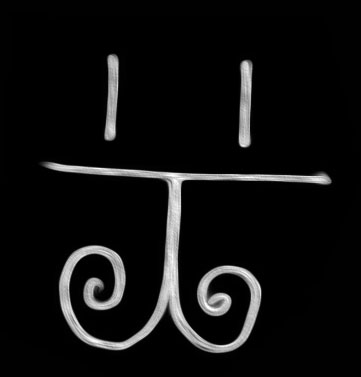
Returning to my attempt to follow the pneuminous calendar through the year (lapsed for quite a few days) I note today is Twilight. This is the 17th Tooth of the current Mouth. Its symbol echoes the strange manhorcan structure that is a gate to the other world. The Pan sigil also refers to the manhorcan (and is the previous Tooth). Twilight of course is the most liminal of times and so in this sense is the manhorcan. Twilight is one half of the great path which descends into the lower half of the tree, the preceding part of which is Pneumatology. The significance of this pairing has not yet been thoroughly thought out.

This Tooth is called Philosopher. In the Hyperqabalah it is the node Hrislohoepp which is the feeder node for Netahucla. Netahucla is a great and strange God about whom I know little yet, though it will disclose itself over time.

It is appropriate to be the Tooth of the Philosopher as the philosophy group discussed Parmenides and his more recent understanding as a healer/shaman. I have already read a lot of Peter Kingsley on this matter, yet it was interesting to revisit it.

I was reminded of an attempt I made to engage with the other world when I was much younger. I never really drifted into any alternate state as such though I do remember entering into a kind of vision in which I plummeted into a crater like face on a surface that I somehow took to me Mars. I went down a long dark hole and saw various strange things. The only really remarkable thing about it is how it repeats the same well known notion of the descent into the cave.

This Tooth is called Incest and in the Hyperqabalah it is the node Jincdotec. This node is fed by Zirnstaai.

The three (heuristic) spheres of reality are, the regular world, the magickal world and the energetic world. I’m not pretending this is a perfect breakdown but for the purpose of this note it will do.

The everyday world is the one we most commonly live in, or at least most of us. It functions on the bounded level of spatio temporality and gives rise to scientific rationality. This world is perfectly real. It is largely easy to communicate about things at this level because they can be spoken about in ways that people can recognise as having similarities. The rules are the same for all of us.

In this level the accretions may be sort of understood, though it will likely be only psychologically. We may understand that things are seen through concepts, though this is only an interesting feature of how perception occurs and not of ontological significance.

Magickal world functions at the level of the accretions. Magick as an activity that attempts to manipulate the world can do so because the accretions are not simply epistemological but rather ontological. Concepts (accretions of pneuma) plug into regions of ‘reality’ known as vectors and then create a filter through which concept creating organisms like humans view them. This makes a feedback loop of reperceiving the object as the concept thus driving the accretion further into the vector, making the identity between closer (though impossible to reach).

This process is the everyday magickal act of perception which reinforces the reification of object/concepts. It is also the level through which ‘magick’ as a reality manipulating activity takes place. Desired concepts (what the magician wants to happen) are applied (spells) to vector regions (situations that are required to be changed to the will e.g. make next Tuesday a sunny day, make it so I get the job etc). This is all achieved at the pneuminous accretive level, which in a sense is still actions with the world with the only difference being that the strings are pulled in non physical ways.

The last division I have called the energetic world. This name is chosen not arbitrarily but on the other hand only in recognition of how this term is often employed in esoteric systems, designating as it does, a nebulous power that courses through all things.

Energy must in a sense be the pneuma itself, except of course it is not bound into accretions. The practitioners who attempt to engage with this level are the mystics and their kin. Here the actions do not attempt to engage with the accretions but only to dispel them so that reality outside of them can be perceived. This is the most difficult aspect of all occult practice. This is the realm of silencing the mind in endless layers that show themselves. The accretive layers are very very deep.

All these layers interlock. The magician makes some use of the energetic but they do not pursue it. The everyday makes some use and has some perception of the magikcal but they do not pursue it. The energetic is inescapbaly embroiled in both of the above constantly strive to over come them.