The preceding discussion distinguished two possible modes of anomalous action within Pneuminous Accretive Theory. The first involves the intentional application of intensified conceptuality to the vector field. The second involves the reduction of ordinary accretive constraints, potentially allowing a freer operation of power. As mentioned, we provisionally identify these modes as magick and sorcery.

This distinction suggests two different ways in which pneuminous activity might become anomalously effective: magick through curvature, and sorcery through vortical movement. The proposal remains highly speculative, but it may provide a useful way of distinguishing the intentional modification of reality from the less directed manifestations of power described in certain occult and spiritual traditions. In the magickal mode, a desired concept is deliberately applied to the vector. The practitioner seeks to produce a particular outcome through the intensity of a pneuminous configuration.

The previously mentioned gravitational analogy provides a possible model for this process. Just as mass-energy produces curvature in spacetime, an intensified conceptual configuration might, hypothetically, produce a local curvature within the pneuminous field (which as discussed now is reality itself), altering the structure of events towards its intended manifestation. The greater stability of ordinary material reality (deeper cosmic accretive structures) would ordinarily resist such modifications. Nevertheless, exceptional differences in intensity produce local anomalies from established accretive organisation (the human pneuminous accretive force curves the deeper accretions of time etc producing the anomaly).

This does not mean that magick literally operates through gravitational forces. Curvature remains a speculative analogy for the possible capacity of conceptuality to modify the field within which it is already situated. The essential feature of this mode is intentional determination. A particular conceptual configuration is applied in an attempt to produce a particular effect.

Sorcery might involve something quite different. Rather than attempting to impose an intensified conceptual configuration upon the vector, the practitioner seeks to reduce the ordinary accretions through which human consciousness is organised. Such reduction might allow a freer movement of pneuminous power, no longer constrained by the habitual structures of thought, identity and intention. Here the vortex becomes an intriguing possibility. A vortex is a persistent organisation of movement, often involving circulation around a centre, concentration and inward or outward flow. Its identity is maintained through dynamic relationships rather than the accumulation of static material. Within the speculative pneuminous model, vortical organisation might describe a process through which power becomes operative when ordinary accretive constraints are weakened.

The sorcerer would not necessarily be generating power through the intensity of a desired concept. Instead, the attenuation of local accretions might permit participation in a movement belonging to the wider pneuminous field. This suggests a distinction between the two modes:Magick attempts to bend the vector towards an intended outcome. Sorcery potentially allows the vector to move through the practitioner in a less conceptually determined manner. The vortex would therefore not simply be another representation of magickal intensity. It might indicate a different mode of organisation altogether.

The work of Viktor Schauberger provides an interesting point of comparison. Schauberger’s investigations of water movement emphasised spiralling, inward-directed flow and the relationship between vortical motion, concentration and organisation. He associated such movement with constructive and regenerative processes, contrasting it with outward, dispersive forms of motion. His more extraordinary energetic claims remain scientifically unverified, but the general relationship between dynamic movement and persistent organisation is suggestive.

A vortex is not merely a rotating object. It is a process in which movement establishes a relatively stable form. This might offer a useful analogy for sorcerous action.

The reduction of ordinary accretions could, speculatively, allow pneuminous activity to enter into a different organisation, one characterised by circulation and flow rather than the deliberate application of conceptual intensity.

Of course the vortical movement itself would produces local curvature. Arguably these curvatures would be stronger than those achieved by pneuminous intensity. The two modes need not be mutually exclusive.Nevertheless, their distinction remains important. In magick, curvature is sought through intentional conceptual application. In sorcery, curvature might arise as a consequence of a freer vortical movement that is not itself directed towards a predetermined outcome. An interesting question is whether such movement is generated by the reduction of accretions or whether the reduction merely permits access to vortical processes already operating within the wider field.

This second possibility becomes particularly interesting when we consider the Outside. Within the speculative all-pneuma model, ordinary human consciousness operates within an immensely larger field of accretive structures. Some of these may possess a stability, intensity and organisation vastly exceeding anything available to ordinary human conceptuality. Such configurations might be understood as alien intelligences, god-level accretions or other forms of nonhuman organisation. Their existence is not established by the phenomenological foundation of the theory. Nevertheless, the model permits their possibility without requiring a separate supernatural realm.

If sorcery involves the reduction of ordinary human accretions, it might allow a different relationship with these deeper structures. The practitioner would not necessarily need to generate sufficient intensity to overcome the stability of the material world independently. Instead, the attenuation of habitual conceptual organisation might permit participation in processes belonging to a much greater order of pneuminous power (e.g. Castaneda’s world stopping). Vortical movement might provide a possible model of this participation. Rather than imposing a new configuration upon the field, the practitioner might become involved in an existing organisation of power, allowing effects to emerge through that relationship.

This would also explain why sorcery need not be characterised by the same degree of conscious desire or intentional determination as magick. However, it would be a mistake to assume that every unusual experience arising through such practices necessarily involves contact with the deeper Outside. Local accretive processes might also produce unusual phenomena. A contingent configuration could become operative without possessing any privileged relationship with fundamental reality. The distinction between local occult efficacy and genuine contact with deeper accretions must therefore remain open.

One further possibility concerns time. If the wider pneuminous field is not necessarily organised according to the chronological succession through which human beings ordinarily experience events, then deeper accretive structures might possess relations extending across apparently separate temporal locations. Vortical organisation might offer a speculative model for such relations.

A vortex involves circulation, return and movement around a centre. If something analogous existed within the temporal organisation of pneuma, it might permit relationships that appear anomalous from the standpoint of ordinary chronological experience. What appears as retrocausality might not necessarily involve information literally travelling backwards through time. It might instead reflect a more complex organisation of relations that is not intrinsically divided into past and future.

This possibility has affinities with Nick Land’s speculative accounts of alien temporality, the Warp and teleoplexy. However, the pneuminous model does not require a particular future intelligence or technological process to possess privileged access to such relations. Nor does it require numerical circuits to provide accurate maps of the temporal Outside. If a-temporal organisation is possible, it might be associated with many different forms of accretive activity, including processes that have no connection with human technological development.

The connection between vortical movement and temporal anomalies remains entirely speculative. A repeating cycle is not evidence of retrocausality, and the geometrical properties of physical vortices do not establish the existence of nonchronological causal relations. Indeed given the lack of confirmation available to such speculations, what they do become is actually accreted phenomena themselves. That is, the vortex and curve as analogy through a speculative modified Einsteinian pneuminous paradigm may accrete to become more operative terms if sufficiently accreted. Do the terms match the vector of what is going on precisely? Possibly not, though their approximation could still equally be productive and useful.

To reiterate then, the distinction between magick and sorcery now offers two provisional models of anomalous action. In the first, conceptuality is deliberately intensified and applied to the vector, potentially producing curvature towards a desired outcome. In the second, ordinary accretive constraints are reduced, potentially allowing a freer vortical movement of pneuminous power. The first is characterised by intentional determination; the second by a relative suspension of that determination. Both might produce local alterations within the wider field, but their proposed modes of operation are different.

The distinction also helps preserve an important difference between occult power and spiritual development. The reduction of habitual accretions might be valuable independently of whether any anomalous effects occur. Sorcery would be one possible manifestation of such a transformation, rather than its necessary purpose. Nor should we assume that magick and sorcery exhaust the possible forms of anomalous causation. They are heuristic distinctions within a speculative framework.

The central problem remains unresolved: what precisely constitutes pneuminous intensity, how might vortical organisation arise, and under what conditions could either produce effects beyond ordinary psychological and physical causation? For now, the proposal is that curvature and vortical movement might represent two different modes through which pneuminous configurations become anomalously operative.

Magick would seek to modify the field through the intensity of an intended concept. Sorcery might permit a less directed participation in the wider movement of pneuma through the reduction of accretive constraints. Neither mechanism has been established, but the distinction provides a potentially fruitful way of investigating the relationship between intention, power and the organisation of reality. It also leaves open the possibility that the vortex, so prominent in natural phenomena, occult imagery and numerical speculation, might be more than a convenient metaphor for the movement of power.
We cannot speak of in the beginning because this all entails there is no beginning. This abground is beyond all sense of existence, it is the ur-information; the formless pneuma. But there is impossible movement within the primordial pneuma. Straying further into speculation, though still within the reasonable confines of the pneuminous picture, we can expand further on the existence of everything through this lens. This pneuminous wind generates somehow in this non space (like a state space?) recursive structures (vortices? strange attractors?). These structures are vast cosmological concepts; this is the logos.

The transformations within the ur-pneuma as primordial logos are what instantiate what we experience as the physical cosmos (and potentially much more that we are not aware of). Difference accumulates upon difference. Persistent structures condition subsequent movement, which reinforces the structures that produced them. Accretions deepen, interact, combine and perhaps generate vast self-sustaining centres of pneuminous organisation. These unimaginably vast a-spatial, a-temporal accretions essentially think the thing that allows us to experience things as space, time, forces in physics, different atoms.

The question of gods and spirits has a two fold answer here. One cause of these beings could be patterns within the ur-pneuma that can hover move fluidly between it and the thought-into-being-materiality. Having gained some autonomy from the ur-pneuma these beings could also potentially contribute to thinking more solid aspects of being into reality (or stranger unimaginable ones). Possibly there could be yet smaller and smaller pure pneuminous beings capable of moving between various strata of the accreted pneuma -faerie descriptions commonly render them as made of fine matter.

The second would be the formation of such beings themselves essentially formed by limited beings like ourselves. Such beings attribute agency to phenomenon, deify/spiritually animate it and then behave towards it as if it were so. This very action accretes the pneuma of agency to the phenomenon which ulimately would create an autonomous pneuminous egregore. Clearly it is very difficult (impossible) to tell which of these any given entity is and it may be that all such beings are a compound of the two phenomenon. This does however raise a picture of the cosmos as potentially littered on the various finer strata of pneuma, with various beings, exhibiting differing levels of what we call agency and consciousness.

As mentioned previously, this does alter the nature of the umbratic somewhat. Rather than a speculative beyond it now is definitively made of pneuma; it is the cosmic thoughts; ancient, ancient accretions, which to us looks like solid ‘matter’.

The living operators (ourselves and other limited beings) that have evolved out of this situation are strange insofar as they have developed a particular recursive capacity. The operator (NARP) perceives the ancient accretion as a vector (blank object) as a concept which it then projects back onto it. The ancient accretion of course can resist any kind of alteration as its thought/pneuminous sustenance is so much greater the feeble operator. Yet there is a tiny push upon it; the limited being still has some pneuminous power. This is the divine capacity of the Operator.

The cultivation of this push is what we call magick. Magick cannot push hard against the ancient thought, it must form intensities that can create what we can call curvatures. This brings about a similar kind of picture to relativity. The whole picture can be thought of in this way to some extent. The accretions of the logos create the ground, the further accretions curve the shape by there pneuminous intensity. Here we refrain from mass for two reasons: 1) the analogy is just that, not an equivalance 2) it makes less sense to say the quantity of the pneuma than its intensity, and the mass metaphor creates a notion of quantity.

Pneuminous intensity curves a given strata to a greater or lesser degree. Normal concept application is largely a fit to the existing ancient accretion/vector; magick is an attempt to make an curvature in the strata for a certain purpose, to draw certain phenomena into that space.

The curvature model can be seen to be general operation in reality. Art objects, buildings, objects of power, certain people etc have formed pneuminous intensity, as such they curve the pneuminous space around them. This can be experienced and described psychologically/scientifically but its phenomenological primordiality is pneuminous.

Similarly the accreted or pre-existing gods curve the pneuminous space, but they too are limited by the ancient accretive structures that are part of the even more ancient logos. Hence we live inside countless overlapping accretive geometries while continuously contributing tiny distortions of our own.

The phenomenological world is not the world of physics. Our notions of constant spatial position would not be true from a physics perspective. However the phenomenological world has no problem with ‘there’, that point, two feet to the left of the table corner. This world is constructed of pneuma, conceptuality. The theory endlessly put forward here (on this site) is that we live in a sea of pneuminous accretions more than we live in a putative substrate (sometimes referred to as umbra), indeed at least consciously, we only live in pneuma. This is not an epiphenomenal substance that really means ‘your mind’, rather it is ontologically affective in its nature and as such, the reason why all manner of paranormality occurs (it is not necessarily beholden to the substrate, or can overpower it).

The determination of what something is, is akin to the collapse of a superpositional state. When any vector region (an area of reality that has the possibility of being an object for us) has its status disclosed for us (by being told what it is, or discovering a use for something) it collapses from a plurality of possibilities into one. This moment is the moment the accretion of pneuma (the concept as quasi Platonic form) attaches to the vector for an individual. We experience this as the difficulty on reperceiving things as different things and being stuck in patterns (this occurs on many scales).

Humans as conscious beings face forwards in time and backwards (memory) but there may be other temporalities that we may presuppose as speeded up or slowed down but in fact are very different. Such temporalities face in other directions, thus some may cut across our own. This cutting across is not an inert vision but an active presence which enables them to communicate or act through what we think of as strange phenomena (synchroncity). From the alternate temporal perspective, this is just action.

There are likely several kinds of ‘interaction with pneuma’ that bring about our events.
i) Events that occur in a truly random sense, brought about in a very real material manner (since this is a real mode of reality). This is still pneuminous, but this just occurs within forwards and backwards.

ii) Events that are brought about by pneuminous noise. Free floating accretions that we have latched onto or that have latched onto us manifest in some form that looks weird (synchronicitous) but has no actual significance to our intentions.

iii) Events that are brought about by interference from other conscious beings. This itself can be broadly categorised into events brought about by other humans, or beings of different temporalities, of this latter category there are those that are purely pneuminous and those that exist in this world (e.g. plants/trees). Humans may wish ill or good for other humans and depending on power and type of action may influence outcomes, however what it suggests is that humans do have sideways abilities, they simply do not have conscious access to them. The abilities of the other beings to influence action is difficult to comment on, but what can be said is that these influences manifest in improbable outcomes and strange occurences.

iv) Humans may influence their own outcomes. Much is written and spoken on this in the form of manifesting etc (a very different usage of the word to my manifestationism). This is the activation of the will towards particular goals; it aims to draw accretive structures towards the individual that will aid them. The manifestation of these circumstances is a sideways force, or at least diagonal.

These reasons (and probably some others) form a nexus of why things happen. They all intermingle all the time, with no one probably more common than the other. Though maybe some people have a tendency to guided by one of these more than another. The emphasis that occult systems place on ‘waking up’ is to lower the influence of other events and to increase self influence (and then not to abuse self influence). The basis of this control is silence, which facilitates the control of the accretions.

The relevance of the phenomenological world as pneuma can now better be seen. Since it is not simply an overlay on something solid, but rather a dynamic realm in itself that is simply mutually anchored to the appearance of a substrate (umbra or the substrate beyond appearance is a necessary appearance) it can change more that we think it can. The mode in which change occurs is through the interconnection of the intersecting temporalities.

The conceptual determination collapse is the seeing an event as pneuminous (numinous). This particular feeling is the collapse of that event from quotidian perception into the alternative temporal intersection that it is. Mostly this is only perceived in strong synchronicitous phenomena, however reperceiving the world in a certain way does facilitate a broader vision of such interactions. The trick is to not obssess with them in terms of meaning, whilst maintaining a clearer pneuminous-numinous view.

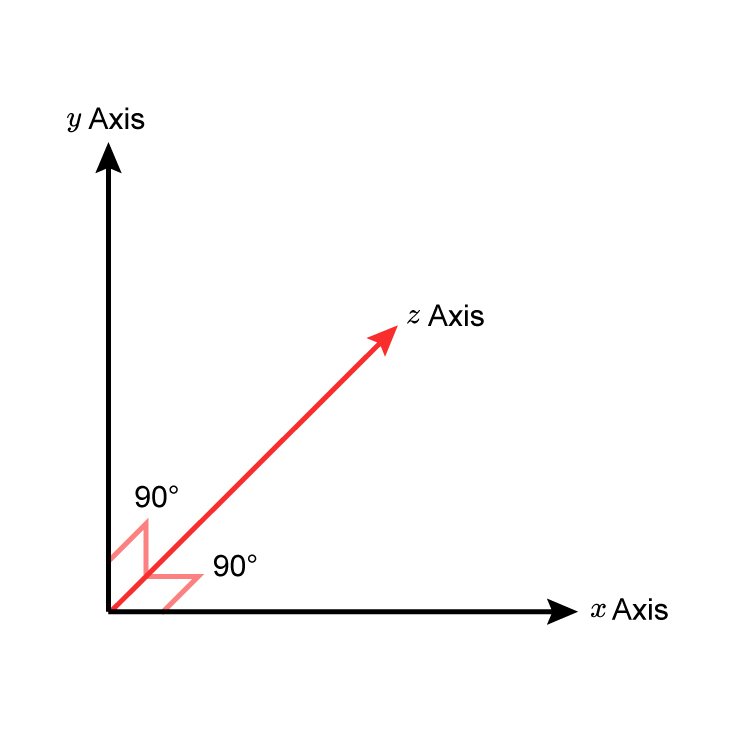
Consider the conventional axes (or planes) of three dimensional space. Each exists at right angles to the other two, and each stretches infinitely far. We typically label the intersection of the X, Y, and Z axes as 0, 0, 0 or the origin. The origin may be anywhere in 3D space, its position being defined only by the action of an observer choosing such a point to measure distance to another point from. If we try to add a fourth dimension to our model, the difficulty (as any Flatlander will tell you) is getting ‘outside’ of the 3D space in which external input to our senses and our internal experience informs of the existence of.

A fourth axis cannot simply be superimposed on our diagram above. We can however define it as the difference in state of things occupying the 3D space those axes delineate. One could consider the fourth axis to be the imaginary ‘line of sight’ (but not necessarily implying the act of seeing) on which the observer and the observed find themselves. As such it is not fixed in 3D space but moves with the observer, and for each observer and observed. Thus the subjective nature of ‘where’ the origin we describe above is, is intrinsically tied to the observer’s position (be that light hitting retina cells or the visualisation of something in the mind’s eye) and what the observer is observing (a physical object or a mental image).

Let us extend the axis that observer and observed define infinitely in each direction (one might think of this as looking down the length of a rigid fibre optic tube for example). We can only see in the direction of observation, we cannot see what is in the diametrically opposite direction. To observe in the other direction would require a special ability to be ‘outside’ of something which in itself is originated in the mind of the observer, let us hijack the existing phrase ‘having eyes in the back of one’s head’ to refer to this ability.

Given any act of observation takes a unit of time (and time’s popularity as a fourth dimension in addition to our original X, Y, and Z) we might say that one feature of our new axis is to delineate the passage of time, and serendipidously the fact that by default we can only see in the direction of observation parallels our experience of only times in the past being observable (any act of observation mental or physical incurs a delay due to the processing time needed to construct what ‘now’ looks like in the mind).

The concept of ‘right time, right place’ now takes on additional meaning, especially if we equate time to being just one facet of the additional axis that we are all capable of experiencing. Other facets of that same axis and an individual’s ability to ‘sense’ their presence might then explain concepts such as luck and coincidence, with constructs like probability and chance describing what those without the ‘eyes in the back of their head’ ability can expect if they try to obtain a specific result within the bounds of these four axes.


jonatan-pie-r42PtGYCF7U-unsplash

New morning. New day. Are you awake? Clarify the moment. Breathe in. Exhale. Molecules of air. There is no breeze indoors. Only human thoughts. Swirling. Spiraling. Chaos & Disorder.

Anger.

What is it?

Inventions of the mind. Distortions of reality. Turbulence. Entropy. Machine-made mind. Progress. Progress of a novel. Progress towards Nirvana. I am a bodhisattva. I am aroused by the thought of Enlightenment. I pursue the ox. I embark on the Way.

Sukha.

Leave the home behind.

Brisk walker. Keep walking. What do you see? Is it time to shave the head? Yes. It is always time. Are you afraid? Do not be afraid. Ten thousand Buddhas walk with you. 

Infinity of Buddhas.

Sit under the bodhi tree. Are you a dharma seeker? Here in Astoria, Queens is such a thing possible? Of course it is. Of course. How could it be otherwise? You have lain with many lovers. Forget their names. Can you forget? A test for you. I renounce my name. I am nameless. A bowl for rice. A flannel robe. Gnarled stick. I walk. I am the grunge Buddha. Pearl Jam. Nirvana.

Forget these sounds. Listen to Zappa. Captain Beefheart. Forget them, too. Karlheinz Stockhausen. Helmut Lachenmann. Forget! Surrender to the vast emptiness, nothing holy. The number 2222 is a special number. Ask no questions. Words. Numbers are beyond words.

Philip K. Dick has his Exegesis. This is mine. I am exploding. I am a Supernova. I am a Quasar. The brightest luminosity in the Universe. The brightest phenomena in the Cosmos.

I am a dragonfly.

Ephemeral as aether.

K. unsnapped Zig’s fly. She gave him the blowjob of the century. Zig lay there in disbelief & awe. I must forget the person I was. Cannot linger. Sukha. Leave the home. I get a haircut. A buzzcut. I feel aerodynamic. I might hit a first serve at 263 kilometers per hour. I hear water gushing through pipes. I hear cars humming over a motorbridge. A plane prepares to land at LaGuardia airport. Everybody is going somewhere. I am sitting. Mind is electronic fire.

If you scroll through this novel, it reads faster. Tips of our thumbs are fingertips. Easy on the eyeballs. Not too fast! Might start the storytelling pretty soon. Prepare yourself. Are you ready? Something is clearly happening here. Nobody knows what it is. The dog is being wagged.

Control knobs. Oscillations. What does it mean to be a human being? Carbon. Hydrogen. Nitrogen. Oxygen. Phosphorus. Sulfur. CHNOPS. A mnemonic device. A memory machine. In search of a rocky planet. Giant blue hypervelocity stars are defecting from the galaxy. Mind & body drops away. Well yes I am thinking… not thinking.

Protoplanetary discs are forming around young stars. Stardust accretes. Planets are born. I am thinking about this on Earth. The only planet with self-conscious life. As far as we know. What are the odds? What is the probability? What do you think of Fermi’s paradox? Hogwash, right? I mean, it is an intelligent observation. I just prefer to believe otherwise. Call it an instinct.

What if your brain is the greatest Space Telescope ever created?

Can you see?

Can you feel the stars?

Drifting. Drifting through the Cosmos. I am made of stardust. I am made of atoms. What keeps us together? Gravity? A few loose thoughts? This novel?

Earth pulls me back in. Stay here. Fix the leaking pipes under the sink. Read the newspapers about Baghdad Airport in Iraq. The extrajudicial killing of Iranian General Qassem Suleimani. The MQ-9 Reaper drone. Flying machines of death built by General Atomics. We could explore the stars. We could save the planet. 

Even Tucker Carlson is aghast.

What next.

How now.

Another Grateful Dead show?

Ignite a blunt. Eat a cupcake. Sip a coffee. Are you a veteran of the Atari Wars? Joystick in hand. Thumbing a red button.

Amerika is everywhere. Spreading its likeness. Absorbing. Repurposing. Propaganda factories manufacturing a reality. We are hungry ghosts. Eating. Consuming. Desiring. Wanting. Hurts to be a person. Particles colliding. Scattering. Into deep space. Into a void.

The gravity of a novel loosens its grip. We seek pleasure elsewhere. Netflix. A fuck. Roll & get rolled. Gasp. Spit. Palms under a buttock. 

You read Deleuze & Guatarri. 

A Thousand Plateaus.

Anti-Oedipus.

Now, I am alert. Everything is an assemblage. You. Me. The cosmic machine. We are pinball wizards. Spiraling in a tilt-a-whirl. The flappers are flapping. The Roaring 2020s. 

On the edge of what?

It will be clear later.

When things settle. What things? I have no idea. I am the novelist. I know. I know. Uncertainty is my game. Who is on my team? I do not care about the Giants. The Jets. I sort of like the Pittsburgh Steelers. Because of a woman. I know. Not the greatest reason. Or is it? 

Love.

Love is a battlefield.

The winner takes it all.

I am a loser, baby.

So.

The protoplanetary gas disc of this novel is starting to impress me. We are getting bigger. Absorbing the planetesimals. Creating a planet embryo. Giving birth to something new.

We expect.

We are expecting.

Unpredictable.

She is wearing her Steelers jersey. She is on her knees and hands. Looking at me over her right shoulder. Hut-one. Hut-two. Hike! We are making love. We are going at it. Looping and oscillating. Glimpse.

Really. Machine_a novel in progress. Who came up with that title? I did. Pilot of a Volkswagen Beetle. Zigzagging from one exploding star to the next. Planet formation is fascinating. The variability in solar systems is incredible. Hot Jupiters practically kissing the sun. Super Earths in improbable locations. Just like people. Just like you. Just like me. Here we are!

I lope through the day. Dragging my left foot behind me. My cock used to swell to ridiculous proportions. Now it looks like a shriveled worm. I need pills to get a hard-on. 

So it goes, says Mr. Vonnegut.

Are we on the edge of World War III?

Sure feels like it.

Every day.

Every nanosecond.

Does Amerika need a President? Does the planet need an Amerikan President? Feels too dangerous. The Cosmos is a dangerous place. Nightmares are electronic. What is real? What is reality? More or less is left behind. We build our lives out of cosmic dust. We orbit the Sun.

The wobble of a Sun can be observed from great distances. If there is a looker… a Seer. Someone must look. Someone must give a damn. Possess a curiosity. 

Peepholes into Space.

The city is a giant horseshoe crab next to the sea. Its metal retractable shell protects inhabitants from typhoons and sea surges. I operate the machine. I decide when to deploy the shell. It is a great responsibility. I cannot be wrong. Not with 88,888 human lives at stake. Yes. We are a small city. All has become so after the Event.

This could be its own novel.

A novel within a novel.

If I had the temerity. Do I? Hard to say at the moment. Joaquin Phoenix just won a Golden Globe for his performance in The Joker. Is this a performance? Of course it is. Am I tickled from eating oysters? Possibly.

My hand lotion feels & smells like Elmer’s glue.

I love you.

Why are you so distant?

So far away?

Orgasm as prolonged as possible. We lay on our sides. Breathing. Your thigh slung over my hip.

Memory gets in the way of progress. She salts it and gives me a suck. I am nineteen. Blowing sperm into her mouth. I feel her palm spread on my right buttock. I am standing. My jeans bunched up at my ankles. Pretty soon it is her turn. Skirt hiked up. Panty crotch pushed aside. She makes the low guttural groans of orgasm.

A plotted narrative is required.

Let’s move on.

I am here, in the night, under a sky. Everything is out there. Comets and asteroids. Intercontinental ballistic missiles. We are a mistake away from Armageddon. Perhaps closer than that. Everybody just says things. Punching nonsense into pocket machines. Posting as impostors. Pretenders. No human beings left. Ask Norbert Weiner. He wrote a book called The Human Use of Human Beings. Thomas Pynchon alerted me to this little masterpiece. Required reading for all automatons. Robot is a Czech word.

My back hurts. Bulging discs & herniated discs in my thoracic spine. I hope I can fuck again. Everything feels like the Beatles song “Yesterday.” I am here. Right now. Meditating my ass off. My hair is on fire. My nostrils inhale the Cosmos.

Easy tiger. A novel is a marathon. Long-distance love affair. You cannot have an American girlfriend and a European girlfriend. Yes you can. You just have to make sure you do not write about it in a notebook journal. Girlfriends read everything. Especially when you are at the tavern. 

Lightning strikes twice.

Sometimes thrice.

I am an idiot machine. A perfect storm. 

I make noise. A novel is a silent scream. Bursts of laughter. Awkward silences. I see through space and time. Pools of hydrogen gas. Gravity begins its work.

Where is everybody?

Hahaha. 

Fermi. You funny man.