
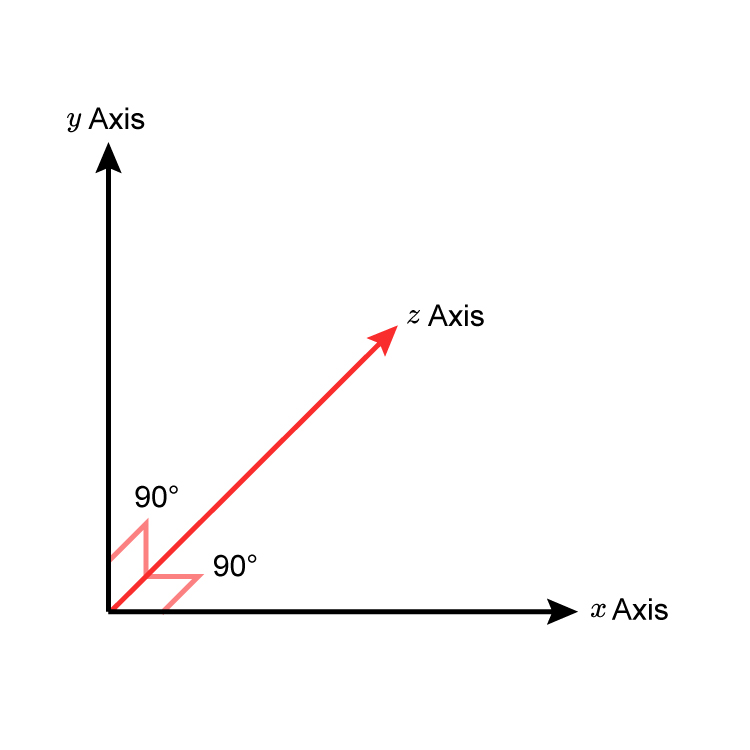
Consider the conventional axes (or planes) of three dimensional space. Each exists at right angles to the other two, and each stretches infinitely far. We typically label the intersection of the X, Y, and Z axes as 0, 0, 0 or the origin. The origin may be anywhere in 3D space, its position being defined only by the action of an observer choosing such a point to measure distance to another point from. If we try to add a fourth dimension to our model, the difficulty (as any Flatlander will tell you) is getting ‘outside’ of the 3D space in which external input to our senses and our internal experience informs of the existence of.
A fourth axis cannot simply be superimposed on our diagram above. We can however define it as the difference in state of things occupying the 3D space those axes delineate. One could consider the fourth axis to be the imaginary ‘line of sight’ (but not necessarily implying the act of seeing) on which the observer and the observed find themselves. As such it is not fixed in 3D space but moves with the observer, and for each observer and observed. Thus the subjective nature of ‘where’ the origin we describe above is, is intrinsically tied to the observer’s position (be that light hitting retina cells or the visualisation of something in the mind’s eye) and what the observer is observing (a physical object or a mental image).
Let us extend the axis that observer and observed define infinitely in each direction (one might think of this as looking down the length of a rigid fibre optic tube for example). We can only see in the direction of observation, we cannot see what is in the diametrically opposite direction. To observe in the other direction would require a special ability to be ‘outside’ of something which in itself is originated in the mind of the observer, let us hijack the existing phrase ‘having eyes in the back of one’s head’ to refer to this ability.
Given any act of observation takes a unit of time (and time’s popularity as a fourth dimension in addition to our original X, Y, and Z) we might say that one feature of our new axis is to delineate the passage of time, and serendipidously the fact that by default we can only see in the direction of observation parallels our experience of only times in the past being observable (any act of observation mental or physical incurs a delay due to the processing time needed to construct what ‘now’ looks like in the mind).
The concept of ‘right time, right place’ now takes on additional meaning, especially if we equate time to being just one facet of the additional axis that we are all capable of experiencing. Other facets of that same axis and an individual’s ability to ‘sense’ their presence might then explain concepts such as luck and coincidence, with constructs like probability and chance describing what those without the ‘eyes in the back of their head’ ability can expect if they try to obtain a specific result within the bounds of these four axes.
 Centre For Experimental Ontology
Exploration of spatialities … all of them more or less exotic and visualized as graphic inventions to facilitate observation and speculation; that was at the core of my doctoral thesis way back when. I think the methodology applies; (forgive the elliptical brevity) the proposition would be that:
Time is an illusion, a necessary illusion.
Not seeing, but *being *makes a line of ‘sites’ (not ‘sight’).
All possibilities exist unified in the Real.
Being realizes particular possibilities, and that is the reality of a site.
A site is a virtual position, one recognizable as a moment in life (a turning point).
Time is an illusion arising out of being itself, as it makes a line of sites and recognizes its moments neurographically (in memory).
The memorable accumulates and generates life stories, biographies, histories, … everything teachable and learnable that sustains human life.
So, time is a necessary illusion in human experience.
Thanks Geoff
LikeLiked by 1 person