
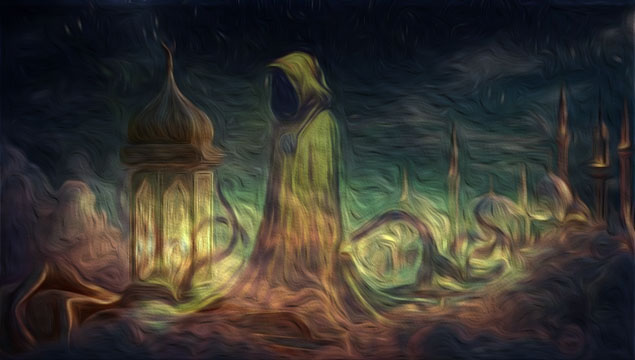
One way to describe where pneuminous theory leads—if it is taken seriously—is downwards rather than upwards. Not a regression into childhood or fantasy, but a stratigraphic descent into older layers of reality.
If reality is constituted by accretions of pneuma—layers of a substantialised meaning, habit, symbol, attention, and constraint—then the world we ordinarily inhabit is a relatively recent construction. It is stable, functional, and efficient, but also historically shallow. It is held together by contemporary typologies, pneuminous social scripts, and pneuminous object-circuits that continually reaffirm one another.
When those accretions loosen—through altered states, intense attention, de-identification, exhaustion, psychedelics, disciplined imagination, or accident—one does not enter a neutral void. From here is is possible to end up in older or deeply alien (or both) pneuminous strata.
At this point it helps to pause and say what kind of “place” we are talking about, because the temptation is to psychologise immediately. The twentieth-century philosopher Henry Corbin introduced the term mundus imaginalis—the “imaginal world”—precisely to block that reflex. By imaginal, Corbin did not mean “imaginary” in the modern sense of unreal or made-up. He meant a real mode of appearing, intermediate between physical objects and abstract concepts, accessed by a faculty he called cognitive imagination. In his reading of Islamic illuminationist philosophy (especially Suhrawardi), the imaginal is a realm of places, figures, and encounters—cities, guides, thresholds—that are not located in physical space but nonetheless possess structure, consistency, and reality.
Such delving in pneuminous terms, is not psychological in the sense of inner fantasy-production. It is not the psyche inventing content. Rather, it is breaking beyond recent accretions, allowing access to layers that predate the current civilisational configuration. What appears feels ancient not because it is archetypal in a Jungian sense, but because it belongs to strata laid down long before the present symbolic order -potentially even cosmically ancient.
If accretions persist, then agents can persist (though the chicken and egg situation here can not be resolved (pneuminous vs umbratic as starting point). A “being” in this framework is neither necessarily a metaphysically independent soul nor merely a figment. It is a stable accretional pattern with agency-like behaviour: it addresses, resists, insists, recruits attention, and maintains a recognisable signature across encounters. Such beings could originate from extinct civilisations whose rituals and cosmologies left durable symbolic residues; from long-abandoned meaning-ecologies; or from non-human strata whose constraint-grammar was never anthropic to begin with. They can therefore be found, not merely imagined. Encounter feels like discovery rather than invention because the accretion precedes the individual.
If accretions can stabilise into agents, they can also stabilise into places. An imaginal place, in this sense, is not a metaphor. It is a topology of constraints: it has an internal logic, thresholds, and a sense of “here” and “there,” and it resists free recombination. It behaves like a place rather than a mood.
This is where the parallel with certain strands of weird literature becomes philosophically interesting rather than merely aesthetic. In H. P. Lovecraft’s Dream Cycle, for example, Kadath is a city reached through dreaming. It has geography, dangers, inhabitants, and rules, yet it cannot be mapped onto the physical world. Likewise, in Ambrose Bierce’s “Carcosa” and Robert W. Chambers’ The King in Yellow, places such as Carcosa and Lake Hali function less like settings and more like intrusions—stable symbolic complexes that infect perception, recur across accounts, and exert agency over those who encounter them.
What makes these places striking is that they behave very much like Corbin’s imaginal cities: they are not private fantasies, but repeatable topologies encountered under altered conditions. The difference lies in orientation. Corbin’s imaginal—especially in its Suhrawardian form—is generally illuminationist. His cities of light (Hurqalya, Jabalqa, Jabarsa) are ordered toward ascent, mediation, and intelligibility. They belong to a human–Earth symbolic ecology shaped by ethical and spiritual teleology.
Kadath and Carcosa feel different. They are not merely darker versions of the same thing. They appear to operate under non-anthropic constraints. They are ancient, vast, indifferent, and often corrosive to human accretive structure. They feel less like local constructions sustained by ritual and tradition, and more like quasi-stable regions in an alien field—places that do not require ongoing human investment to persist.
This suggests a useful distinction. Some imaginal places are telluric: tightly bound to Earth, human-scaled, and sustained by cultural and spiritual practice. Others are xenopneuminous: weakly anchored to human meaning, ancient beyond memory, and operating under constraints that do not prioritise human sense-making. Both are real. Their difference is ecological rather than ontological.
This suggests a point about fiction often made (especially Lovecraft related materials). Some works of fiction function as accidental cartography. They do not invent worlds ex nihilo, which in a sense would be the sign of mundane fantasy at work. Rather they tune into ancient or alien (or both) regions of the pneuminous field and give them names, contours, and partial maps. Once named and stabilised, such regions become easier to re-enter. Attention feeds them; repetition gives them inertia. A place can be fictional in origin and real in operation. This does not blunt but gives an extra angle to Corbin’s critique of western degenerate imagination; that is that whilst it may generally peddle in imagination as fantasy, it is possible that sometimes the imaginal-pneuminous comes through a human-vector (author/artist etc), and though they know it not, the work generates an unworldly feeling in the reader that they have nowhere to put.
They have nowhere to put it because they can only see that ‘artist as creator’ lens and do not understand the possibility of the imaginal intrusion. This at least suggests that various creative works (assuredly not just Lovecraft) may put us in contact with the imaginal, though we then feel placed in a strange position in which we feel foolish if we indulged in this sensed connection as if it were real, yet equally we feel (Twin Peaks possibly is a region that has partially overcome this) there is more to our connection to the book/show than simply fandom.
The question of value, however, remains open. Reality does not guarantee benefit (whatever that might mean). Access to strata is, not wisdom. By the Persian Islamicists’ standards only some strata are illuminating, some are indifferent and some are actively hostile to human coherence. Pneuminous theory does not moralise this; it only insists that such encounters are not reducible to hallucination, because hallucination presumes a stable world onto which false images are projected. Here, the world itself—understood as accretional structure—is what is being re-authored and the value espoused by Suhrawardi may only be a relative perception.
If we truly dwell in the pneuminous field of accretions, then the imaginal is not elsewhere (as Corbin teaches). Ancient beings need not be metaphysically invented. And places like Kadath can be real without being physical, benevolent, or human-centred. Pneuminous strata like these cities are not fantasy. They are contact with older layers of how reality has been made.
 Centre For Experimental Ontology