This transcript is of a conversation between the CEO’s Balthazar Schlep and Lis who has been experimenting with various sorcery techniques. We do not recommend emulating Lis’ experiments at home.

Lis is italicised to differentiate the voices.

CC is Carlos Castaneda. DJ is Don Juan.

I mean to be fair to standard Thelemite or otherwise practice they all want inner silence, but equally they use words to direct acts. Sorcery seems to bypass words entirely. Let’s think: if pneuma was real real, then it seems to me sorcery is playing in unaccreted pneuma. Where maybe the nagual would be the umbratic?

Do you think the following of a magickal writing system, like the Qabbala underlying Thelema, is a marker of the difference between the occult and sorcery, maybe? With sorcery having no writing system because it prevents the apparatus of recording to actualize? (Very Derridean)

It seems a fair distinction.

The nagual as the umbratic would make for something very cool aesthetically. I just want to say this is the case, but caution makes me want to think some more

Yes I don’t think it’s right.  It is good aesthetically, but it doesn’t fit, as it was the pneuma that altered the umbratic which played the role of underlying structure. Maybe this just doesn’t work here. The pneuma umbra thing was specifically designed for a very human magickal interaction description and we seem to be way out of that here.

Maybe nagual is a category distinct to a sum-property of an object, its identity. Maybe nagual is itself the perspective of the pneuma in its interaction with something that from the tonal perspective is incoherent (the umbratic). And that’s why one becomes a nagual, yet it was already there (negative form). This would make it still pneuma, but in a freer state of accreting. Which would be like a Spinozian hierarchy of being. So the umbratic, in this case, is like a zone of the vestigial encounters events and acts of naguality (and similar states). But pressed against the tonal, so it’s pitch-black incoherent and inorganic from this perspective.

What you say would seem to fit with the notion of sorcery dealing with unaccreted pneuma: unaccreted pneuma is the nagual? Though I’m not sure I have quite got your take on the umbratic here, it seems to me to be what DJ labels the unknowable. To be a Nagual would also fit with this I think insofar as its a maximally unaccreted person

Yes for both. I think it makes sense for example that the unknowable is like the eagle itself. The nagual can experience the unknowable differently from the tonal, like a second-attention vs first-attention thing. That’s why I mean that maybe the nagual understand the umbratic better because interaction is maximized. Exactly, and that’s why impeccability is the most important rule, because as sorcery opens the individual more, it puts the body in contact with more generated energy and so the expenditure always increases. So much that DJ says that even to cook an egg he needs all his attention, because the umbratic has invaded the world through him once he nagualized. Sorcery indeed has the potential equal or superior to philosophy and indeed is like an experimental ontology possible beyond fiction.

I suppose though this will always be a problem i.e.  no matter how out there with Laruelle or whatever people get, most academics/thinkers don’t have serious truck with any of this. They dip their toes in the occult or they metaphorize Lovecraft. You can’t bring these pearls back to them which sadly is also why the sorcery thing is correct again —that only some people will get it. I suppose another reasonable question is ‘why would you want to mess with this stuff?’ This that your live in is reality, this is all the reality you need. And this is true, sorcery is pretty useless in a way. Having said that, and I don’t know how much you want to go down this road, I wonder if you could get that potential IOB to ‘do’ something?’

I’m pretty sure it’s not even a question of my want (with regards to ‘messing’ with this stuff) in a straightforward way. Meeting this thing is like seeing the circuitry of your life so far and understanding that there were always tracks that I deviated as part of the plan all along. Something opposite to how ontology thinks. The accidents are above in the hierarchy of realness. As if a species is an iterative error of cell-replication in a simulation of cancer, and the individual that sees this is the true product and we just happened to, despite being unspecial, crash into.

Yes you’re right, I cannot put the investigation even if down if I wanted to. It gnaws at me.

This is amazing because it’s like we finally have a tool to talk about the impersonal individual

Again, another failure of the other nonsense (speculative realism/ooo) totally achieved here. Thinking in terms of this circuitry and the Castaneda-updated accretive model, the outside is accessible

Yes. The transcendental critique is still correct, but it describes a historical condition rather than a telos or final state.

Yes the Kantian subject is a contingency itself.

It is not absolute, like Newtonian mechanics. It’s local. Exactly.

A brief and unpretentious dive into the Castañeda/Lynch connection through the show Twin Peaks and the book The Eagle’s Gift (the last one before Carlitos’ descent/capture). The key non-thesis of the speculation thus: David Lynch, finding himself in a similar condition as Carlos Castañeda, fighting assimilation of his vision by Hollywood, produced, more specifically with The Return, a critique of the descent in-itself, sketching a diagram of his own escape (which Carlos himself failed to perform). If Lynch ever read Castañeda is beyond the point. Here are fragments of conversations held at the CEO.

I wonder if we could think of Judy (Jowday), that is represented by the beloved “Owl Peaks” symbol as the dark side/counterpart of the Eagle (or really just the nightly aspect of the Eagle, for what is an owl if not an eagle one sees at night). If we assume Jowday is a manifestation tied to the Black Lodge, it seems to be the case. Even more because, in this book particularly, and its transition to the next, Carlitos fails (like our beloved agent Cooper) and is captured (as is expressed in the mythos of his own cult always torn and in constant war from within).

“We are luminous beings, we are better than that”, the motto La Gorda keeps repeating to Carlitos each time he starts worrying or wimping too much, the one thing she supposedly kept on repeating as she tried to “save” Carlitos from the jaws of the jaguar, fits very well with the White Lodge’s ‘residents’ true face:

Or at least Laura’s (since she is luminescence and good herself)

Laura truly is the Twin Peaks equivalent of the infamous Nagual woman: a prodigious, luminous being that got snatched too early in her life and exhausted her potential by the suffering her captors imposed on her, into and onto, for the very teleological motif that is the production of garmonbozia. And they did it all, the Black Lodge’s rogues, to feed on this secreted creamed corn. It sounds too much like the story of the beautiful forgotten Nagual woman. By the end of Twin Peaks (The Return), everything in one timeline is corrected and Laura’s corpse even disappears as if either she never existed there or was saved (I think she was erased from that timeline and jumped, only unwillingly via Coop — who thought he was doing good by that, when in fact he was only reviving her death and so prolonging her suffering, pain and sorrow, much like Carlitos and Carol Tiggs joining the cult). If more pain and sorrow, that is, garmonbozia, is the result of Coop’s failure to fix his heart, and said creamed corn comes from a continually doubled Laura, doesn’t this mean he is worse than BOB? Upgraded BOB, in fact, that feed us the garmonbozia while reciprocally being fed by our need to hear that lovely scream.

The Nagual/TonalRight/Left side quadratic polarity is also very reminiscent, to me, of Coop’s multi-self:

BOB-Coop (or Doppelganger, The Lovers Reverse and The Magician Reverse),

Homo hermaphroditus masculinus, failed

Dougie Jones (or Tulpa, The Lovers Upright and The Fool sideways),

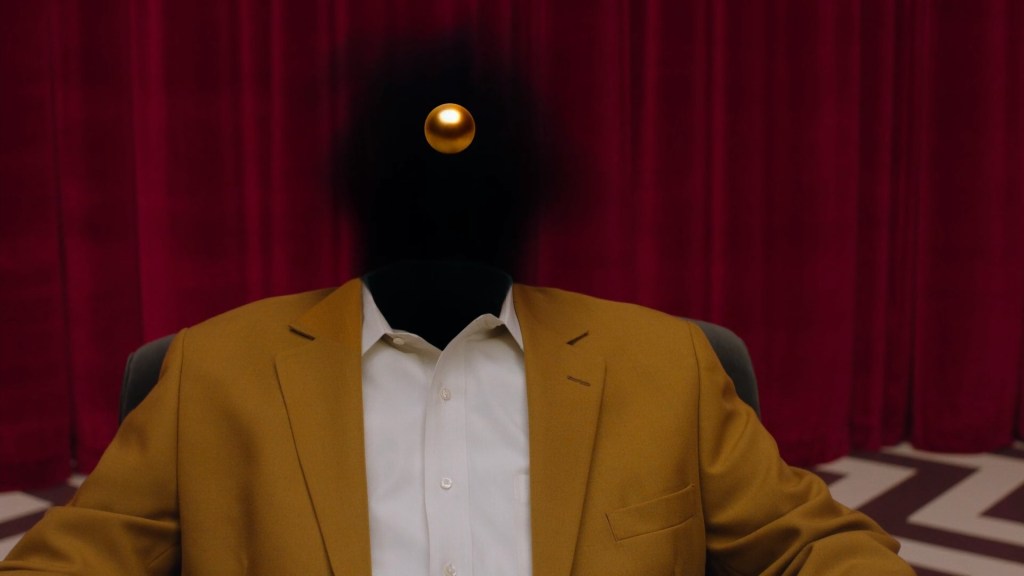
The golden ball, the core of the tulpa, expands until finally disappearing from the screen. The true shape of humans according to Don Juan. This one is artificial, however, a golem, and upon expansion to determine the totality of oneself, it vanishes and the tulpa ceases.

‘Original’ Coop (or The Fool Upright and The Magician Upright),

The Fool’s Magic Trick

the guy Coop snatches the body by the end (or The Fool Reverse and The Hanged Man Reverse).

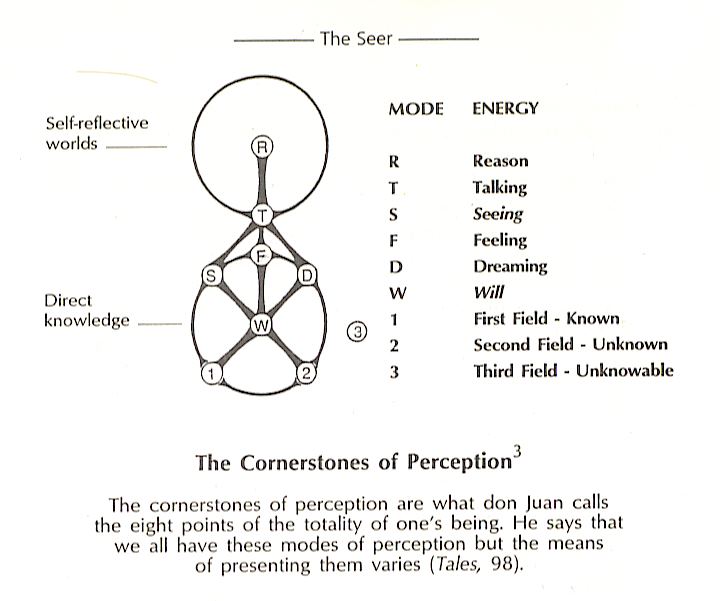
Relationship with Carlos Castañeda (or Carlitos, for the “fictional” character), following the diagram of the Seer:

Courtesy of Ken Eagle Feather

Tulpa/Dougie: fake double, Carlitos’ right side that forgot his Naguality.

Trapped in the Sphere of Direct Knowledge, devoid of access to the Sphere of Self-reflective Worlds.

BOB-Coop/Doppelganger: fake nagual, Coop’s and Carlitos’ snatched left side that does not remember but that still subsists due to power-momentum (Bad-Coop managed to contain BOB, still inside him, for 25 years). Its destruction is the rejoining of the left and right sides and Coop/Carlitos put back together.

Trapped in the Sphere of Self-reflective Worlds (like BOB), devoid of access to the Sphere of Direct Knowledge.

Original Coop: the Tonal, Carlitos before the split performed by Don Juan and Don Genaro.

Composed by and composing of the gra-tree-like structure, the hero’s journey proper is the dissolution of this harmony via the scission/split between spheres, resulting in the Doppelganger effect where communication is made difficult and an antagonist projected/manifested.

‘Spirit’ Coop/Coop of the end/Coop snatching the body of the guy at the end: Coop failed to remember and rejoin what was split properly, just as Carlitos, and his Naguality then, instead of entering the third world like his masters, jumped back into the island of the Tonal to snatch the body of another person (by invading another’s dream, other TV show). He indulged to the very end and became like BOB, a vampiric specter, only by the end we got to finally see the world from BOB’s perspective, or an upgraded version of a rogue of the Grey Lodge, the in-between that is the failure of proper conjunction. We are invading the automaton carcass that is “Cooper” in the same way he is invading people from another dream, supposedly our dream. It is, instead of a mutualistic symbiosis, a reciprocal parasitism (where the audience may find some enjoyment in the confusion, and Coop find some purpose in continuity as we feed him energy to continue his task of failing to do the good he wants).

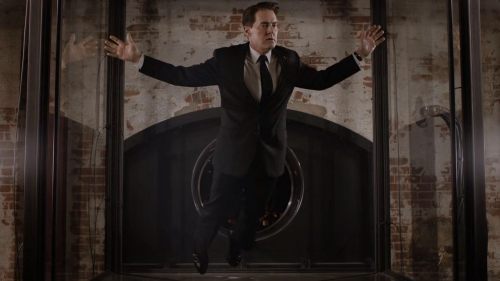
Lost in the Third Field of the Unknowable (3), and in fact the avatar for such. He finally did it, but failed in doing it properly.

If Lynch would comment on the later activities of CC, I think he would say something along these lines, that he “didn’t fix his heart — but he did not die either”.

The house of the spirit (Cooper), now as pure electricity, the synthetic fire that walks as you. Cooper achieved immortality in the perpetual act of drifting at the speed of light without control. A proper cosmic neuron, which is sadly not a person anymore. Not even a character now, he is the stuff of dreams, a symbol. He opened Pandora’s box from the inside and became hope. Our hope.

But there are things worse than dying, as the Naguals would say.

25 years on and Laura is still (back?) inside her mother, in the worst way

Carlitos Cooper continues to refuse to die, like the fabled Hope of the myth, their leftover residue just symbols now. The dreamer vs. dream debate is over, nobody is the dreamer, there is only nightmare.

Meanwhile…

Final shot of the series, before the lights go out.

Last summer I did my first end to end reading reading of Deleuze and Guattari’s ‘Thousand Plateaus’. Previously I had only read sections here and there and fragments of other works (of theirs) so this was an edifying experience. As I read I began to notice the Castaneda references. These grabbed my attention as I had previously read Castaneda’s books some 20 years ago. Prior to reading them I had always avoided them assuming them to be some kind of new-age claptrap, however when I did read them I found them compelling and beautifully written (or at least most of them). I played somewhat with the techniques and found they actually did things. This was something of a revelation as my prior interactions with meditation and western style magic seemed to get nowhere. However interest waned, other things happened and slowly I forgot about this time.

So reading Thousand Plateaus was an incredible experience for two reasons. Firstly it was fascinating to engage with this book properly and secondly it seemed interesting how many Castaneda references were in it. To review these, they are:

i) In ‘On Several Regimes of Signs’ he is mentioned in relation to combating solidified mechanisms of interpretation.

ii) In ‘How do you make yourself a Body Without Organs’ Castaneda’s experience is cited in relation to the construction of the BwO, this too relates to the breaking down of interpretation and construction of flows and becomings. In the same chapter we also have a mention of the tonal/nagual dualism set up in Tales of Power where the tonal is everything cast under an organising principle of intelligibility (quite like pneuma in the accretive system variously detailed throughout the site) whilst the nagual is simultaneously everything but from the position of flows themselves, an ineffable a-signification that (arguably) also potentially, obliterates the restraints of space and time (this would correlate to the umbratic in the pneuminous system).

iii) In ‘1933: Micropolitics and Segmentarity’ the works are mentioned again in relation to the obstacles that Don Juan says stand in the way of becoming a ‘man of knowledge’. Don Juan here is given the illustrious comparison of Nietzsche’s Zararthrustra. The obstacles are: fear, clarity, power and disgust (old age in Castaneda). Fear here seems to be fear of existence of flows/becomings etc. Clarity is comprehension of the same. Power is dangerous as once clarity is achieved and movement is possible between rigidity and flow and second kind of rigidity re-emerges as threat, the power to control the flows at this new level. The last danger concerns the lines of flight and the possibility that they will not connect to other lines but instead will end in abolition. One might hazard a guess that the chance that the line of flight ends in death increases with age.

iv) In ‘1730: Becoming-Intense, Becoming-Animal’ in ‘Memories of a Sorcerer III’ Castaneda is invoked again. Here he is used to illustrate the progression of a sequence of becomings; becoming-dog, becoming-water, becoming-air. It also mentions an incident of Carlos being pushed through a door and reappearing in a totally different place.

v) In the same chapter Castaneda is credited with having effected a ‘broad synthesis’ of earlier 20th century comprehension of mind altering drug effects. In this way he makes a key contribution to the ‘drug assemblage’.

This Deleuzo-Guattarian connection gives Castaneda a connecting line to philosophy. This is the starting point for Parasol 6. It doesn’t mean that we want only DnG/Castaneda papers but here is the bridge. A beautiful synchronistic connection is of course the English translation of the the French agencement: assemblage. This brings immediately to mind what Castaneda no doubt thought his most important concept in his later work: the assemblage point. The assemblage point supposedly determines the reality we experience by lighting up a certain set of human luminous fibres at a time. The point is normally fixed, sorcery, dreaming, power plants etc move it and hence alter our experience of the world. The two concepts may not be directly connected -but on the pneuminous plane they are.

We must also remember that there are many non-philosophical adherents to the ‘system’ still in existence. There is a reasonable sized subreddit that seems to have some of Castaneda’s old students in it. There is a heavy focus in the group on a practice called dark room gazing. This basically entails silencing the mind and staring into pitch blackness for a long time. Many practitioners report results, often involving purple smoke but many other phenomena. Interestingly the criterion for the reality of the experience seems to be to test whether or not any coloured lights/smoke can me touched and manipulated. Participants seem to frequently report being able to grab such lights/smoke.

The big question here is of course, does it actually do anything? One could potentially explain most of the subreddit participants activity by saying that they are inducing hypnogogic images of a powerful nature. This is all very well except it does leave us again in a rather agnostic disjunctive situation. That is, smoke/lights that appears in the dark may be adequately described as a hypnogogic effect however this is identical to the appearance of the same phenomenon that is actually some kind of energy as described in Castaneda. We might at this moment recall another previous Parasol topic who reported almost exactly the same phenomenon. Wilhelm Reich claimed orgone could be seen by staring into the dark and that it would appear as a blueish mist. Such a description of course is not far from the darkroom gazers purple smoke. The agnostic disjunctive point (like in the synchroncity argument) is that in order to privilege the hypnogogic explanation we must know that this version of reality is correct. Since both accounts are simply what it would look like for that to be the case we cannot be certain that the hypnogogic one is correct, so when (as many do) they simply thing dismissal is easy they beg the question by assuming a version of reality in order to dismiss the phenomenon. The big question of ‘does it do anything?’ then is partially rendered inert by the agnostic disjunctive observation insofar as being able to induce such experiences in a sense does count as doing something (it has the appearance of some experience commensurate with the descriptions in the books).

This is my impression of these kinds of practices too, the satisfaction of them is that they generate such experiences which then can be interpreted in light of the Castaneda system or reduced to hypnogogic hallucination. The Castaneda system makes one thing abundantly clear though. If one wishes to develop these kinds of things into full blown weirdness there is no place for the agnostic disjunction. One must be committed to accepting the weirdness and not dwelling on its ontological nature as only under this condition will it properly be able to develop. And this is reasonable really, one can imagine that if reality really were sensitive to mental/bodily activity then one must temper the mind to maximise the result.

In the books Castaneda is pushed beyond any level of agnostic disjunction by events so bewildering he has no choice -people flying, teleporting, producing energy doubles. These kinds of events are not reported as replicated in the subreddit and of course one can quickly think, ‘because they aren’t possible’ and probably they aren’t. However there are plenty of mentions of phenomena similar to astral projection/OBE’s which, through the Castaneda system are interpreted as ‘accessing the double’ and there are plenty of reports of such phenomena successfully interacting with the world (not necessarily from the CC camp). This suggests that there may indeed be a kind of progressive link between smoke like phenomena and the ‘double’. This furthermore (to me at least) suggests a kind of open end to the phenomena that we may not know the limit of.

With regards to scepticism, the system suggests there is a kind of protective mechanism built into extreme weirdness for it is repeatedly said (when Castaneda asks such questions) that when an ordinary person observed such a phenomena they would not be able to see it. We may take this to be a convenient or plausible explanation in a similar agnostic disjunctive manner.

Two more points spring to mind in this area. The first concerns that well known topic from various strands of neo-materialism, speculative realism, hauntology etc.: the outside. The exit to the outside is an idea that comes up a lot. The outside itself can be split into a strong and weak version. The weak one being the scientific outside which potentially allows for at least our comprehension and possible somehow greater interaction with fields beyond the human whereas the strong Kantian version prohibits our ability to ever make contact with the noumenal realm. Sorcery (the Castaneda system) seems to suggest a third option. Sorcery would seem to align itself basically with Kant except that transcendental categories and pure intuitions would only be pseudo-transcendental. That is, the transcendental status would be true for every human unless one took the trouble to dismantle the categories/intuitions using sorcery. Then it would be possible to experience something beyond them. This experience in Castaneda’s terms is indeed the experience of the noumenal realm. That is, it suggests that the exit from the human security system (to Coin Land’s phrase) is possible, it’s just it takes more than copious amounts of amphetamine to achieve this. Secondly I think no matter how stable and functional our current scientific paradigm looks, we have to put aside our prejudices about anomaly in general, listen to the phenomenological picture, override the tendency that comprehension of things is within easy reach and consider our understanding of reality may yet be extremely primitive by standards yet to come. The appearance of spatio-temporal solidity may yet turn out to be erroneous as a flat earth.

Another aspect of the whole Castaneda affair that we equally cannot ignore is exactly the claims of invention. We do not raise these in the tired sense of lambasting him for lying -as Deleuze and Guattari point out, it scarcely matters if he did. No one can tell how much of any of it is real. This in itself is an incredible achievement. Castaneda may have pulled off one of the greatest hyperstitional ever. The power of the writing, the strangeness of the events, the endearing natures of Don Juan and Don Genaro all go to making an incredibly attractive world that people want to be real. The work minimally exists as possibly real which means it essentially is hyperstition. It’s a whole canon of potentially largely invented work that exerted and continues to exert a powerful effect on reality.

What my wandering writing here is trying to get at is that there are many good angles from which to write/create upon this topic. There may be more but I offer here:
i) Deleuze and Guattari as a philosophical entry point -though I can see non-philosophy can work quite well here too.
ii) Considerations of the practical aspect of the practices and the ontological/epistemological implications
iii) Possible connections to other theories (e.g. Reich).
iv) The meta-fictional/hyperstitional aspect of the work.
v) Considerations of Castaneda’s work in relation to the outside.
vi) Ontological implications of treating such work seriously -even without practical engagement.

Submissions should be sent into ceo47@outlook.com

There is no deadline as yet, though 2021 itself roughly marks the boundary of submissions.

These notes are a product of conversation with Emanuel Magno.

We are painting in simple broad brush strokes here, yet even these can reveal some interesting thoughts and possible structures. To recap briefly we are investigating how certain modes of interacting with the world can be conceived as responses to the the nothingness. We would say the nothingness can be a cognitive discovery (there may be always a trace of this). When this occurs reason philosophy is a void response. Furthermore philosophy here is characterised precisely by its untestable nature and desire to ground its subject matter (knowledge, how to live, the being of Being). This is not a derogatory comment only a descriptive one. Philosophical concepts a priori cannot be defeated by any opposing philosophical concept. Science may shore up the edges of philosophy but sceptical possibilities can persist in the face of overwhelming evidence (and philosophy is duty bound to take them seriously -even though sometimes it would not like to). Hence this shoring up is more a case of rendering unpalatable rather than removing from the philosophical realm. Philosophy tries to ground what it cannot ground using thought, this is its nature.

We also identified sorcery as described in the works of Castaneda as a void response. The accusations of fiction levelled at the works are irrelevant here, all that is relevant is the system and the system describes a way of living that absolutely accepts the void and urges action as if there was no void -yet all the while knows it is there. Sorcery then is a magickal response of action to the void and chaos magick is a very similar (though not identical) one. Chaos magick is more forgiving of regular human nature than sorcery.

Compassion/love was also noted as a void response i.e. in the face of the nothingness the only tenable action is to show compassion to the world and all the beings in it.

It can be argued of course that these are all philosophies insofar they attempt to ground existence by an ungroundable principle. However the difference is that sorcery and compassion responses supply action to be lived and hence they transcend the philosophical realm of thought.

As previously noted there is no claim that philosophy never leads to altered lives, only that the majority of the time the biggest change philosophy makes to someone’s life is that they become interested in philosophy.

We must also consider the source of what looks like a philosophy. This kind of notion turns on the ontological status of revelation. If revelation comes from within a discrete self and represents nothing more than the subconscious mulling over of a problem, the answer to which is fed back to the questioner by some means that appears to not be the questioner, then we might consider it little more unconscious cognition. However if revelation comes from an external power (God/Spirit) then the philosophy in question has not be grounded in cognition of any kind and hence is not philosophy in the above sense of thinking hard about problems.

Of course one cannot actually tell the difference between these two phenomena, the problem is as we say, agnostic disjunctive. In this sense then the phenomenology of external revelation is only what is important and such systems as they arise are not -in our brush strokes- to be considered philosophy in the sense of trying to conceptually/logically disentangle problems.

External revelation though often results in the void-cocoons (or a-voidances). These are systems that shield humans from the void by giving rules for living that are transcendent to humanity. They often supply a teleology. This is a very important part of an a-voidance. Shamanic systems, polytheisms and monotheisms are all largely a-voidances. Shamanic systems do so by direct contact with spirit. Spirit in turn will reveal a creation myth to the shaman. The non-reflectivity of shamanic based communities means that spirit may be naively trusted in its claims. Contact with spirit is perfectly real (though ontologically questionable as the above agnostic disjunction shows) it is just that, as is often said, the spirits cannot be trusted.

Alternative again to any kind of spirituality, cognition or compassion is a certain physical response of fullness to the world -like a hedonism. This may not be born necessarily out of direct cognition of life as a problem, but rather is the result of a certain effusive spirit. When such a person asks themselves whether or not their pleasure in life is reasonable, they simply find that there is no reason why it is not reasonable; life becomes justified on these terms. Equally such a consideration may be never made. The effusiveness of the physicality of life covers the yawning void.

Does this consideration mean we may paint the aesthetic temperament (the poetic, the musical, the artistic) also as void response? Such responses are not cognitive reactions and hence they probably should considered a further part of the picture.

The void responses as we have identified them so far are: philosophy, sorcery, love-compassion (characterised by Buddhism) and a concept we feel in the region of hedonism. This latter category may have an almost Nietzschean quality to it, a fullness of life that attempts to overcome the void by strength of enjoyment of life.

Probably the notion of lining these up with the Jungian quaternity is something of heuristic fantasy, nevertheless the idea spawns more consideration of the matter generally. Can philosophy be viewed as such a purely mental activity when it overtly recognizes the void as an issue for us? The 20th century saw phenomenological existentialism recognize the void as a feature of existence that we must deal with. This is a fascinating occurrence considering the thesis (that philosophy is a response to the void) that implies a Hegelian moment of self awareness for the discipline. Yet is such a moment sufficient for some these aspects of philosophy to be considered to transcend its morass of endless argumentation -by which we characterised it?

On reflection possibly not. The multiplicity of phenomenologies and existentialisms, despite possibly having some marginal effect on peoples lives, largely functions only to create more philosophical territory which can then be debated. The word marginal is probably a disservice here. There are no doubt people who, having read Nietzsche feel inspired to reach higher, people who have read Sartre who sought to live every moment to the full. Such cases are not to be denied, our claim is only that in the majority of cases even the when one feels strongly impressed by the ideas, the impact on actual behaviour is largely minimal.

For this reason then the original claim of philosophy as an activity which understands the nothing and seeks to build a foundation of reason where a priori none is possible is maintained.

Another consideration is that the category of sorcery must be made to include chaos magick. CM is most certainly a void response. The awareness of the insanity that not all the magickal systems can be true pushed the (potential) efficacy of it onto the subjects will and subtracted the intrinsic powers of the symbols. Castaneda’s sorcery and CM make an interesting pair. At a glance CM would be thought to subsume sorcery, however we are not convinced this is the case. CM tends to facilitate the desires of the ego, whereas for sorcery all such desires are a priori pointless and can only undertaken as ‘acts of power’, that is acts done to their absolute best despite their absolute pointlessness. A CM practitioner could employ this belief set for their own purposes, however this proves difficult since if the CM practitioner considers the matter they will discover that CM itself considers all activities pointless, from this though it merely concludes that we might just as well indulge the ego as not. It would however be probably be difficult to be brought to face the void and act in the face of it (sorcery) and then to return to an ego position as then the holding of the ego itself would be forced to be viewed as an act, which one could choose to uphold or not. Probably acts of petty magick would drop away. This is not to say a CM practitioner might not learn all such things without every touching sorcery. Here we only comment on a certain popular playful aspect of it. The truth is that both sorcery and CM advocate altering the self frequently to destabilize it. The only claim here is that sorcery is not necessarily one more tool in the CM kit, and can be better considered to be a complementary equivalent.