Previously we considered sorcery as a kind of response to the void. We also consider that maybe the previously phraseology of void-parasite may be awry. This is the case because the void must always be mediated and hence it is not the void that is the parasite but the void-mediation-system. In the examples of Buddhism of sorcery we may broadly say that compassion and awe respectively mediate the impact of the void upon the human-vector.

We can consider other activities also as responses to the void. Not least of these is philosophy. Philosophers all brush with the void to a greater or lesser extent. This encounter is (for example) the dizzying vertigo one gets when encountering Descartes radical doubt for the first time. This sensation is often (but not always) easily repressed and the activity looks like one more mode of study. But of course what characterises philosophy is that really none of its questions receives an actual answer. It has this character because there are no regular knowledge criteria for the kinds of questions involved. This is because it responds to an encounter with nothing. Ultimate questions have no answers, only speculations: What should we do? Maybe this… What is the nature of all things? Maybe this…

Philosophy proceeds by creating and counter-posing logical speculation against logical speculation. Sometimes more regular-world criteria emerge from other disciplines (science, logic) that facilitate the partial withdrawal of some aspects of it. However otherwise what happens is largely a proliferation of systems reacting to a total unknowable.

In this way philosophy is indeed a void response, only unlike the awe and perceptual manipulation of sorcery and the compassion of Buddhism, it focusses on arguing about what is the case and what we can know. It is what it thinks it is: a love of reason (to interpret wisdom in the way in which philosophy has evolved it).

Such talk cannot help but put us in mind of the work of Laruelle and our own notions of manifestationism and agnostic disjunction. Laruelle puts forward a similar notion of war between differing ontologies, none of which can triumph, as all are reliant in the last instance on the One. The One in this sense can be likened to the void. It is the font of all concepts and yet contains none in itself. What we note also is that the conception we have of philosophy as an encounter with the void presents the void as a transcendental condition for philosophy and stronger than this philosophy is a transcendental consequence of the void. The human as human cannot help but develop these questions because the void is real and hence cannot help becoming locked in their labyrinthine argumentative structures.

Two additional observations come to mind. The first concerns prescriptive religion (largely monotheisms). These are interesting insofar as they do not so much represent a void interface as a-voidance. That is, they deny at least the moral void whilst preserving the ontological void -only God can understand being properly. The response that humans should have to the world though is not up for grabs, rather it is dictated by the deity in a book/system of rules.

The void is a more rational response to existence whereas the dictator God seems less so. However in a sense either of these notions is equally plausible such that they form a kind of meta-manifestationism (meta-non-philosophy). That is, it seems that the void/prescriptive God opposition operates at a different level to which e.g. idealism/realism does.

This fascinating consideration aside there is another way in which the prescriptive God works with the void. If we consider pneuminous accretive theory (which is a void entailing theory) to be correct, then any monotheistic deity can be seen as a vast pneuminous accretion that by its own conceptual power (definition) entails its supreme nature. As such, this supremacy is to its followers (and even to some extent to non-followers) actually supreme and its laws ‘real’.

In this case such a deity does not so much as make a void mediation system as a void-protection system. The monotheistic accretive entity cocoons the void and prevents the humans from coming into contact with it, offering up instead a deity complete with life and death explanation, teleology and morals to determine how existence should be lived. It is of course the removal of such a cocoon that Nietzsche called the death of God.

Secondly, and this in part builds on the possibility of a two tier philosophy dissection. It seems interesting (if maybe not at this stage plausible) to potentially align the void interfaces with the Jungian quaternity.

Such a lining up would tentatively be as follows:

Thinking Philosophy -mediated through reason

Feeling Compassion -mediated through good deeds

Intuition Sorcery -mediated through awe, astonishing events

Sensation Pseudo-Hedonism -mediated through physical work and sensory pleasure.
What is sorcery (in Castaneda’s sense)? Sorcery seems to be the altering/replacing of the self through doing acts alien to the the original self. These acts might be perceptual, physical or mental though in the system they all might be described as perceptual. The body perceives in ways we do not understand. Accessing the bodies ability to do this part of the aim. Everything is about perception, though perception is not a passive power, rather it is an active force with the ability to alter what is at large (not unlike my description of how the pneuma can alter the umbra).

How does sorcery spread? The lineage is described as transferring from established sorcerers to new ‘apprentices’ who are invariably tricked into the world of sorcery or presented with it as the only escape route in opposition to death -people down on their worst luck. Sorcerers identify apprentices according to omens that identify them as viable potential sorcerers. These omens are supplied by ‘power’, the name given for both the general force at large for determining events and the force that can be harnessed by sorcery as ‘personal power’. What is interesting is that there is no overarching teleology given. What does sorcery do? It would seem nothing other than create sorcerers. It is like Dzogchen without compassion. It seeks only to enter ‘the other world’ and bypass death.

Power then can be seen as selecting the victims of sorcery. What is interesting is that in the absence of any teleology the acts of power could be meaningless coincidences. This is the problem of the agnostic disjunction, the inability to discern an ‘omen’ from an coincidence -they look identical. To the sorcerer apparently they don’t, but does this really help as even if they do look different on some level, the sorcerer still admits that she/he doesn’t understand why power chose one person and not another. Thus it seems the arbitrary choice of power is still available even if it can be ‘seen’ to be different from a coincidence.

Once power has selected the next set of apprentices, the current sorcerers must go about installing sorcery. As mentioned the initial hook is brought about by trickery or shown as a last resort. Once the hook is in, the apprentice is instructed to begin to behave ‘impeccably’ and not to ‘indulge’. This basically means to try ones best at everything and not to bother with futile thought patterns. This is all done with the aim of streamlining the organism. This streamlining process can take years and running alongside it is the instruction in the business of sorcery itself: dreaming (the developing of the dream double), stalking (manipulation of the physical self to enable hypnotic like trickery) and various other things. The combined force of these alterations is supposed to essentially dismantle the self and not reassemble it. The remaining entity as a sorcerer is no longer the person they were, both physically and mentally they are different. There is a moment in CC where the tragedy of this alteration is brought out. One of the apprentices weeps to think of his mother, whom herself, late in her life was identified by power as a viable sorceress. Her son the half-sorcerer, wishes that she had never met the sorcerers as then she would still be his mother. But the woman who biologically was his mother can not be said to be so anymore, rejuvenated and transformed away from her lot as a timid ageing cook and cleaner, her entire personality is altered -sorcery has replaced it with a fearsome intimidating sorceress. He himself loses his gloomy regret by stopping himself from ‘indulging’. He cannot indulge because it’s all too late, she has gone and in part so has he. So the indulgence advice in its context is even correct, there is only onwards for both of them.

Even part of the way through this process we can see how we can look upon this as sorcery installing itself into certain vectors as selected by power. But since sorcery wants nothing from the world as such what is it doing? Everything seemingly turns on the machinations of ‘power’. The sorcerers themselves, once dismantled simply respond to the fate that power doles out, presumably making their impeccable best out of whatever hand is given. All of which raises the question, can it be cogently asked if ‘power’ wants anything? Presumably from the perspective of sorcery power does show certain things are desirable, but does not say why -no answer of this nature is ever forthcoming.

Sorcery and systems like it seem to feed off ordinary life; this is the parasite analogy. Sorcery enters the ordinary human and destroys it from inside, the victim does not even know they are replacing themselves with the sorcerous installation. It is perhaps curious why it tries to stay so limited in its host-occupancy, though maybe this is its natural rate. Certainly many people who attempt occult systems only do so at a very shallow level, so even when the information is out successful parasitism is low.

Buddhism seems probably the closest parasite system with its inherent attempt to show the emptiness of things. Buddhism though of course attempts not to proselytize as such but still to help other beings, the compassion parasite must take over -but the Buddhists know, behind the compassion installation is the void. Is this possibly what commands/is power? The nothingness. In this sense sorcery and Buddhism offer just two different responses to the same phenomenon. Both install the void-parasite. One says that in a meaningless world endless play in the vast scope of perception is viable option -but that this is not for all and many must just live in the illusion. Whilst the other says almost the opposite, compassion towards all beings, the way is open regardless of omen.

The void-parasite will have any takers.

What I want to consider here is the term ‘power’ as used by Castaneda and consider how this fits with various other types of experience. To qualify my use of treating Castaneda with this level of seriousness I would point out that I do not naively take the contents of the books to depict actual events, though neither do I deny that they might. What I do find important in the books is the way in which (to me at least) concepts like power make a massive amount of sense. This feeling though, as we shall see, serves as a ambiguous kind of evidence for the general thesis.

Power in Castaneda is both an impersonal and personal force. Basically it is what is responsible for any incredible things occurring. Persons wanting to cultivate occult ability need to acquire ‘personal power’. The chief manner in which this is achieved is through ‘impeccable’ living. This simply means doing ones best at everything and not wasting time on endless thinking about what to do, thought is functional so that it leads to action and it should lead to action (not more thought). The notion is that by tidying up ones life one stops leaking ‘power’ and becomes able to retain it. The distinction between the personal and impersonal is something of a false one. Incredible things that occur are ‘for’ specific people insofar as they brought them about themselves. Jungian synchronicities could be seen as examples of such phenomena though events in the books are far more extreme. Power can present itself as something that might seem incredibly impersonal, yet the possibility of viewing the event at all turned on whether one had enough ‘personal’ power to do so.

Another key feature of power is the ability of more powerful individuals to lend power to others. Don Juan frequently tells Carlos that some of the things he is able to witness are only because of his (DJ’s) power and not Carlos’. Some entities that Carlos sees in the hills and Carlos’ initial dreaming success are both ascribed to Don Juan’s power and not Carlos’. It is this feature of power that has captured my attention.

This notion of acquiring power from others seems related to a common experience people have when reading texts, or even reading about texts. Certain texts to certain individuals can feel so persuasive that they feel overwhelmed by them. In the case of philosophy this may result in becoming ‘a Heideggerian’ ‘a Deleuzian’ ‘a Wittgensteinian’ etc. This kind of acolytehood no matter how temporary can be seen through the above lens in two ways: i) as the power of the author to bring you under their fold ii) as the power of the individual to comprehend the text. The second interpretation features in a similar manner in CC’s work. There are instances of certain explanations that are literally impossible to understand without a certain level of ‘personal power’.

I tentatively want to argue for a heuristic division of ways in which texts strike us. This split I would label as rational and intuitive (for want of a better word). Furthermore this division is not intended as always occurring in an absolute manner, all instances will no doubt be blurred. Neither should we think that the rational understanding of a text is denigrated. This is the attempt to understand the arguments presented and follow the authors steps through to their conclusion. I am not saying that this results in truth; lurking underneath this tendency are still affective factors -as suggested here.

What I am suggesting though is that it is when an intuitive tendency takes over, that one is more open to the double motion of being-controlled and suddenly-grasping. Being-controlled is as such,, only insofar the author has exerted power through the text. Being-controlled is the sense that the work is so powerful that one must push this agenda and adhere to it. This is what elsewhere referred to as being-an-agent, that is even if it is not for a particular thinker, one might be an agent for e.g. idealism. As someone ‘persuaded’ of this truth, one works for idealism, to further its status in the world etc. Suddenly-grasping can be separated from being-controlled insofar as it does not entail that one agrees with what one has suddenly grasped. Whilst I could also concede that suddenly-grasping does not entail that one has suddenly-grasped correctly, in the sense of power that we mean here, in a way it does. Suddenly-grasping as an act of power is an actual comprehension brought about fluidly from the text in a very natural unfolding as opposed to hard cognitive work.

Let’s be clear, this is an occult thesis offering a parallel interpretation to more normal ways in which we think we understand things (we read something, we take in the information and weigh up). Power is not understood to have an agenda, the actions of power are completely mysterious. Why was a given person suddenly able to understand the text? Simply because they had enough power to receive that information. End of story. We can render power in this sense, slightly more cogent by thinking that unconscious forces in operation are motivated towards certain ends and as such will reveal text that suits their ends.

Being-controlled can be thought of in a similar way, though it can also be comprehended as being literally taken over by an alien conceptual body. The thoughts that we have that agree with, (indeed argue for) this stance seem like our own but really we are simply being partially controlled through lines connected to the relevant theory accretion/psychic structure. Whilst, at first this suggests a sense in which there was a ‘me’ that is now partially controlled in its theoretical doings by an external accretion. A more sensible way of looking at it would be that there was either no or very little ‘me’ and in fact all the thoughts present in this region were just the external plugins of all manner of different kinds of accretions. The ‘me’ could be better understood as the system of filtering rather than the ideas themselves, as it is the system of filtering that actually is local whereas all the ideas are essentially out there and in this case very literally ‘out there’.

Another instance of this kind of usage of ‘power’ is a therapeutic one. We can conceive of a therapist as someone who lends some power to their patient. This is a specific kind of action in a sense. It is not the kind of action that normal healthcare uses as the modern western system externalises power into the action of the medicine and not the healer and psychologically increasingly the the technique and not the therapist.

A psychological type therapy though is the best kind of relevant example as the aim is very similar to the Don Juan/CC relation, that is, one seeks to alter the way of perceiving things of the other. In the therapeutic setting, if we allow for an occult concept like power to have force, then the action is literally one of lending some power to the patient. Now the being-controlled notion takes on a different edge. Here being-controlled would be a deliberate allowing oneself to be-controlled. The therapist plugs the forces for which they are an agent directly into the patient. ‘Power’ here is ability to do so, to lend your ‘stable’ mind to the patient and attempt to nuture autonomy of the stability-implant so that the connection can be eventually mostly severed. This would also suggest that power is the power to control ones own filtering system and other people’s filtering systems.

Lest this sound too reasonable statement, the extreme version of ‘filtering system’ here would be the alteration of seemingly solid reality. The line between what looks like simply perceptual alteration and actual ontological change would also be totally blurred.

The meaning of the ambiguous force of Castaneda’s own works as evidence for the thesis is probably fairly clear now. The ambiguity is of course our old friend the agnostic disjunction -is power ontologically real or purely psychological? On the strong (occult) interpretation CC’s works themselves are capable as a power source capable of altering the filtering system of readers. This is certainly a common enough effect of reading the books just as being infected by the 23 phenomenon is with RAW/Burroughs’ work. Power in this way operates in a certain circularity. Its comprehension requires sufficient power itself. This is almost the strangest heart of agnostic disjunctive territory for only by allowing power to be power could it show itself in this wise. A constant refusal to do so will reveal it only in its psychological dimension which will view its occult counterpart as total bunk. This does not even say the psychological reading is wrong, it is consistent within itself.

It is not called an agnostic disjunction for no reason.

Original Post Here: ‘Notes on a Pre and Post Ontological Structure.’


Perhaps the upcoming reunion with Castaneda holds out a hand “a man learns to see, he realizes that he can no longer think about the things he looks at, and if he cannot think about what he looks at everything becomes unimportant.” (A Separate Reality, ch. 5.)


Don Juan’s complaint is that Carlos will not stop thinking and because he will not stop thinking he never gives himself a chance to see properly.[1] Another way to put it would be: he could not silence his inner voice to allow a connection with his inner eye. This does work, but no-one can explain why because explanation requires the inner voice and the inner voice renders one blind and therefore with nothing in mind to explain. Eye and voice are literally poles apart.[2] [3]

One can visualize the dialectic of reasoning in Carlos’s condition because, according to western philosophical standards of logic and rhetoric, it is conventionally ‘rationalistic’. It relies on the inner voice; it cannot operate without it (for long). Even the irrational thought that crosses one’s mind partakes of the rationality it is initially set against, being ‘set against’ still entails a setting in the language that the inner voice engages, which is a language that cannot escape its own rules except to enlarge, edit and ultimately reinforce them. In fact, irrational thoughts are always crossing one’s mind; the rational and the irrational partake of each other within the space of the language, a push and pull that sometimes dies down and sometime resolves into a clear thought, one stable enough to be externalized. Hence around one pole, the pole of the voice, there is a dialectic that allows for narrative, decision, configuration, i.e. deliberative outcome. In thought sense and nonsense are equal in their requirement for a language of reasoning, its use and its abuse merge. Nonsense does not remain without sense for long because its very formation predetermines a trajectory toward sense. In such thought sense making is the force.

To leave behind all that thought, in the aforementioned sense, entails and permits is an extraordinarily difficult ask for Carlos. It goes against his inclinations, his training, his sense of identity, and his very reason for returning to Mexico and talking to don Juan again. And yet, this what he must do if he is to move forward. Except it is not really forward, or indeed backward, motion that is required. In effect forward and backward motion, and the expectation of progress and the fear of failure that it warrants, belong to the system of thought that is to be abandoned.

  Rather a ‘letting go’ is required which amounts to a radically altered orientation, another inclination entirely. If you will, a colourful metaphor is in order: the voice pole is ‘solar’ and, because of its elliptical formation, the thought system that revolves around it cannot help but normalize zodiacal experience. Whereas the eye pole floats free and that is its mystery; it has no satellites (no linguistic structures).

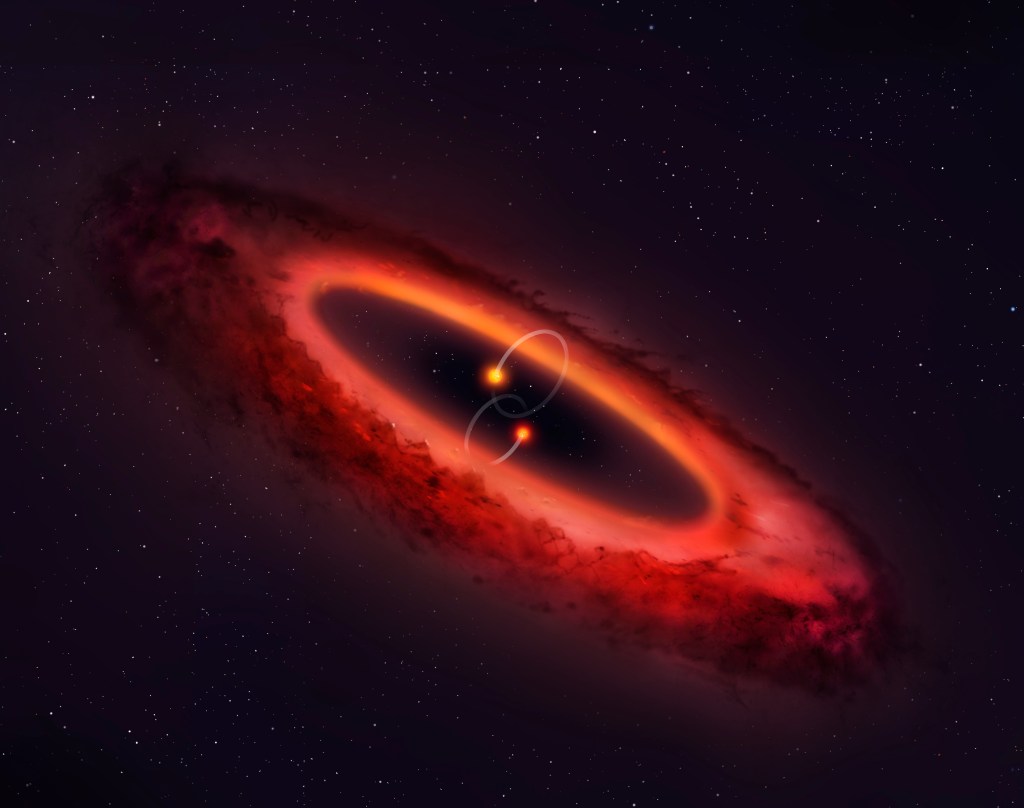
The deviant body may pass through the normal plane, catch the attention of the conventional body, causing a ripple of concern, which is the case in Carlos’s early encounter with don Juan. What happens later is forever a matter of speculation, but my best guess is that the voice pole and the eye pole become a binary system and the elliptic is tipped through ninety degrees to become ‘pole-oriented’.


Artist’s concept of a view of a double star system and surrounding pole-oriented planetary disk. Image via University of Warwick/Mark Garlick.[4]


I think it likely that don Juan is a fiction or at least has fictionalized himself for the apprentice’s benefit—how else could the deviant body reach in in the first place?

In spherical terms the cautionary point of don Juan’s teachings is that the modern rational way of being is dangerously precarious because of its over-reliance on acoustic deliberation and verification, what cannot be internally sounded and listened to is ignored or worse becomes inexistent. In this planar universe of being only zodiacal experience is valued and the illusion that everything succumbs to ‘calculation’ in the end is maintained through a constant sounding and echoing around the voice pole. Consequently only normalized bodies in predictable orbits are acknowledged in reality and labelled ‘understandings’.

Don Juan alerts his apprentice to a ‘separate reality’, a larger mystery, one that is non-rational, i.e. one that is beyond the rational-irrational dialectic of thought and which one can learn to see if only one will draw towards the eye pole and activate the optical aspect of the sphere. However, don Juan is also playing a game. He knows full well that Carlos’s compulsive and naturalized ‘thinking’ exemplifies a functioning condition of being, even if he thinks it, knows it, to be dangerously precarious. The voice pole can and does operate as a unitary centre and its functioning underpins all realisms, idealisms, pragmatisms … rationalizations in general, which glue the world together for human collectives. Don Juan also knows full well that the eye pole cannot operate to the same end, and does not need to. That is not the point. The point is that its operation corrects an imbalance in being. It does this by generating the stable condition of being that seeing exemplifies. By opening a direct line of sight back to the origin of being everything one can and has conceived of is reduced to unimportance. More importantly one avoids the abyss and annihilation.


[1]     In A Separate Reality, Castaneda recounts “further conversations with don Juan” which happened in 1968-9 three years after his original encounters of 1960-5.

[2]     I insert a rather Sloterdijkian ‘biune’ ‘spherical’ image here.

[3]     In MacFarlane’s pithy summary of Duchamp’s contribution linking art and philosophy he said: “Art requires our left brains and our right brains to talk to each other, and so give meaning to experiences which lie beyond the grasp of reason.” It is shorthand, of course, but in essence makes the same point. The artist has to see (even if briefly and inadequately) in creating art. (Philosophy Now, June/July 2015, p.10.)

[4]     Double star system flips planet-forming disk into pole position <https://warwick.ac.uk/newsandevents/pressreleases/double_star_system&gt;

The structure that we attempted articulate seems to have some relation to the work of Laruelle, though in fairness this is more coincidence than inspiration. The early description of ‘manifestationism’ always struck us as similar to his work. However ‘manifestationism’ never pretended to be anything other than a meta-philosophy and was never developed beyond a certain point owing to a paradox type problem. This being that philosophers became agents of the ontologies, or at least this was the preferred tack. However in making this the case one had to align the meta-theory with a particular ontological bias -something definite has to be asserted about the nature of the subject/agent, in this case, that the ontology is essentially of a higher order than the agent that works for it (the philosopher). The problem then is that manifestationism cannot ground itself without lapsing into a particular manifestation. We find there is still something attractive about the notion of philosophers as agents of ontologies and may well pursue this line of thought again.

Current considerations of Laruelle and Castaneda have somewhat reinvigorated this idea, or at least complemented it. For Laruelle, what I have called the manifestations are the philosophies that arise out of the one but are determined by it in the last instance, meaning the impenetrable one calls the shots on them but the converse is not true. Manifestationism had no transcendental one. The endlessly proliferating philosophies were caused by the agnostic disjunctive incoherence between them all. They did not require a transcendental extra, rather they formed a closed system which was basically kept going by scepticism about each other.

Castaneda’s (or Don Juan’s) insistence on mystery, emphasis on the occurrence of seemingly impossible things and resistance to any kind of theorising suggests something similar to the region that we wish to disclose. In making such a move though we stray even closer to Laruelle, for now we have a region closed off to theory from which all theory springs, which is of course very similar to the Laruellian one. The structure here though whilst similar is also different, for here we seek to feed paranormality back into the system without discussing it in any ontological sense, whilst the Laruellian project is more interested in showing the contingent nature of philosophical practice as a practice though arguably still retains the same hidden presupposition of materiality that most of the standard philosophical canon does.

An attempt at the level of ‘what is before’ has two potential strands to it. One is more akin to a Laruellian one insofar as it exists in a pseudo phenomenological space and operates as a transcendental to all possible philosophies. The other would involve reflections akin to those found in Lewis-Williams ‘The Mind in the Cave’. In this book cave paintings are theorised as being the nailing down of hypnagogic like imagery that may have appeared spontaneously to early humans spending time in cave recesses where darkness was absolute. Notions such as this point out a whole realm of experiences which the western theoretical mind will dismiss as not ‘real’ owing to this word’s near synonymity with the solid and continuous. This is not to be dismissive of such reasoning, of course this kind of thought has very good reason for thinking (to the point of assuming) this. The physical world does indeed appear to be solid and continuous. From this perspective of the before then, it is what we call now call the illusions, possibly also the marvellous sights (rainbows, light reflected through water onto rocks, glowing mists etc), powerful displays (thunderstorms, winds e.g.), hallucinations of any sense (for the sake of argument these would include the paranormalities: ghosts etc) and serendipities. If we strip these of our understanding of them then we can allow ourselves a glimpse of the prior. These experiences would all form a continuum with the solid and continuous.

Another example of thinking similar to this is found in Jaynes book on the origin of consciousness. The argument there is that the internal dialogue was previously experienced as an auditory hallucinogenic command voice. This bicameral mind, as he calls it mind was slowly superseded by modern consciousness which integrated the internal voice into its own understanding by the process of learning metaphorical language. We do not say (unlike with optical illusions e.g.) we now have excellent theories about nature of the internal dialogue, our best notions still turn on the theories of Vygotsky, however Jaynes argument is a related claim to our own insofar as it draws attention to possible ways in which phenomena which just ‘are’ were previously taken to be very different in a very fundamental way.

Of all of these what we come back to again and again are the issues surrounding the serendipities or synchronicities and how to conceive these in this more fundamental way. These are taken to be of maximal importance because these are the phenomena the most represent the possibility of reality at large altering itself in relation to the perceiving being. Even the most sceptical of us can experience a certain jolt when we are struck by a synchronicity (or coincidence if you prefer). If we quickly annul it with our agnostic disjunctive choice then we proceed with passive interest at the curiosity but not with the sense that something exceptional has happened. There is good reason for this of course. The alternatives don’t look appealing to many, there is either a kind of predetermined harmony, psychic awareness or reality altering itself around us to choose from.

In the prior there is no such theorising, there is no choice of ontologies. This state shows all these possibilities in a unified way. What we believe we have here is a world inhabited by powers that would be later classified as spirits but here are so continuous with it as to be unremarkable. The synchronicities themselves would be also nothing but normality, an expression possibly of the powers’ state towards the experiencing beings. And it is here we run into difficulties in this heuristic. Statements like the above seem to drag us dangerously close to a primordial theorising of spirits being linked to fortune. The emphasis we feel has to be on the ineffable fluctuating sense of reality that seems possible here, that makes possible the more ridiculed possibilities of psychic awareness or reality altering. The primordial experience that makes these now largely discarded possibilities has them in its living unity. This means there is a kind of push pull action embedded in it between the appearance of the solid continuity and the fluctuating reality of interplay between extended awareness, powers and actual alteration.