
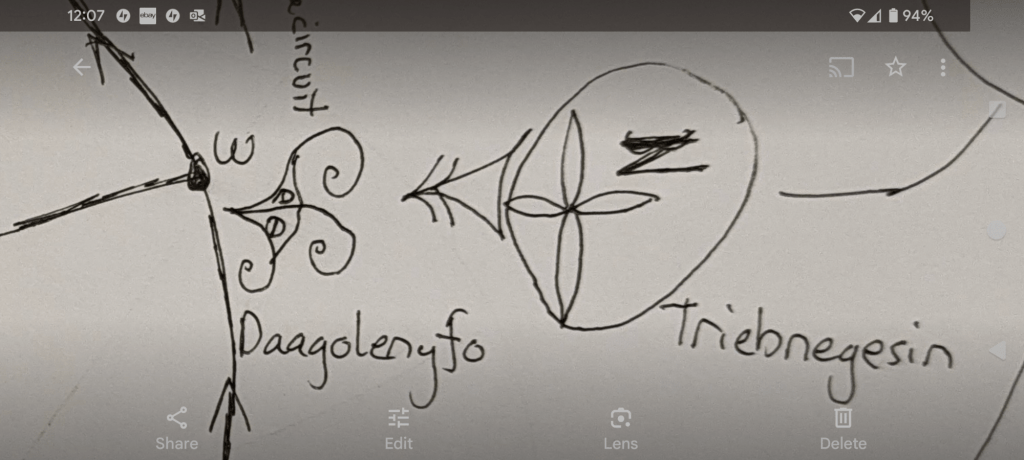
This Tooth is called Passion. In the Hyperqabalah it is Pnaslokied, it is the feeder node for Bnasupach which is related to Pan. Passion as a primal energy feeding Pan seems appropriate.
The notion of feeding is relevant to the note. From a level of ordinary reality one is forced to concede that a piece of art made by an artificial intelligence may be superior to one made by a human artist. Furthermore as AI gets better, so its ability to produce works of art that surpass human abilities will continue.
However from the pneuminous perspective the works remain quite different owing to the underlying metaphysical structure. Pneuminous theory is there to make an ontological connection between phenomena that is actual and not psychological. Things are literally connected on the conceptual (pneuminous) plane and the pneuma can actually do things (magick).
This means that at least in part the artists intent (such as they have one) is a real factor that can never be separated from the art as the pneuminous fibers continue to cling to it, even in death. That is, the dead artist is still an accretion in the pneuma and their fibres still cling to the vector that is the art object. This perpetual connection may be correctly or incorrectly read. Even if incorrectly it does not mean it is wrong experience of art, only that it is wrong in relation to the artists connecting pneuma, the original accretion. The new perspective forms further accretions onto the vector which layer on top of the earlier artists intentional levels.
When AI produces art it does so with none of the intent or passion or conceptual play that humans do. Its accretive relation is totally different to that of a human artist. Because of the way humans form pneuminous accretions, they are entangled with the objects. AI will be producing some kind of pneuminous relation but it is not at all similar to the human relation.
In the diagram we can see that the subject S perceives the art object AO . It folds it into its own pneuminous field understanding it as the artist does or otherwise. Either way there is an increase of pneuma to the AO vector. In the AI relation the subject still perceives/interprets the work but the creator only produces through algorhythmic lines which can contain nothing like ordinary artistic involvement/dedication —there is nothing like effort in the same sense involved. Furthermore, in the human relation, the artist perceives its own art work thus adding extra layers of complexity. The work is created and interpreted by the artist as well as being interpreted by the subject. In the AI relation the artist does not then perceive the work, the work is not appraised by the artist (unless prompted) it has no connection to it other than slender impersonal pneuminous fibres of necessity.

We might argue that currently AI is still prompted by a human and then appraised/selected. This is largely true however it doesn’t massively change the metaphysical difference. There would then be an ‘artist’ behind the AI on the bottom right (in the diagram) which would supply some sense of intent. The pneuminous structure would be somewhat connected but it would still not be identical to a totally human produced artwork. Furthermore the pure AI model can stand as we can readily conceive of an AI artist that once programmed creates things at its own behest, yet still cannot be said to employ effort and passion in the same way.
This is all a moot point in a sense as whilst the pneuminous theory does present a model in which the metaphysical structure of art would be literally different between the various modes, it would also be impossible to tell this difference. No part of this argument says the pneuminous relation is visible, only that under a certain conception of reality, it is necessary.

 Centre For Experimental Ontology