Here we posit that there is an influence in this reality that comes heuristically from the side (though the picture is probably more complicated than that). It’s quite hard to explain what we mean by this, though the sense may well be intuited readily enough. Let’s say we face forwards in time, fundamentally we are doomed to do this. We can sort of face backwards (this is what we call memory), but we cannot face sideways. At least our consciousness awareness cannot.

What we call information making sense, is when it comes to us from facing forwards, we also make sense of it happily when we look at it facing backwards. But when it comes from the side, we don’t really understand it and we try to say it isn’t there. Of course it may not be there, we are back in an agnostic disjunctive situation, the same one essentially as I have endlessly written about. This talk of sideways is just a differently articulated speculation.

Interestingly though, the speculation came from sideways. Let’s spell this out. Sideways is the synchronicities, the intuitions, the bursts of creativity from nowhere. Probably it’s more, probably if it it can’t be understood from facing forwards or backwards then it must have come sideways. Note that doesn’t deny the power of forwards and backwards facing; sometimes something looks like it came from sideways but really, when you look at it closely, it can be seen to be a phenomenon that came from forwards.

The speculation came from plants. I was looking at plants and thinking about plant awareness and how we assume its primitiveness in relation to ours. But then I felt the sideways direction and thought that maybe the plant awareness wasn’t primitive but simply facing a different direction. Plant awareness faces sideways (maybe). This makes sense at least in the context of occult/shamanic type practices. In such systems plants exert effects, some are forward facing —medicine- but others are sideways. Plants can protect or even extract revenge, how? From sideways actions. Damaging fairy property brings about action from sideways not from forwards or backwards. The same thing.

But this can be extended. If the unconscious (to us) plant world, has a sort of conscious operating sphere that extends in a different direction —it thinks in a different direction- then maybe other putatively unconscious beings also do so. Possibly, life as it tends towards consciousness as we think of it, it simply bending its gaze forwards. Many animals may have this tendency but still also have access to sideways consciousness —they have their spirit counterparts. Maybe the intelligence of rocks, water, fire and air faces sideways, more so even than plants (who must face forwards a little). Maybe there is a kind of spiral that bends from sideways slowly round, with a continuum of beings on it, leaning towards forwards (maybe some beings face even more forwards than we do?).

And what of us? Can we only face forwards and backwards? No, we have the sideways facing part, but it is so hard to see it, and without wanting to fall into cliches (but doing so) even harder to trust it, or even to know it, so as to trust it. We must becareful here though, because if we think it wrongly we will think that facing sideways is about a special way of knowing things; one that is there to help us facing forwards, and it isn’t like this. Sideways facing is its own direction. Power comes from sideways. Things live in the sideways (the faeries we used to see for one, probably the UFOs too). Sideways is not at the service of facing forwards (or backwards), we don’t even know what it is. The contemplation of sideways is quite strange, this is a good thing. We should contemplate it more.
  1. Nearly every word in the esoteric/occult lexicon is overly accreted with layers that distort the possibiity of a renewed sense of an understanding of the territory.
  2. The basic premise of a loving (in a very broad sense of acceptance) force which underpins everything is taken as basically correct.
  3. The suggestion that a modern understanding of this as quantum information is also reasonable. This provokes something of split insofar as to use such terms it must be acceptable to understand them at the level of explanation (a kind of heuristic) and not necessarily to have to understand the underpinning maths and physics. In a way, these only reify and confuse the matter —yet have ironically been necessary to bring the notions to the rational mind.
  4. Whether then we call it a Hilbert space or not, this means there is a hyperdimensional space which for want of a better word, collapses into this one somehow.
  5. A phenomenology of this reality is an equally good place to start to create possible inferences about this collapse-interaction.
  6. This space would be like the reticulum mentioned elsewhere in this site, though maybe also the umbratic —reimagined.
  7. Misunderstandings occur when it is taken to be the case that once the (Hilbert Space hyperdimension) HCE has collapsed into this reality, it then behaves in a materialist manner. The phenomenology of this reality contradicts this by the manifestation of the many pneuminous anomalies that appear: ghosts, ufos, fairies, synchronicities, precognitive dreams etc etc.
  8. The failure to understand these phenomena does not signal their non-ontological status |(though the agnostic disjunction accounts for the ability to see them through materialist lenses), rather it only signals that their presence comes, at least partially, from the irregular (to our normal selves) interaction with the phenomenon we call time.
  9. These various phenomena represent no doubt different kinds of interactions which may suggest some of the different ways in which the general system works (though of course they may only supply a limited picture).
  10. We, insofar as we are the conscious body controlling aspects of whatever it is we are, exist in the pneuminous layers. We are stuck, embedded in them. These are the layers of conceptual information (pneuma) that lay over something like a substrate but interact with it.
  11. Here is one of the issues that confuses the most. The emphasis on seeing beyond the rational struture of words and reification means we fail to recognise that the concepts are not simply some epiphenomal attempt to understand a substrate, but rather are living accretions of a kind of ‘substance’ (pneuma). Each word binds, creates knots, which may make accretions.
  12. Hence the map is not the territory is correct, however the map is in general life what we are dealing with and the actual territory is only the goal of esoteric practice.
  13. This hails back to the point about the occult lexicon. We are awash in ancient and obscure terms, holy books, systems, each one with the power to confuse.
  14. Power is real. It is related to energy in the sense often used in occult sciences. This is no doubt related to ones access to the HCE. Energy is the emanation, power is its use.
  15. All traditions agree that the silencing of the mind is part of the path to the HCE. The mind is the endless parade of accretions through the local pneuminous space of the human.
  16. Silencing the mind opens the gates to the pneuminous layers below, The HCE is a long way down. This is what Buddhism realises and why one (in Buddhism) should not pay attention to the manifestations on the way. The Gods live in here, even Yahweh etc exist as vast overlapping accretive layers.
  17. Do autonomous spirit entities exist? The evidence seems ambiguous. Lack of consistency is against them, however there does seem to be some hubris in believing we have made up (accreted) the entire spritual world. Yet through projected feedback mechanisms this may be exactly what has happened. The possibility certainly exists that there might be or have been other pneuminous spheres with equally rich environments. The Lovecraftian reality thesis is in this region.
  18. Here it will be understood that spiritual world is the free floating debris of accretive pneuminous powers that have acquired a kind of autonomy from previous belief systems. In this sense they are as real as a human ego, possibly moreso. A second use of spiritual world can pertain to the recognition of then pneuma for what it is. As pure information it may be the quantum informational HCE itself, however it is constantly employed in finite capacity to describe concepts at our level.
  19. Two kinds of interaction appear to be happening. The organism has a primary ontological collapse as surviving being in an environment that must obtain energy and shelter, hence the putatively external structure is either stable in itself or their are built in conceptual projections (like in Kant) that literally stabilise reality. This still leaves vast swathes of being unaccreted. The second interaction would be the conceptual apparatus that the organism develops. These pneuminous manipulations spread across vast vector regions of existence and by reifying feedback loops tie reality into being the things we attribute it to be. The fluid potential of pneuma is bound in conceptual service.
  20. This is somewhat akin to our usage of electricity (and probably they are related as powers). The accretion ‘electricity’ as an incoherent name for a controllable force fails to acknowledge the sheer mystery of it —David Lynch knew this.
  21. If this is correct, it makes this reality less a solild projection from the HCE but rather it is constantly shot through with it, which we perpetually collapse into forms that we can think we can comprehend. The common appearance of the incoherent coherence pervades the everyday without our realising the actual presence of the coherent incoherence.
  22. Sideways or orthogonal interactions from various accretive forms, conscious or otherwise constantly intrude upon the quasi stable form. These are variously repressed and not understood. These orthogonal interactions are a real part of the whole and suggest at its simplest that the system folds round on itself in various temporal manners. More likely there are complex interactions from the different accretive layers which, according to the levels of power present either in an individual here or sometimes in the accretion itself may result in highly anomalous occurences.
  23. It should be remembered that our conscious and unconscious selves (to some extent at least) are accretive structures and that we are co-created by each other. As such we are (as stated) not more real than entities that live in the pneuminous debris.
  24. The reality of the accretive forms as being literally spirits or concepts (any concepts) and their existence in the pneuminous space, and its perpetual collapse into this, means the connections between concepts are not psychological but real. Orthogonal interaction is exactly this. The piece of litter, road sign, number plate that seems to tell you something can actually be doing so, as bent around connection within the pneuminous space. However it also true that it can be not doing so. If you then project upon it that it is doing so, you forge the connection, though it may be slight. Power comes into play here as to what might happen from here.
  25. The silencing of the accretions liberates the organism to interact with power because the accretions likely block the flow, or absorb it into themselves. Greater power acts as a kind of gravity which then encourages bends in the pneuminous space and can increase orthogonal interaction. This is difficult to get beyond because the orthogonal interactions are so fascinating that they distract from moving beyond them.
  26. The phenomenology of our existence suggests fate like structures seem to exist. These may be natural fluctuations in the general system. Astrology etc attempted to tap into these, possibly with some success. There are moments when things are possibly for individuals and then they are not possible. Removing accretive layers likely increases possibilities. The gravity like force may bend opportunities in the individuals favour. This is the manifestation effect that sometimes works, activated by will power. Ultimately this is what has been referred to as low or black magick as the person does not realise what they have played with and merely acquired more accretive layers.
  27. The point of the problems of the occult lexicon are reinforced by the usage of black magic as a term. Clearly there is nothing here to suggest one kind of action is better than another. This is an interesting feature. Unless value can be derived from the HCE in concreted sense then the only value that exists is the value created as pneuminous construct.
  28. The accretive layers will instruct humanity in what is best for them if asked. They will produce more holy books/rules. Determining the use of these is difficult, however we need to get past the point where they are accepted without question, whilst at the same time understanding that we still live in the pneuminous layers. We are shot through with the debris cf Nietzsche.

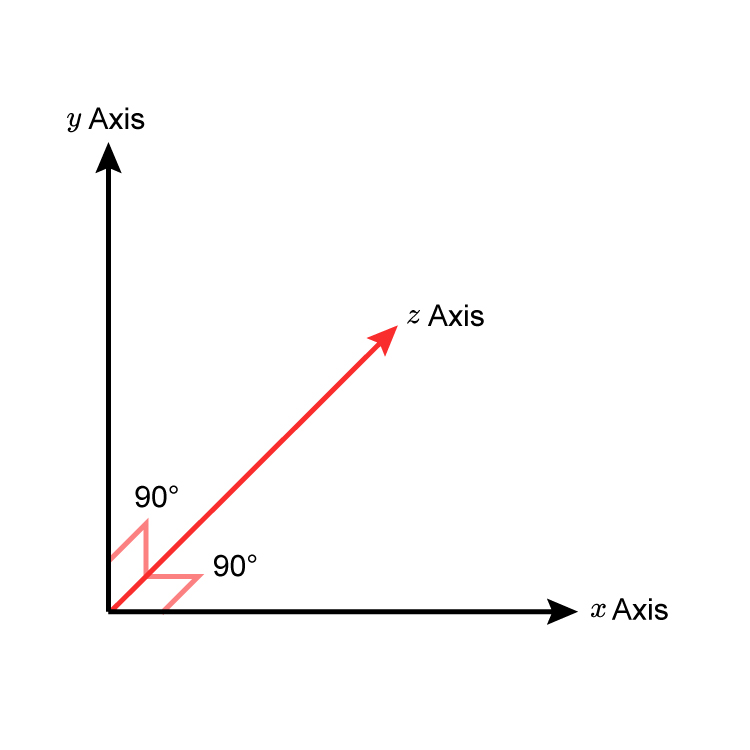
Consider the conventional axes (or planes) of three dimensional space. Each exists at right angles to the other two, and each stretches infinitely far. We typically label the intersection of the X, Y, and Z axes as 0, 0, 0 or the origin. The origin may be anywhere in 3D space, its position being defined only by the action of an observer choosing such a point to measure distance to another point from. If we try to add a fourth dimension to our model, the difficulty (as any Flatlander will tell you) is getting ‘outside’ of the 3D space in which external input to our senses and our internal experience informs of the existence of.

A fourth axis cannot simply be superimposed on our diagram above. We can however define it as the difference in state of things occupying the 3D space those axes delineate. One could consider the fourth axis to be the imaginary ‘line of sight’ (but not necessarily implying the act of seeing) on which the observer and the observed find themselves. As such it is not fixed in 3D space but moves with the observer, and for each observer and observed. Thus the subjective nature of ‘where’ the origin we describe above is, is intrinsically tied to the observer’s position (be that light hitting retina cells or the visualisation of something in the mind’s eye) and what the observer is observing (a physical object or a mental image).

Let us extend the axis that observer and observed define infinitely in each direction (one might think of this as looking down the length of a rigid fibre optic tube for example). We can only see in the direction of observation, we cannot see what is in the diametrically opposite direction. To observe in the other direction would require a special ability to be ‘outside’ of something which in itself is originated in the mind of the observer, let us hijack the existing phrase ‘having eyes in the back of one’s head’ to refer to this ability.

Given any act of observation takes a unit of time (and time’s popularity as a fourth dimension in addition to our original X, Y, and Z) we might say that one feature of our new axis is to delineate the passage of time, and serendipidously the fact that by default we can only see in the direction of observation parallels our experience of only times in the past being observable (any act of observation mental or physical incurs a delay due to the processing time needed to construct what ‘now’ looks like in the mind).

The concept of ‘right time, right place’ now takes on additional meaning, especially if we equate time to being just one facet of the additional axis that we are all capable of experiencing. Other facets of that same axis and an individual’s ability to ‘sense’ their presence might then explain concepts such as luck and coincidence, with constructs like probability and chance describing what those without the ‘eyes in the back of their head’ ability can expect if they try to obtain a specific result within the bounds of these four axes.

Consider the virtual/pneuminous. Here we are in the pure present (again the accretive problem arises) the virtual/pneuminous presses against us from both sides (the future and the past). Endless lines are drawn between all phenomena that might facilitate rupture like occurences.

Rupture like occurences are the synchronicities, the hauntings, Jung’s room crammed full of spirits so thick you can scarcely breath. This world is there, it is real, yet it hides behind the purely brilliant now, ever unfolding, ever receding.

Where are these lines? What do you mean? The lines are drawn in the pneuminous, in the other world, in the virtual. Maybe they are not drawn in it, but rather are it (then this line drawn is a key). Nodes and lines shimmering in the umbratic nothingness.

The rolling madness of pneuminous feedback layers endless complexity into the system. As the regions are named so they accrete; hammer, table, computer, seratonin, differential equation, on and on. Every accretion trying to solidify, failing at its edges. Not just these terms but vast abstractions like time, space, present, future.

Know that everything is formed in this way. Wittgenstein is a priori absolutely correct to say meaning is use. This truth is unassailable. However because reality is the way it is, it is also more than this. Each word exists in intensive use and extensive object . Open horizon, vertical structure. Every potentially ephemeral use summons the virtual hoard which accretes to it, affective and intellectual. When words are relatively simple like ‘table’ the accretions, the rules, whilst still swarming with affective virtuality and formal possiblity are much simpler than that of ‘time’.

Time too is an accretion. The word is a use word, its being exhausted by its use. And yet not, for the meaning of time as accretion is the bewildering morass of contradictory theories and overlapping similar uses that form this node. It is for this reason there are three different language games of time: chronos, aion and kairos. These being measured, numerical time (chronos), eternal time of future and past (aion) and qualitative heterogenous time (kairos).

What occurs that makes magick possible? Only the natural feedback that happens especially with beings that have complex conceptual breakdown of the vector field. Each identified region produces a contingent archetypal form, an ideal image of that kind of thing. This is the unbound pneuminous accretion. This unbound accretion is projected upon all the instances of this kind of thing encountered. The effect of this is to bring the phenomena more in line with the ideality (the pneuminous form). Magick imposes the ideal pneuminous accretion upon the empirical pneuminous form making it more like itself.

How can time become more like itself? As Bergson observed, chronos has come to dominate time, so that nearly all is perceived under this auspice. Mathematically measured time becomes our phenomenology. Time as accretion comes to mean this. Time is a vector region, whatever we can use the word time for is the use of time. What facilitates this grammar. The underpinning experience that makes the grammar of time possible. But when this grammar shifts to time as chronos, the accretion itself as it is embedded in the vector exerts that small but powerful effect upon it. The vector region that makes the grammar of time possible is made, in a subtle way, more fixed, more solid, like this incohehent chronological archetype.

One of the key ways emphasised to faciliate access to the other world is through our experience of temporality. Bergson and Deleuze and Guattari say this, but (Deleuze and Guattari especially) pull the punch. Intuition is a kind of act of imagination that can give access to reality other than our own but the occult significance of this is played down. Goethe understood it because he actually could do it. Elsewhere it appears as a myth. A fantasy whose literal reality the world of philosophy struggles to cope with -the pulled punches.

The CEO is proud to host this fascinating paper by Mina Baek on Accelerationism, Reza Negarestani’s ‘Intelligence and Spirit’ and Blaccelerationism.

Introduction

“Accelerationism comes from the Marxist idea that communism comes after capitalism, and therefore, to get to communism, we have to accelerate the logics of capitalism. Rather than resisting corporate exploitation with robust unions, maybe we should implicate ourselves in corporate takeover of the world. Rather than feeling guilty about being trashy consumers, maybe we should get out there and enjoy commodity fetishism. Accelerationism is a seductive idea. It says: it’s okay to lay down the hermeneutics of suspicion, the nagging doubt that capitalism is out to get ya, to screw you over. It’s all part of the plan. Just hang on tight, accelerate the process, and we’ll be in communist utopia in no time. Never mind the question whether Marx was right; never mind the debate that well, Marx didn’t quite mean that communism will just naturally happen to us inevitably; never minding those, nevertheless immediately one might worry: capitalism is racist. If we ought accelerate the logics of capitalism, doesn’t this entail that we ought accelerate racism? But surely one would have to be an evil racist to believe that.”

Read the paper here.