One way to describe where pneuminous theory leads—if it is taken seriously—is downwards rather than upwards. Not a regression into childhood or fantasy, but a stratigraphic descent into older layers of reality.

If reality is constituted by accretions of pneuma—layers of a substantialised meaning, habit, symbol, attention, and constraint—then the world we ordinarily inhabit is a relatively recent construction. It is stable, functional, and efficient, but also historically shallow. It is held together by contemporary typologies, pneuminous social scripts, and pneuminous object-circuits that continually reaffirm one another.

When those accretions loosen—through altered states, intense attention, de-identification, exhaustion, psychedelics, disciplined imagination, or accident—one does not enter a neutral void. From here is is possible to end up in older or deeply alien (or both) pneuminous strata.

At this point it helps to pause and say what kind of “place” we are talking about, because the temptation is to psychologise immediately. The twentieth-century philosopher Henry Corbin introduced the term mundus imaginalis—the “imaginal world”—precisely to block that reflex. By imaginal, Corbin did not mean “imaginary” in the modern sense of unreal or made-up. He meant a real mode of appearing, intermediate between physical objects and abstract concepts, accessed by a faculty he called cognitive imagination. In his reading of Islamic illuminationist philosophy (especially Suhrawardi), the imaginal is a realm of places, figures, and encounters—cities, guides, thresholds—that are not located in physical space but nonetheless possess structure, consistency, and reality.

Such delving in pneuminous terms, is not psychological in the sense of inner fantasy-production. It is not the psyche inventing content. Rather, it is breaking beyond recent accretions, allowing access to layers that predate the current civilisational configuration. What appears feels ancient not because it is archetypal in a Jungian sense, but because it belongs to strata laid down long before the present symbolic order -potentially even cosmically ancient.

If accretions persist, then agents can persist (though the chicken and egg situation here can not be resolved (pneuminous vs umbratic as starting point). A “being” in this framework is neither necessarily a metaphysically independent soul nor merely a figment. It is a stable accretional pattern with agency-like behaviour: it addresses, resists, insists, recruits attention, and maintains a recognisable signature across encounters. Such beings could originate from extinct civilisations whose rituals and cosmologies left durable symbolic residues; from long-abandoned meaning-ecologies; or from non-human strata whose constraint-grammar was never anthropic to begin with. They can therefore be found, not merely imagined. Encounter feels like discovery rather than invention because the accretion precedes the individual.

If accretions can stabilise into agents, they can also stabilise into places. An imaginal place, in this sense, is not a metaphor. It is a topology of constraints: it has an internal logic, thresholds, and a sense of “here” and “there,” and it resists free recombination. It behaves like a place rather than a mood.

This is where the parallel with certain strands of weird literature becomes philosophically interesting rather than merely aesthetic. In H. P. Lovecraft’s Dream Cycle, for example, Kadath is a city reached through dreaming. It has geography, dangers, inhabitants, and rules, yet it cannot be mapped onto the physical world. Likewise, in Ambrose Bierce’s “Carcosa” and Robert W. Chambers’ The King in Yellow, places such as Carcosa and Lake Hali function less like settings and more like intrusions—stable symbolic complexes that infect perception, recur across accounts, and exert agency over those who encounter them.

What makes these places striking is that they behave very much like Corbin’s imaginal cities: they are not private fantasies, but repeatable topologies encountered under altered conditions. The difference lies in orientation. Corbin’s imaginal—especially in its Suhrawardian form—is generally illuminationist. His cities of light (Hurqalya, Jabalqa, Jabarsa) are ordered toward ascent, mediation, and intelligibility. They belong to a human–Earth symbolic ecology shaped by ethical and spiritual teleology.

Kadath and Carcosa feel different. They are not merely darker versions of the same thing. They appear to operate under non-anthropic constraints. They are ancient, vast, indifferent, and often corrosive to human accretive structure. They feel less like local constructions sustained by ritual and tradition, and more like quasi-stable regions in an alien field—places that do not require ongoing human investment to persist.

This suggests a useful distinction. Some imaginal places are telluric: tightly bound to Earth, human-scaled, and sustained by cultural and spiritual practice. Others are xenopneuminous: weakly anchored to human meaning, ancient beyond memory, and operating under constraints that do not prioritise human sense-making. Both are real. Their difference is ecological rather than ontological.

This suggests a point about fiction often made (especially Lovecraft related materials). Some works of fiction function as accidental cartography. They do not invent worlds ex nihilo, which in a sense would be the sign of mundane fantasy at work. Rather they tune into ancient or alien (or both) regions of the pneuminous field and give them names, contours, and partial maps. Once named and stabilised, such regions become easier to re-enter. Attention feeds them; repetition gives them inertia. A place can be fictional in origin and real in operation. This does not blunt but gives an extra angle to Corbin’s critique of western degenerate imagination; that is that whilst it may generally peddle in imagination as fantasy, it is possible that sometimes the imaginal-pneuminous comes through a human-vector (author/artist etc), and though they know it not, the work generates an unworldly feeling in the reader that they have nowhere to put.

They have nowhere to put it because they can only see that ‘artist as creator’ lens and do not understand the possibility of the imaginal intrusion. This at least suggests that various creative works (assuredly not just Lovecraft) may put us in contact with the imaginal, though we then feel placed in a strange position in which we feel foolish if we indulged in this sensed connection as if it were real, yet equally we feel (Twin Peaks possibly is a region that has partially overcome this) there is more to our connection to the book/show than simply fandom.

The question of value, however, remains open. Reality does not guarantee benefit (whatever that might mean). Access to strata is, not wisdom. By the Persian Islamicists’ standards only some strata are illuminating, some are indifferent and some are actively hostile to human coherence. Pneuminous theory does not moralise this; it only insists that such encounters are not reducible to hallucination, because hallucination presumes a stable world onto which false images are projected. Here, the world itself—understood as accretional structure—is what is being re-authored and the value espoused by Suhrawardi may only be a relative perception.

If we truly dwell in the pneuminous field of accretions, then the imaginal is not elsewhere (as Corbin teaches). Ancient beings need not be metaphysically invented. And places like Kadath can be real without being physical, benevolent, or human-centred. Pneuminous strata like these cities are not fantasy. They are contact with older layers of how reality has been made.

  1. Nearly every word in the esoteric/occult lexicon is overly accreted with layers that distort the possibiity of a renewed sense of an understanding of the territory.
  2. The basic premise of a loving (in a very broad sense of acceptance) force which underpins everything is taken as basically correct.
  3. The suggestion that a modern understanding of this as quantum information is also reasonable. This provokes something of split insofar as to use such terms it must be acceptable to understand them at the level of explanation (a kind of heuristic) and not necessarily to have to understand the underpinning maths and physics. In a way, these only reify and confuse the matter —yet have ironically been necessary to bring the notions to the rational mind.
  4. Whether then we call it a Hilbert space or not, this means there is a hyperdimensional space which for want of a better word, collapses into this one somehow.
  5. A phenomenology of this reality is an equally good place to start to create possible inferences about this collapse-interaction.
  6. This space would be like the reticulum mentioned elsewhere in this site, though maybe also the umbratic —reimagined.
  7. Misunderstandings occur when it is taken to be the case that once the (Hilbert Space hyperdimension) HCE has collapsed into this reality, it then behaves in a materialist manner. The phenomenology of this reality contradicts this by the manifestation of the many pneuminous anomalies that appear: ghosts, ufos, fairies, synchronicities, precognitive dreams etc etc.
  8. The failure to understand these phenomena does not signal their non-ontological status |(though the agnostic disjunction accounts for the ability to see them through materialist lenses), rather it only signals that their presence comes, at least partially, from the irregular (to our normal selves) interaction with the phenomenon we call time.
  9. These various phenomena represent no doubt different kinds of interactions which may suggest some of the different ways in which the general system works (though of course they may only supply a limited picture).
  10. We, insofar as we are the conscious body controlling aspects of whatever it is we are, exist in the pneuminous layers. We are stuck, embedded in them. These are the layers of conceptual information (pneuma) that lay over something like a substrate but interact with it.
  11. Here is one of the issues that confuses the most. The emphasis on seeing beyond the rational struture of words and reification means we fail to recognise that the concepts are not simply some epiphenomal attempt to understand a substrate, but rather are living accretions of a kind of ‘substance’ (pneuma). Each word binds, creates knots, which may make accretions.
  12. Hence the map is not the territory is correct, however the map is in general life what we are dealing with and the actual territory is only the goal of esoteric practice.
  13. This hails back to the point about the occult lexicon. We are awash in ancient and obscure terms, holy books, systems, each one with the power to confuse.
  14. Power is real. It is related to energy in the sense often used in occult sciences. This is no doubt related to ones access to the HCE. Energy is the emanation, power is its use.
  15. All traditions agree that the silencing of the mind is part of the path to the HCE. The mind is the endless parade of accretions through the local pneuminous space of the human.
  16. Silencing the mind opens the gates to the pneuminous layers below, The HCE is a long way down. This is what Buddhism realises and why one (in Buddhism) should not pay attention to the manifestations on the way. The Gods live in here, even Yahweh etc exist as vast overlapping accretive layers.
  17. Do autonomous spirit entities exist? The evidence seems ambiguous. Lack of consistency is against them, however there does seem to be some hubris in believing we have made up (accreted) the entire spritual world. Yet through projected feedback mechanisms this may be exactly what has happened. The possibility certainly exists that there might be or have been other pneuminous spheres with equally rich environments. The Lovecraftian reality thesis is in this region.
  18. Here it will be understood that spiritual world is the free floating debris of accretive pneuminous powers that have acquired a kind of autonomy from previous belief systems. In this sense they are as real as a human ego, possibly moreso. A second use of spiritual world can pertain to the recognition of then pneuma for what it is. As pure information it may be the quantum informational HCE itself, however it is constantly employed in finite capacity to describe concepts at our level.
  19. Two kinds of interaction appear to be happening. The organism has a primary ontological collapse as surviving being in an environment that must obtain energy and shelter, hence the putatively external structure is either stable in itself or their are built in conceptual projections (like in Kant) that literally stabilise reality. This still leaves vast swathes of being unaccreted. The second interaction would be the conceptual apparatus that the organism develops. These pneuminous manipulations spread across vast vector regions of existence and by reifying feedback loops tie reality into being the things we attribute it to be. The fluid potential of pneuma is bound in conceptual service.
  20. This is somewhat akin to our usage of electricity (and probably they are related as powers). The accretion ‘electricity’ as an incoherent name for a controllable force fails to acknowledge the sheer mystery of it —David Lynch knew this.
  21. If this is correct, it makes this reality less a solild projection from the HCE but rather it is constantly shot through with it, which we perpetually collapse into forms that we can think we can comprehend. The common appearance of the incoherent coherence pervades the everyday without our realising the actual presence of the coherent incoherence.
  22. Sideways or orthogonal interactions from various accretive forms, conscious or otherwise constantly intrude upon the quasi stable form. These are variously repressed and not understood. These orthogonal interactions are a real part of the whole and suggest at its simplest that the system folds round on itself in various temporal manners. More likely there are complex interactions from the different accretive layers which, according to the levels of power present either in an individual here or sometimes in the accretion itself may result in highly anomalous occurences.
  23. It should be remembered that our conscious and unconscious selves (to some extent at least) are accretive structures and that we are co-created by each other. As such we are (as stated) not more real than entities that live in the pneuminous debris.
  24. The reality of the accretive forms as being literally spirits or concepts (any concepts) and their existence in the pneuminous space, and its perpetual collapse into this, means the connections between concepts are not psychological but real. Orthogonal interaction is exactly this. The piece of litter, road sign, number plate that seems to tell you something can actually be doing so, as bent around connection within the pneuminous space. However it also true that it can be not doing so. If you then project upon it that it is doing so, you forge the connection, though it may be slight. Power comes into play here as to what might happen from here.
  25. The silencing of the accretions liberates the organism to interact with power because the accretions likely block the flow, or absorb it into themselves. Greater power acts as a kind of gravity which then encourages bends in the pneuminous space and can increase orthogonal interaction. This is difficult to get beyond because the orthogonal interactions are so fascinating that they distract from moving beyond them.
  26. The phenomenology of our existence suggests fate like structures seem to exist. These may be natural fluctuations in the general system. Astrology etc attempted to tap into these, possibly with some success. There are moments when things are possibly for individuals and then they are not possible. Removing accretive layers likely increases possibilities. The gravity like force may bend opportunities in the individuals favour. This is the manifestation effect that sometimes works, activated by will power. Ultimately this is what has been referred to as low or black magick as the person does not realise what they have played with and merely acquired more accretive layers.
  27. The point of the problems of the occult lexicon are reinforced by the usage of black magic as a term. Clearly there is nothing here to suggest one kind of action is better than another. This is an interesting feature. Unless value can be derived from the HCE in concreted sense then the only value that exists is the value created as pneuminous construct.
  28. The accretive layers will instruct humanity in what is best for them if asked. They will produce more holy books/rules. Determining the use of these is difficult, however we need to get past the point where they are accepted without question, whilst at the same time understanding that we still live in the pneuminous layers. We are shot through with the debris cf Nietzsche.

This is a somewhat convoluted observation that I had the other day that, to me at least, makes some sense of my (largely erstwhile but still slightly lurking) Twin Peaks obsession. I’ve been reading quite a lot of Gurdjieff/Ouspensky and have been struck frequently by their characterisation of humankind as largely asleep. They constantly write that such sleep is not easy to understand but equally that it is in fact possible to do so. With the help of another writer (one E J Gold), I think I may understand some of this now.

Understanding here is a curious thing, it’s not a cognitive understanding, it’s an entirely practical or at least an experiential one. The first understanding I had of sleep was the obvious way in which one cannot really be aware of everything that is happening as it happens, one can try to keep a track of events in a more aware (awake) state, but it is, as Gurdjieff admits, nearly impossible to do (unless apparently one has had some level of esoteric training). This is ‘sleep’; it’s a fair characterisation of it, however it is not all of it. Furthermore thinking of sleep in this way encourages one to think of it as something almost simple, that if one simply could keep track of events, one would be ‘awake’.

In fact sleep is far more entrenched than this. Sleep is also your patterns and emotional responses. If you observe yourself accurately you will come to see that your organism almost entirely runs itself. This brings into play a curious kind of separation. One can kind of see that there is part of us that can observe that your organism including its thoughts and feelings is indeed quite machinic. Certain jokes arise in you, to make certain people laugh, certain situations irritate you without any action on your part. You, this other part of whatever we are, are entirely unnecessary to this process, it will run entirely without you.

So what is awakeness? Awakeness is also a natural occurence that we do have some limited access to. Strange moments of clarity that may just occur or be induced by drugs, stress, or meditation etc, are actual experiences of awakeness. Awakeness is often characterised by the absence of any sense of irritation or indeed enthusiasm towards anything. But these are just the foothills of awakeness. Esoteric systems generally are about trying to cultivate this sense. Pretty much all of the activities of these systems are designed to try to put you in some form of awake state and try to do something whilst you are in it, to work with it.

Awakeness/sleep is also very clearly not a binary on/off system. Furthermore it is simply a grammar that helps explain something. To be partially awake can be, as mentioned, a normal but fleeting thing. However, being more like a sliding scale than an on/off switch one can be more awake still (or less awake still). Indeed many of the normal more awake states are in fact still highly automatic but simply have an increased awareness of the automation.

The sliding scale in some sense though is confusing, for it can conflate the awakeness with the weird reality interference. The two are related, though not necessarily correlated. The weirdness will probably activate waking and being awake will also bring about weirdness but its not a precise relationship. We can (sort of) think of these as two axes. That is, we might find our selves somewhat entangled with events that emanate from the higher dimensions/other world/pneuminous realm whatever you want to call it and/or we may find ourselves with an increased sense of presence, awareness ability to perceive and override our automatic actions and words. Extensive ability to do the latter will likely increase the former but an increase in the former may only negligibly increase the latter, as we will often marvel and forget or obsess over the weirdness in unproductive ways e.g. by reifying and attempting to place weirdness within the scope of regular reality (which it will totally resist). Ghost hunters and UFO obsessives may fall into this category.

Gurdjieff famously disavowed his magickal abilities in favour of a pure focus on something like will and attention. This was his sacrifice. We could place our axes precisely on his decision, saying that he restricted his access (and control) over weirdness (axis 1) in favour his concentration and will (axis 2) believing this to be the important part of his spirituality. This makes sense since, as discussed, it is perfectly possible to continue to have sleep like responses and be interested in weird phenomena.

The other world is a strange thing. From sleep you can kind of intuit its presence. This intuition is going to be supplied by clues like manifestations of phenomena that either are or resemble synchronicity, telepathy, entity interaction, precognition etc. Personally I was prone to one of those number synchroncities and can still remember the moment when one of my friends finally had access to the internet so we could look it up. It is an understatement to say I was suprised that my very number (47) was right there on the net as ‘the mysterious number that connects all things’ or some such. Indeed the state the phenomenon put me in something close to a waking state. This was one of the ‘shocks’ that Gurdjieff says we need to experience. Occult phenomena are good at this because they either scare the bejeesus out of us or they imbue us with a sense that reality is actually bigger that the spatio-temporal kind of layer we seem to live in.

What has Twin Peaks got to do with this? I would contend that Twin Peaks was extremely good at putting me into some kind of waking state (albeit it temporarily and certainly not for all of the show whilst it was on). I might extend this claim to say that a lot of Twin Peaks cult popularity was because it was quite good at doing this generally. This is also responsible for the sensation that some watchers get that the show is somehow more than just a TV show.

As mentioned, being awake is a smooth curve, the lower reaches of which we are familiar with (sleep) and the rising of the curve is also accessible for free sometimes. Twin Peaks and other cultural experiences sometimes move us up the curve by their ability to powerfully demonstrate a kind of recognisable world that simultaneously blends with esoteric manifestations. Whilst this is true of it, it is also true of many other kinds of supernatural shows. However, straightforward fear in this sense is not so productive of waking states (at least from cultural products) so shows that produce this kind of response only put the organism in a state in which it is afraid and not in which it is jarred by ontological dissonance.

How does Twin Peaks achieve the ontological dissonance that I ascribe to it? I would say it is i) by its seamless fusion of the competence and rational clarity of its hero (Agent Cooper) combined with his rapidly disclosed belief in divination/synchronicity as valuable guideposts to his enquiry and ii) by the way show unambiguously contains the existence of other than human powers and places that have some sense of existence external to human reality iii) the way in which the other world is depicted in a manner never before thought of (at least in anything mainstream that I have seen). By this I mean the famous red room. With its red velvet curtains, art deco decor and black and white zig zag floor (all set to various jazz like themes), the black lodge is/was one of the most amazing/strange characterizations of the other world that has ever been.

The show makes it clear that some of the spirits work to help Cooper whereas others do not, others still are unclear in their alliances (e.g. the man from the other place). As such the favourable synchronicities can be interpreted as clues from these beings. Whilst there are direct manifestations of entities, the communication of clues through reality (synchronicity) suggests the curious sideways on interaction with the normal real that so often characterizes the phenomenology of such events. That is, the paranormality does not occur from powers that act on the level of regular reality (like a poltergeist might move a plate) rather the interaction alters the elements of reality themselves (or potentially our perception of them) to produce the clue. This of course is a little too ontologically simplistic and needs (in my opinion) the help of something like pneuminous accretive theory to complete it. That is, we cannot talk about things of the world as ontological simples themselves, for they are each informational/conceptual structures and thus capable of being different vectors of meaning.

Twin Perfect’s famous explanation of Twin Peaks as expressing TV itself or maybe rather TV’s slide from authenticity into impoverished entertainment is extremely convincing. I’ve no need to disagree with it and I don’t particularly want to. However, correct as it may be, the phenomenology of Twin Peaks does not show this level of it. Twin Peaks is generally watched as if it were a TV show and not a meta-indictment on TV itself. As such it is interpreted through these rules. The Red Room may well be code for TV signals and stage curtains but without this realisation it hits a level of perfect surrealism that disarms all regular expectations of paranormal interaction. This, I would say is a key factor that colours all the other weirdness that goes on in the show. That is, if this other dimension of ‘evil in the woods’ were given a more conventional representation of evil spirits with their realm looking suitably gothic (or some other cliche) then the power of the show to disturb/shock would be considerably diminished.

By shock, I don’t mean the ordinary kind of shock of fear necessarily (though this can do it), but rather the Gurdjieffian shock which can suddenly place us in a heightened/weirdified state to some degree. Twin Peaks by its very ongoing presence (whilst watching it) can give this shock. This is because the ontology is necessarily embedded in the world. Of course many elements of the show do not deal with the weird, however as long as the thread to Laura remains, we can know a priori that the rest of the madness is entailed.

Another layer to the shock/awakeness inducing phenomena is the resonance people feel to the weird realism. Whilst one end of Twin Peaks is totally off the deep end, the other end exists at the totally relatable level of synchronicity. Soft esoteric experience like synchronicity are something that make even hardened materialists pause, even if only for a second or two. This is because (as I have spent more words than is necessary elsewhere explaining) the interpretation of the synchronicity as the weird reality intruding phenomenon is epistemically equivalent to its interpretation as coincidence of pure chance.

The point is, whether they give it much thought or not, almost everybody knows this kind of potentially paranormal experience. Twin Peaks takes that experience and shows you that a highly intelligent agent of the state uses and believes in this as a method and furthermore is not wrong to do so. This means the show unambiguously comes down on the weird reality intrusion version of synchronicity. Subliminally or otherwise, the display of this capable, highly likeable protagonist using this intuitive method (and it being ‘true’) facilitates a certain feedback with the viewer that lifts them into a space where they too (given probably a certain psychological disposition) engage/believe deeper in this weltanschauung.

This is more of what makes Twin Peaks have the sensation of being more than just a program i.e that it is in some sense a coded message about how things actually are. The aforementioned implication from synchronicity to entities and other dimensions also escapes the screen, travelling along the legitimised synchronicity path. That is, because the show supplies a ‘cause’ of the synchronicities (the sideways interference into reality by the spirits), buying into the show’s ontology comes almost as a whole. Again, this is a sliding scale type effect, however because an answer as to how these phenomena occur is given, the sense of possible coded revelation that the show presents carries through, therefore the more extreme weird end of the show’s ontology is also displayed as possible.

To briefly return to Twin Perfect’s analysis we can again agree but with a slightly different twist. Because Twin Peaks is Television, the reality manipulations in it are identical to what we think of as paranormal in this world. The scriptwriters (spirits) can insert any synchronicity into events that they wish and it will be meaningful because it was exactly written to be so. We can bounce back the paranormality as television back to the real world and feel another angle of the well-known show’s epithet ‘we live inside a dream’. The Twin Peaks characters do live inside a dream, but somewhat trite though it is to say, from the Gurdjieffian perspective so do we. When defined as asleep (and it is not the least fair characterisation of our repetitive automatic characters) we can be seen to be dreaming, only drifting occasionally into anything resembling a cognizance of what is going on.

Twin Peaks, through these various loops, appearances and reflections can partially drag us out of this somnambulance into a slightly heightened state. The problem with this state (through this means) is that the usual path it takes is not the development of the state itself (to be fair, why would you notice this or engage with it, I mean you just thought you were watching a TV show that made you feel a bit strange) but rather a fascination with the other axis of weirdness we described. By plugging into various quasi ‘real’ phenomena (synchronicity (which is real phenomenologically at least), project bluebook etc.) it pulls the Lovecraftian trick of blurring the lines between fiction and reality. This can make us feel the pull of the weird and end up obsessing about these aspects on the wrong ontological level (a kind of taxonomisable or contactable real), which, whilst fascinating, are dead ends of paranoia, madness and disappointment.

This doesn’t mean the weird stuff isn’t real in some sense and it doesn’t mean we can answer the question about whether entities are inside or outside of us or even if it really makes any sense to ask this. What it means is that occult value is not in obsessing about a kind of weird science of this stuff that never gets anywhere, it’s more about the ability to develop a kind of awareness that escapes the regular sleeping state. Engaging only with the weirdness on this level of fascination is a return to sleep. This is kind of the tightrope that Erik Davis talks about (in High Weirdness) or at least similar. Weirdness provides shocks but is also fascinating. Fascination brings sleep. Staying awake though, increases weirdness even if only in the way things sometimes look different (though it can also trigger synchronicity and other things). More weirdness increases the fascination obsession temptation and so on.

There is of course the possibility (I admit slim) that Twin Peaks even overtly refers to all of this. By this I am referring to coffee. Let’s ask ourselves ‘what does coffee do?’ The answer is ‘it wakes you up?’ What does the intelligent, capable, likeable FBI agent do? He drinks coffee. Cooper can easily be identified with someone in the waking state and his love of coffee is part of what identifies this. He doesn’t want to fall asleep and he loves coffee (Gurdjieff is often referred to as drinking coffee). He unambiguously is shown as someone who engages with meditation and who is two steps ahead of everyone else by sheer awareness of what’s going on. This is an at least partially awake human being whose awakeness is partially fuelled by coffee. Furthermore, it is only Cooper who is capable of receiving the messages from the other world (awakeness increases weirdness). As if to reinforce this trope of the ‘awakeness of Cooper’, ‘Twin Peaks: The Return’ features largely an entirely asleep Cooper, this time in a state even lower than that of the regular human sleep.

In a way it is nothing to say this, Lynch knows lots about meditation and will definitely be familiar with terms like ‘awakeness’. His usage of coffee as symbolic/connected to Cooper’s awakeness could indeed be entirely deliberate. The interesting possibility would be if Twin Peaks was actually designed to wake people up. Twin Perfect’s argument would sort of agree with this insofar as Twin Peaks exists to symbolically point out the dire state of TV (at least back in the 80s) and act as a wake-up call against it (though this is hardly an esoteric point). Is it designed to wake people up esoterically by identification with a synchronicity legitimator (amongst other things)? Probably not. However, I would say that regardless of intent, even though it may also open up weird fascinations (and hence sleep) it does contain certain shock-keys that can facilitate some access to altered consciousness.

These thoughts are the product of being an avid Twin Peaks (and Lynch generally) fan since its inception and reading Ballard’s ‘Cocaine Nights’ for the first time. I don’t think for a second Ballard tried or needed to try to copy Twin Peaks in any sense. His imagination seemed to have been perfectly self sustaining and the trope of the weird small town was not invented by Lynch -just perfected. However some things leapt out at me enough that I felt forced to commit them to writing.

Ballard once reviewed Blue Velvet saying it was ‘like The Wizard of Oz reshot with a script by Franz Kafka and decor by Francis Bacon.‘ Ballard’s gaze is spot on of course; Lynch is both a massive Wizard of Oz and Kafka fan. I think this is pertinent to Cocaine Nights insofar as there is definitely something Kafkaesque about the way Charles tries to penetrate the deeper layers of Estrella del Mar only to be perpetually told he’s looking in the wrong places, or won’t find answers. In the end Charles Prentice is assimilated by the Estrella del Mar machine, a move he believes works in favour of his investigation when really his subconscious complicity is greater than he understands as is his misrecognition of where the power lies.

My Twin Peaks observations are fairly straightforward. The most obvious is that Estrella del Mar is of the Twin Peaks ilk. A seeming small town paradise —albeit of a different kind to TP- with a seething underbelly of crime. Of course as the book evolves we can see that the two, whilst having a kind of structural isomorphy are functionally quite different. Twin Peaks dark side is shunned by the residents or at least repressed. Whereas in Estrella del Mar the life of the place emits directly from crime and deviancy that runs through it.

These are two analyses of societal functioning. Twin Peaks appears idyllic but is shot through with crime and corruption whereas Estrella del Mar appears idyllic in a different way. Estrella del Mar is very culturally active in a middle class way, Tai Chi, pottery classes, gyms, painting and all such activities flourish. The theory employed in Estrella del Mar is that if you awaken people by targeting crime at them in a specific way they become more alive, become involved in the community and want to partake in projects of all kinds. A persistent underbelly of crime in this way keeps people on their toes and keeps the machine ticking over. This is explained as the activation of primal defence parts of the mind which awaken the animal to a more heightened state generally -due to the threat of crime. But of course since the crime is not so perpetual that the state of alert is required all the time, the surplus energy of the people becomes sublimated into the various sports and arts.

In Twin Peaks one might say (if the theory was right) that a) the demographic is different -Estrella del Mar seems a largely 30-60 year old adult population whereas Twin Peaks seems to have a more normal age range of people and b) the crime is just regular crime and not the targeted crime of Estrella del Mar. In this way as ‘normal’ crime it exists only in certain peripheral zones which enable its repression thus disabling the mechanism that Estrella del Mar utilizes.

And what is the apparent driving force of Estrella del Mar’s crime-social machine? The answer is probably the key synchronicity between the two worlds. Bobby Crawford is the name of the part psychopath, part saint who creates and facilitates both the crime and social threads of the town. He seeks to reawaken people from their TV slumbers by generating a wave of aesthetic crime to bring them to life. One of his biggest associations is: fire. We have frequent sections in parts of the book where the protagonist refers to Bobby as having a taste for fire.

Bob and fire, where have we heard that before? Now Bobby Crawford is by no means straightforwardly evil and indeed his connection with the central conflagration of the book is largely rebuked by the end. This doesn’t however distract from his burning down a car and two boats in the course of the story. We’re repeatedly told that Bobby is dangerous and even though the protagonist becomes criminally complicit with him and sympathetic to his methods, we know that Bobby still facilitates rape videos and possibly worse. All the time everyone loves Bobby Crawford and his easy charm and playful nature —he is Bob eager for fun, he wears a smile, everybody runs. Bobby Crawford may have sincere motivations and be morally ambiguous in some ways, however his role as a kind of dark Dionysian agent is quite clear. Twin Peaks’ Bob is largely an unambiguously evil presence, except that there is some sense that Bob’s activities are in a sense just what is fun for him. It is not simply that Bob plots to be and do evil, it is just that he acts according to his nature —which happens to be terrifying and dangerous to humans. In this sense he is similar to Bobby Crawford —and they both like fire.

Another thread of connection I noticed was upon the introduction of Dr Sanger in a ‘tropical suit’. The eccentricity of the tropical suit at the introduction of the psychiatrist immediately brought to mind Dr Jacobi. The similarity continues insofar as the murdered (by fire) Bibi Jansen (a drug troubled young woman) was under the supervision of this psychiatrist. Sanger, like Jacobi is morally ambiguous. He seems to genuinely want to help and at the same time seems to sleep with his young female patients.

Lastly there is Charles Prentice as agent Cooper. Prentice comes to the town to hopefully free his ‘obviously innocent brother’ (a whole Kafkaesque routine in itself) Frank, from the accusation of burning down the Hollinger house which resulted in the deaths of five people. Like K of the Castle, Charles is sucked into the inner world of Estrella del Mar. The same thing that also happens to agent Cooper in Twin Peaks. Cooper readily allows his assimilation into the wholesome aspects of the town and in doing so permits himself to fall in love with Annie Blackburn. Ultimately though when faced with the test of the Black Lodge, Cooper fails. His soul is too riddled with guilt and he is doomed to 25 years of residing therein.

Charles Prentice is seduced by Bobby Crawford into helping with his criminal re-enlivening schema, believing this is the powerhouse of Estrella del Mar. He feels so close to uncovering the secret that he does not spot the dark machinations of the real power seat closing in on him -also involving a woman for whom he has feelings (Paula Hamilton). When Bobby Crawford is killed, Charles Prentice’s guilt makes him pick up the gun that killed him, thus implicating him in his murder and condemning him to plead guilty to it, as his brother has to the fire. Like Cooper, he has been caught by the Black Lodge, just when he thought he was on the verge of solving everything.

A brief and unpretentious dive into the Castañeda/Lynch connection through the show Twin Peaks and the book The Eagle’s Gift (the last one before Carlitos’ descent/capture). The key non-thesis of the speculation thus: David Lynch, finding himself in a similar condition as Carlos Castañeda, fighting assimilation of his vision by Hollywood, produced, more specifically with The Return, a critique of the descent in-itself, sketching a diagram of his own escape (which Carlos himself failed to perform). If Lynch ever read Castañeda is beyond the point. Here are fragments of conversations held at the CEO.

I wonder if we could think of Judy (Jowday), that is represented by the beloved “Owl Peaks” symbol as the dark side/counterpart of the Eagle (or really just the nightly aspect of the Eagle, for what is an owl if not an eagle one sees at night). If we assume Jowday is a manifestation tied to the Black Lodge, it seems to be the case. Even more because, in this book particularly, and its transition to the next, Carlitos fails (like our beloved agent Cooper) and is captured (as is expressed in the mythos of his own cult always torn and in constant war from within).

“We are luminous beings, we are better than that”, the motto La Gorda keeps repeating to Carlitos each time he starts worrying or wimping too much, the one thing she supposedly kept on repeating as she tried to “save” Carlitos from the jaws of the jaguar, fits very well with the White Lodge’s ‘residents’ true face:

Or at least Laura’s (since she is luminescence and good herself)

Laura truly is the Twin Peaks equivalent of the infamous Nagual woman: a prodigious, luminous being that got snatched too early in her life and exhausted her potential by the suffering her captors imposed on her, into and onto, for the very teleological motif that is the production of garmonbozia. And they did it all, the Black Lodge’s rogues, to feed on this secreted creamed corn. It sounds too much like the story of the beautiful forgotten Nagual woman. By the end of Twin Peaks (The Return), everything in one timeline is corrected and Laura’s corpse even disappears as if either she never existed there or was saved (I think she was erased from that timeline and jumped, only unwillingly via Coop — who thought he was doing good by that, when in fact he was only reviving her death and so prolonging her suffering, pain and sorrow, much like Carlitos and Carol Tiggs joining the cult). If more pain and sorrow, that is, garmonbozia, is the result of Coop’s failure to fix his heart, and said creamed corn comes from a continually doubled Laura, doesn’t this mean he is worse than BOB? Upgraded BOB, in fact, that feed us the garmonbozia while reciprocally being fed by our need to hear that lovely scream.

The Nagual/TonalRight/Left side quadratic polarity is also very reminiscent, to me, of Coop’s multi-self:

BOB-Coop (or Doppelganger, The Lovers Reverse and The Magician Reverse),

Homo hermaphroditus masculinus, failed

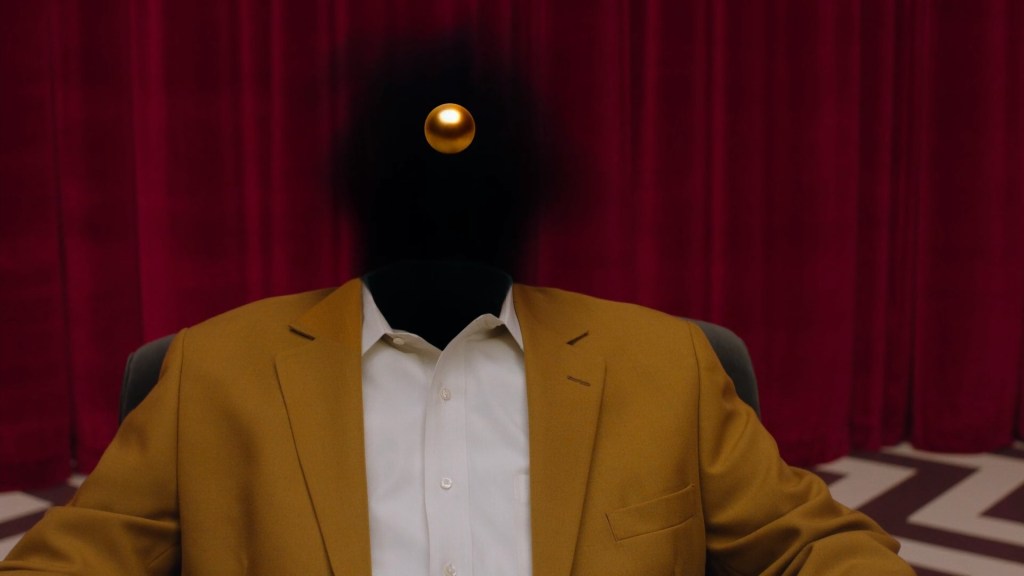
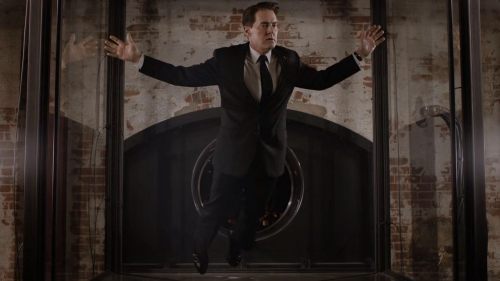
Dougie Jones (or Tulpa, The Lovers Upright and The Fool sideways),

The golden ball, the core of the tulpa, expands until finally disappearing from the screen. The true shape of humans according to Don Juan. This one is artificial, however, a golem, and upon expansion to determine the totality of oneself, it vanishes and the tulpa ceases.

‘Original’ Coop (or The Fool Upright and The Magician Upright),

The Fool’s Magic Trick

the guy Coop snatches the body by the end (or The Fool Reverse and The Hanged Man Reverse).

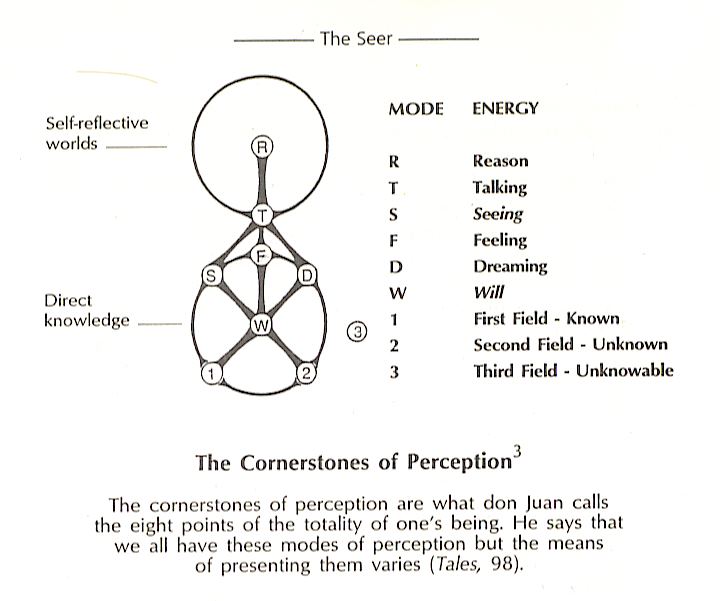
Relationship with Carlos Castañeda (or Carlitos, for the “fictional” character), following the diagram of the Seer:

Courtesy of Ken Eagle Feather

Tulpa/Dougie: fake double, Carlitos’ right side that forgot his Naguality.

Trapped in the Sphere of Direct Knowledge, devoid of access to the Sphere of Self-reflective Worlds.

BOB-Coop/Doppelganger: fake nagual, Coop’s and Carlitos’ snatched left side that does not remember but that still subsists due to power-momentum (Bad-Coop managed to contain BOB, still inside him, for 25 years). Its destruction is the rejoining of the left and right sides and Coop/Carlitos put back together.

Trapped in the Sphere of Self-reflective Worlds (like BOB), devoid of access to the Sphere of Direct Knowledge.

Original Coop: the Tonal, Carlitos before the split performed by Don Juan and Don Genaro.

Composed by and composing of the gra-tree-like structure, the hero’s journey proper is the dissolution of this harmony via the scission/split between spheres, resulting in the Doppelganger effect where communication is made difficult and an antagonist projected/manifested.

‘Spirit’ Coop/Coop of the end/Coop snatching the body of the guy at the end: Coop failed to remember and rejoin what was split properly, just as Carlitos, and his Naguality then, instead of entering the third world like his masters, jumped back into the island of the Tonal to snatch the body of another person (by invading another’s dream, other TV show). He indulged to the very end and became like BOB, a vampiric specter, only by the end we got to finally see the world from BOB’s perspective, or an upgraded version of a rogue of the Grey Lodge, the in-between that is the failure of proper conjunction. We are invading the automaton carcass that is “Cooper” in the same way he is invading people from another dream, supposedly our dream. It is, instead of a mutualistic symbiosis, a reciprocal parasitism (where the audience may find some enjoyment in the confusion, and Coop find some purpose in continuity as we feed him energy to continue his task of failing to do the good he wants).

Lost in the Third Field of the Unknowable (3), and in fact the avatar for such. He finally did it, but failed in doing it properly.

If Lynch would comment on the later activities of CC, I think he would say something along these lines, that he “didn’t fix his heart — but he did not die either”.

The house of the spirit (Cooper), now as pure electricity, the synthetic fire that walks as you. Cooper achieved immortality in the perpetual act of drifting at the speed of light without control. A proper cosmic neuron, which is sadly not a person anymore. Not even a character now, he is the stuff of dreams, a symbol. He opened Pandora’s box from the inside and became hope. Our hope.

But there are things worse than dying, as the Naguals would say.

25 years on and Laura is still (back?) inside her mother, in the worst way

Carlitos Cooper continues to refuse to die, like the fabled Hope of the myth, their leftover residue just symbols now. The dreamer vs. dream debate is over, nobody is the dreamer, there is only nightmare.

Meanwhile…

Final shot of the series, before the lights go out.