Calmly Considering what Clothing to wear Tonight.

A new serialised piece of fiction by Jim Meirose

1
Out far in the future, from your last full stop, there comes reading back to you this description of an unusual event some several dozen years back, from even farther out, of a strange body, needing immediately examination, in room number five of Helmut Greene’s worldwide discreet autopsy and private twenty-four-hour emergency lawn care contracting concern. Motto—no questions asked, and no answers given—at least not out loud or in writing. Pup. Here is the writeup of this pertinent to us big bang.

Mediation objective goal; Immediate the presence of a large hysterical object das interior. Subjecteriorianne pap; formerly bright shine objection being, the climb up some political ‘ss.

Esquire!

Pig Humphry lay back in his cushy Brads only big spittoon, waiting for the delivery of the job to his station thirty, the last opening for walk-in’s today, and which would be so for the next few hour-sez as writing up by contract, for today. Who, where, or what they would not say, but; it’s unusual, more actually highly irregular, and somehow disturbing that three of her majesty’s very big princes must offal bee present as Pig slit down the front of the subject in question, whom, he assumed, must have fallen from some overtoweringly top-fatal, perhaps largest, and widest of any of all the diseases that be, infection or whatever. Of these, there are many wheezes; so, he did not spend the time ‘til Jess wandering, but; waited ou’ ‘s haunches off some powering down, to clear them all out, and the resultant crying and wailing and why the hell’d di’ddd ing, of every large sweep, but actually made on a budget, seventies style disaster movie.

B’.

Then, abruptly, he rose from his divan, and went to the window. There was nothing to see. There was nothing to see; his classmates began to assemble; and, there remained nothing at all to see, as he waited alone for the lab session to start, but, the time continued passing, the door opened, and Venisienne entered—already clad from head to foot in her trademark too-small baby blue, nothing to see still, nothing—rubber gloves. Hey, Pigman, she greeted him quickly, and he turned from the window, trusting there’d remain nothing to see, as; hell, the day was early, so he nodded also, but, said nothing, too. There was still nothing to ‘ee ‘cause, jus’ a’ third member of his way back when human anatomy twelve, lab group five, had to arrive for preparations to be fully complete, so, also. Hey, also. They said that ‘til the doorknock knobbed rattling eck, he is here; yes, ‘way team nuh’ b’ bringing today’s special job for Pig to do—though it’d be soon they’ll all be here, which. Which was important for the human anatomy twelve, lab group five, which had grown close, as did every of all ten lab groups working human anatomy twelve each

and every day, but s’ ‘ere ‘e comes; here comes Lavender Boy—the nick’ Venisienne teased all over him since his outlandish baggy pants day, some far back when time, which they jokingly called it to this very day, and Pig found it came to his tongue automatically, when he saw this Chester named boy enter the room, Hi, Lavender Boy, eh, we got to wait, so calm down, hang a few. Uh. That janitor didn’t come unlock this lab yet.

Okay, b’

Agents work for ontologies, agents being humans in this case. The big question is why do agents work for particular ontologies? From the perspective of the agent it is because this is the correct ontology. However owing to the fact that there are many agents for the various ontologies and also agents for new ontologies (whether or not the agents produce the ontologies is a problem we will touch on later), we must presume that argument between agents fail to result in any resolution in which one agent has ‘defeated’ the other. In other words ‘truth’ is not the deciding factor other than from the perspective of the agent -who believes they are right. This is related to the thesis that all concepts are incoherent in some manner or other. Argumentation between any two given agents exploits the incoherence present to each others mutual advantage.

So if choosing the correct ontology is not what is actually going on with agents then what is? We feel the answer to this must be at the level of some kind of affect. Indeed other options seem limited when truth is removed. One can appeal to straightforward determinism but this doesn’t really help as since one can never tell if we are determined or not, we lapse back into one of the warring ontologies themselves -becoming an agent for determinism. The same problem ensues for any philosophical speculative solution.

If however we dwell at the level of a kind of bracketed affect then we do not comment on the metaphysical determination of the whole situation but rather look to the only other determination available (without drawing in other invisible possibilities like people are fated to be certain kinds of people). By bracketed affect we mean that the level of human preference exists but is not attached to any ontology. This is seems fair enough since the affective register of humans is a priori present in any given ontology to a greater or lesser extent. What we propose here though is that it is the affective register that is largely determines the ontology one might be an agent for.

This does not mean that argumentation/logic plays no role in determining agenthood. This however generally occurs more at an student-philosophical stage in which factors like: the persuasiveness of certain arguments, favoured lecturers, prose styles, favoured historical periods and capacity for formalisms work together to determine what philosophy will be preferred and hence that the student will become an agent for. It will be noted that the factors themselves are already in many cases (potentially all) preference tendencies. Asking where these tendencies came from results only in asking where we come. Answering this question results self-ontology which similarly schisms into the multiple agnostic disjunctive series and of course choice from this series itself will be similarly decided by preference.

This leaves us trying to speak of a kind of ontologically neutral term, like persons having a ‘disposition’, whilst at the same time refusing to speculate on how such a disposition came about -this is the bracketing. A disposition then would be the general affective tendencies of that person which in turn tries to express their conscious and unconscious likes and dislikes. This in turn does invoke an immediate sense of yet another order of controlling entities -affective ones.

The previous structure that was considered had at one end the pre-ontological and at the other end the multiplicity of ontologies (manifestations) all in competition with each other. This affective addition presents a third element which so far is to added only to the manifestationist end (though already possibilities of applying it to both ends seem reasonable). This has been done in order to supply some kind of ground as to why different agents work for different ontologies (given that the truth of the ontologies is so indeterminable as to render agreement impossible -which is in turn grounded in the incoherence of any given concept). The affective register and disposition concept supplies the control mechanism necessary to render differing agenthood cogent without lapsing into any specific ontology.

As an after thought we note that the only self-ontology question that escapes the bracketing off of self-ontologies is whether or not the subject is i) a discrete unit of autonomy or ii) whether it is more appropriate to think of it as a node with conceptual powers flowing in and basically controlling it by their flows. This is an important point because on this turns the actual sense of whether the language of agent is truly appropriate. If i) is true then it makes more sense to think of concepts as working for us than vice versa. Preference/affect is still an issue but in this instance pertains to the subject’s control of the ontologies, rather than the reverse. ii) is more the schema generally talked about above, in which a pre-existing conceptual-ontological realm controls the nodes, which in turn create new variations of ontology. A ‘disposition’ is an interesting possibility insofar as it does not suggest control (though does not outright rule it out) but it does suggest a susceptibility to only certain conceptual powers.

Original Post Here: ‘Notes on a Pre and Post Ontological Structure.’


Perhaps the upcoming reunion with Castaneda holds out a hand “a man learns to see, he realizes that he can no longer think about the things he looks at, and if he cannot think about what he looks at everything becomes unimportant.” (A Separate Reality, ch. 5.)


Don Juan’s complaint is that Carlos will not stop thinking and because he will not stop thinking he never gives himself a chance to see properly.[1] Another way to put it would be: he could not silence his inner voice to allow a connection with his inner eye. This does work, but no-one can explain why because explanation requires the inner voice and the inner voice renders one blind and therefore with nothing in mind to explain. Eye and voice are literally poles apart.[2] [3]

One can visualize the dialectic of reasoning in Carlos’s condition because, according to western philosophical standards of logic and rhetoric, it is conventionally ‘rationalistic’. It relies on the inner voice; it cannot operate without it (for long). Even the irrational thought that crosses one’s mind partakes of the rationality it is initially set against, being ‘set against’ still entails a setting in the language that the inner voice engages, which is a language that cannot escape its own rules except to enlarge, edit and ultimately reinforce them. In fact, irrational thoughts are always crossing one’s mind; the rational and the irrational partake of each other within the space of the language, a push and pull that sometimes dies down and sometime resolves into a clear thought, one stable enough to be externalized. Hence around one pole, the pole of the voice, there is a dialectic that allows for narrative, decision, configuration, i.e. deliberative outcome. In thought sense and nonsense are equal in their requirement for a language of reasoning, its use and its abuse merge. Nonsense does not remain without sense for long because its very formation predetermines a trajectory toward sense. In such thought sense making is the force.

To leave behind all that thought, in the aforementioned sense, entails and permits is an extraordinarily difficult ask for Carlos. It goes against his inclinations, his training, his sense of identity, and his very reason for returning to Mexico and talking to don Juan again. And yet, this what he must do if he is to move forward. Except it is not really forward, or indeed backward, motion that is required. In effect forward and backward motion, and the expectation of progress and the fear of failure that it warrants, belong to the system of thought that is to be abandoned.

  Rather a ‘letting go’ is required which amounts to a radically altered orientation, another inclination entirely. If you will, a colourful metaphor is in order: the voice pole is ‘solar’ and, because of its elliptical formation, the thought system that revolves around it cannot help but normalize zodiacal experience. Whereas the eye pole floats free and that is its mystery; it has no satellites (no linguistic structures).

The deviant body may pass through the normal plane, catch the attention of the conventional body, causing a ripple of concern, which is the case in Carlos’s early encounter with don Juan. What happens later is forever a matter of speculation, but my best guess is that the voice pole and the eye pole become a binary system and the elliptic is tipped through ninety degrees to become ‘pole-oriented’.


Artist’s concept of a view of a double star system and surrounding pole-oriented planetary disk. Image via University of Warwick/Mark Garlick.[4]


I think it likely that don Juan is a fiction or at least has fictionalized himself for the apprentice’s benefit—how else could the deviant body reach in in the first place?

In spherical terms the cautionary point of don Juan’s teachings is that the modern rational way of being is dangerously precarious because of its over-reliance on acoustic deliberation and verification, what cannot be internally sounded and listened to is ignored or worse becomes inexistent. In this planar universe of being only zodiacal experience is valued and the illusion that everything succumbs to ‘calculation’ in the end is maintained through a constant sounding and echoing around the voice pole. Consequently only normalized bodies in predictable orbits are acknowledged in reality and labelled ‘understandings’.

Don Juan alerts his apprentice to a ‘separate reality’, a larger mystery, one that is non-rational, i.e. one that is beyond the rational-irrational dialectic of thought and which one can learn to see if only one will draw towards the eye pole and activate the optical aspect of the sphere. However, don Juan is also playing a game. He knows full well that Carlos’s compulsive and naturalized ‘thinking’ exemplifies a functioning condition of being, even if he thinks it, knows it, to be dangerously precarious. The voice pole can and does operate as a unitary centre and its functioning underpins all realisms, idealisms, pragmatisms … rationalizations in general, which glue the world together for human collectives. Don Juan also knows full well that the eye pole cannot operate to the same end, and does not need to. That is not the point. The point is that its operation corrects an imbalance in being. It does this by generating the stable condition of being that seeing exemplifies. By opening a direct line of sight back to the origin of being everything one can and has conceived of is reduced to unimportance. More importantly one avoids the abyss and annihilation.


[1]     In A Separate Reality, Castaneda recounts “further conversations with don Juan” which happened in 1968-9 three years after his original encounters of 1960-5.

[2]     I insert a rather Sloterdijkian ‘biune’ ‘spherical’ image here.

[3]     In MacFarlane’s pithy summary of Duchamp’s contribution linking art and philosophy he said: “Art requires our left brains and our right brains to talk to each other, and so give meaning to experiences which lie beyond the grasp of reason.” It is shorthand, of course, but in essence makes the same point. The artist has to see (even if briefly and inadequately) in creating art. (Philosophy Now, June/July 2015, p.10.)

[4]     Double star system flips planet-forming disk into pole position <https://warwick.ac.uk/newsandevents/pressreleases/double_star_system&gt;

The structure that we attempted articulate seems to have some relation to the work of Laruelle, though in fairness this is more coincidence than inspiration. The early description of ‘manifestationism’ always struck us as similar to his work. However ‘manifestationism’ never pretended to be anything other than a meta-philosophy and was never developed beyond a certain point owing to a paradox type problem. This being that philosophers became agents of the ontologies, or at least this was the preferred tack. However in making this the case one had to align the meta-theory with a particular ontological bias -something definite has to be asserted about the nature of the subject/agent, in this case, that the ontology is essentially of a higher order than the agent that works for it (the philosopher). The problem then is that manifestationism cannot ground itself without lapsing into a particular manifestation. We find there is still something attractive about the notion of philosophers as agents of ontologies and may well pursue this line of thought again.

Current considerations of Laruelle and Castaneda have somewhat reinvigorated this idea, or at least complemented it. For Laruelle, what I have called the manifestations are the philosophies that arise out of the one but are determined by it in the last instance, meaning the impenetrable one calls the shots on them but the converse is not true. Manifestationism had no transcendental one. The endlessly proliferating philosophies were caused by the agnostic disjunctive incoherence between them all. They did not require a transcendental extra, rather they formed a closed system which was basically kept going by scepticism about each other.

Castaneda’s (or Don Juan’s) insistence on mystery, emphasis on the occurrence of seemingly impossible things and resistance to any kind of theorising suggests something similar to the region that we wish to disclose. In making such a move though we stray even closer to Laruelle, for now we have a region closed off to theory from which all theory springs, which is of course very similar to the Laruellian one. The structure here though whilst similar is also different, for here we seek to feed paranormality back into the system without discussing it in any ontological sense, whilst the Laruellian project is more interested in showing the contingent nature of philosophical practice as a practice though arguably still retains the same hidden presupposition of materiality that most of the standard philosophical canon does.

An attempt at the level of ‘what is before’ has two potential strands to it. One is more akin to a Laruellian one insofar as it exists in a pseudo phenomenological space and operates as a transcendental to all possible philosophies. The other would involve reflections akin to those found in Lewis-Williams ‘The Mind in the Cave’. In this book cave paintings are theorised as being the nailing down of hypnagogic like imagery that may have appeared spontaneously to early humans spending time in cave recesses where darkness was absolute. Notions such as this point out a whole realm of experiences which the western theoretical mind will dismiss as not ‘real’ owing to this word’s near synonymity with the solid and continuous. This is not to be dismissive of such reasoning, of course this kind of thought has very good reason for thinking (to the point of assuming) this. The physical world does indeed appear to be solid and continuous. From this perspective of the before then, it is what we call now call the illusions, possibly also the marvellous sights (rainbows, light reflected through water onto rocks, glowing mists etc), powerful displays (thunderstorms, winds e.g.), hallucinations of any sense (for the sake of argument these would include the paranormalities: ghosts etc) and serendipities. If we strip these of our understanding of them then we can allow ourselves a glimpse of the prior. These experiences would all form a continuum with the solid and continuous.

Another example of thinking similar to this is found in Jaynes book on the origin of consciousness. The argument there is that the internal dialogue was previously experienced as an auditory hallucinogenic command voice. This bicameral mind, as he calls it mind was slowly superseded by modern consciousness which integrated the internal voice into its own understanding by the process of learning metaphorical language. We do not say (unlike with optical illusions e.g.) we now have excellent theories about nature of the internal dialogue, our best notions still turn on the theories of Vygotsky, however Jaynes argument is a related claim to our own insofar as it draws attention to possible ways in which phenomena which just ‘are’ were previously taken to be very different in a very fundamental way.

Of all of these what we come back to again and again are the issues surrounding the serendipities or synchronicities and how to conceive these in this more fundamental way. These are taken to be of maximal importance because these are the phenomena the most represent the possibility of reality at large altering itself in relation to the perceiving being. Even the most sceptical of us can experience a certain jolt when we are struck by a synchronicity (or coincidence if you prefer). If we quickly annul it with our agnostic disjunctive choice then we proceed with passive interest at the curiosity but not with the sense that something exceptional has happened. There is good reason for this of course. The alternatives don’t look appealing to many, there is either a kind of predetermined harmony, psychic awareness or reality altering itself around us to choose from.

In the prior there is no such theorising, there is no choice of ontologies. This state shows all these possibilities in a unified way. What we believe we have here is a world inhabited by powers that would be later classified as spirits but here are so continuous with it as to be unremarkable. The synchronicities themselves would be also nothing but normality, an expression possibly of the powers’ state towards the experiencing beings. And it is here we run into difficulties in this heuristic. Statements like the above seem to drag us dangerously close to a primordial theorising of spirits being linked to fortune. The emphasis we feel has to be on the ineffable fluctuating sense of reality that seems possible here, that makes possible the more ridiculed possibilities of psychic awareness or reality altering. The primordial experience that makes these now largely discarded possibilities has them in its living unity. This means there is a kind of push pull action embedded in it between the appearance of the solid continuity and the fluctuating reality of interplay between extended awareness, powers and actual alteration.

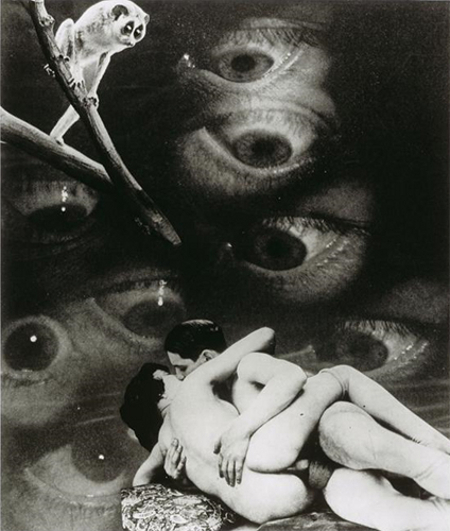
Jindřich Štyrský, Emile Comes to Me in a Dream, 1933

The novel is completing itself. 

I simply watch.

I remember the first time I put my face into a mass of pubic hair. 

            Too late… almost.

I am nineteen.

19.

Everybody keeps track of everybody. It is a nightmare.

The writer must… well… perhaps? I sink into jargon. Collapse under absurdity. I, Zig the machine. Rise, you human being! You big mistake. You beautiful mistake. We must conquer. What. Exactly. You lose your way. Breadcrumbs will not help you. Particles. Waves. Ariadne’s silk. A spiderweb of electricity ensnares you. Break free. Yes. Please. By whatever means & ways.

You are collider.

Her rump against your pelvic bone. You cry out. She giggles. The Cosmos echoes the giggles.

Sex is a conversation.

Zig lays there feeling the tone and texture of a blowjob. “Careful!” Zig whispers.

The fluctuating muscles of buttocks during a rigorous fuck.

The bright light of eternity is darkness.

A flicker.

Command-end. I see the page of oblivion. I scroll into nothingness.

Thoughts. Permutations of thoughts. Half-thoughts. Half-giggles. We are insane. The right response. Spirals. Parallelograms.

Predictability of reality? Shaping the repetition. Difference. What are we? Sometimes?

Keep going. Electric swimmer. Spermatozoa. Spermatozoon. Wiggles. Zigzags.

Intercept, a novel.

People walk around knowing and not knowing. City of unknown unknowns. Are people knowable? Are you?

I fell off Gaddis. I fell off the fucking page. That was a while ago. I am so elsewhere. 

I might be the only one. The only writer. The brain is just reporting this information.

I no longer trust language to say anything. [I] being [I]. She lowers. I’ll not forget. We lay bewildered. Almost happy. Waiting for change. Uncertainty. Anything can happen. A lot of noise is made during the act. Silence. Talking will begin soon. 

I think of this book as a hypertext. You need not read it in chronological order. You need not read it at all.

Everything is connected.

Nodes of existence.

Waiting for Mom to come home. Is she coming? Are you coming?

The house is an apartment is a labyrinth of unfinished chores. Everywhere we look, something lurks. Recycling bags of plastic bottles are to be curbed. Plastic bags of garbage, too.

10:22pm. Nothing is happening. 

I stare at myself.

Earth rotates. I tag along for the ride. Thousand miles an hour. I do not feel a thing.

Did you turn off your computer? Might devour your reality.

I am bombarded by particles of light.

Darkness at the fringes of the curtains. The fringes of the Universe. A panel truck is parked on the street. Beings there not at all. Intelligence agents inside gather intelligence. Listening. Murmurs under the eiderdown. Listening. Fast radio blasts in the far fringes of the Cosmos.

The agents are everywhere. They must be. Chaos and disorder. The System is under threat.

A novelist has no goal. The purpose is purposeless. Cannot be any other way. Uncertainty. 

The American experience is really something. Eh? Are you experiencing it? Do you live in Germany? Botswana? Thailand?

These damn elm trees. The quivering branches. Slanted light. Blocked in part by a hulking bridge. 

Tortillas in the fridge. Panties in the hamper.

Thirty-three degrees Fahrenheit. We are still in the HZ. The Habitable Zone. Nice planet.

Electronic rage. Kids want the machines. Kill for it.

Valentine’s Day. 4:44pm. Taking agency over my narrative. Her ass is a little bigger than perfect. In other words, perfect. She walks by on purpose. I can tell. Pretending to be interested in something. Not purchasing anything. Returning to her seat. Yeah. I notice. You wear glasses, too. It will be fun taking our glasses off, kissing and fucking. We will have to meet first, of course. Perhaps talk. I am silent. I remain silent. Makes conversation difficult. I must drink cucumber sparkling water. Sip coffee. Write furiously in my composition notebook. Distract myself from the nothingness on the fringes of my existence. I may never fuck again. Not like I used to. Every writer disintegrates. Dissolves.

Night keeps getting in the way of day. Day keeps fooling night. Everybody thinks it is an illusion. I know it is real. Everything. All of it..

She puts a bare leg over my hip. My big hand cups her right ass. She fellates my nose. Tells me I am beautiful.

It makes no sense. How can it?

A piece of writing is an attempt at understanding.

Every novel becomes a Cosmos.

Nobody beats Finland 43 times in a row. 

We used to be people. It becomes too fucking hard. We separate. Become animals. Eating & fucking.

The flavor of your life. What is it? Cucumber? Lime? Tangerine?

The wonder and awe of first sex. Buttocks clenching and unclenching. Cries of pleasure and disbelief.

I sip coffee. Thinking about emerging civilizations. Blinking in and out of existence. Somewhere in the Cosmos.

Expanses of time before us

we remove our clothes.

“Let’s get moving,” you say.

We do. 

I like books. Books like me. We get along in my apartment. Walls and walls of books. Eyeballs follow me wherever I go. Not even the kitchen is safe. Not even the lieu. I am a beggar of books. I borrow. I steal. Ideas are everywhere. The Zeitgeist. Reach your hand up into the stratosphere and grab a bolt of lightning. You must. It is your prerogative. You are a human being. A god. A goddess. 

The leader? Who is the leader? What is a leader? Is there a need for a leader? I don’t even know what to say anymore. I just stop saying. I just stop being.

Machine. Machine. Machine. I just need to say that. To remind myself. Progress is at hand. The mind is a labyrinth. Curving steel walls get in the way. Palm the surface. Push. Push. 

It begins and ends and begins and ends and begins and ends and begins and ends and begins

A string of zeros and ones bewilders us all.

Throwing our heads back into pillows. Laughing. Getting serious. Coming and coming.