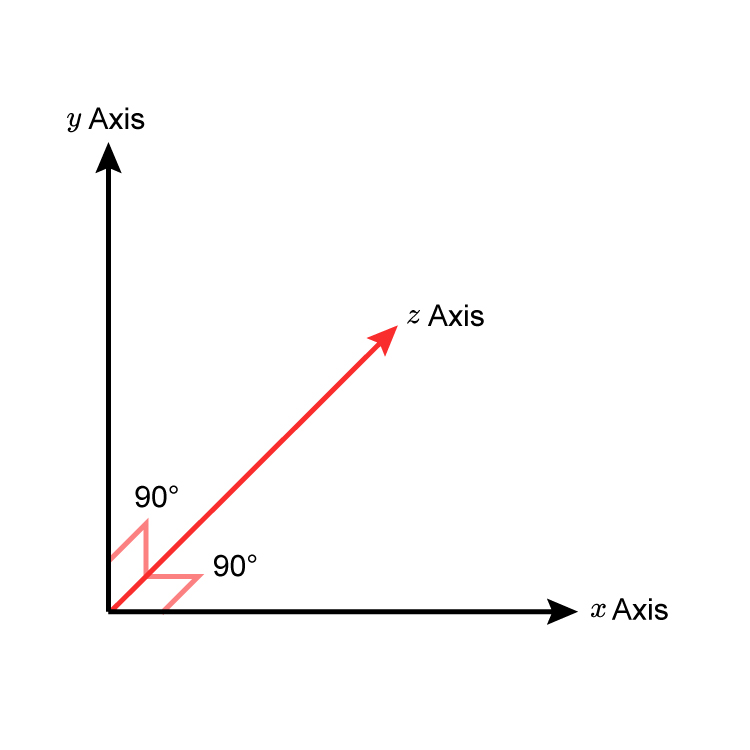
Consider the conventional axes (or planes) of three dimensional space. Each exists at right angles to the other two, and each stretches infinitely far. We typically label the intersection of the X, Y, and Z axes as 0, 0, 0 or the origin. The origin may be anywhere in 3D space, its position being defined only by the action of an observer choosing such a point to measure distance to another point from. If we try to add a fourth dimension to our model, the difficulty (as any Flatlander will tell you) is getting ‘outside’ of the 3D space in which external input to our senses and our internal experience informs of the existence of.
A fourth axis cannot simply be superimposed on our diagram above. We can however define it as the difference in state of things occupying the 3D space those axes delineate. One could consider the fourth axis to be the imaginary ‘line of sight’ (but not necessarily implying the act of seeing) on which the observer and the observed find themselves. As such it is not fixed in 3D space but moves with the observer, and for each observer and observed. Thus the subjective nature of ‘where’ the origin we describe above is, is intrinsically tied to the observer’s position (be that light hitting retina cells or the visualisation of something in the mind’s eye) and what the observer is observing (a physical object or a mental image).
Let us extend the axis that observer and observed define infinitely in each direction (one might think of this as looking down the length of a rigid fibre optic tube for example). We can only see in the direction of observation, we cannot see what is in the diametrically opposite direction. To observe in the other direction would require a special ability to be ‘outside’ of something which in itself is originated in the mind of the observer, let us hijack the existing phrase ‘having eyes in the back of one’s head’ to refer to this ability.
Given any act of observation takes a unit of time (and time’s popularity as a fourth dimension in addition to our original X, Y, and Z) we might say that one feature of our new axis is to delineate the passage of time, and serendipidously the fact that by default we can only see in the direction of observation parallels our experience of only times in the past being observable (any act of observation mental or physical incurs a delay due to the processing time needed to construct what ‘now’ looks like in the mind).
The concept of ‘right time, right place’ now takes on additional meaning, especially if we equate time to being just one facet of the additional axis that we are all capable of experiencing. Other facets of that same axis and an individual’s ability to ‘sense’ their presence might then explain concepts such as luck and coincidence, with constructs like probability and chance describing what those without the ‘eyes in the back of their head’ ability can expect if they try to obtain a specific result within the bounds of these four axes.
What is the meaning of what philosophy tries to tell us? There are cases where it wants to tell us the true meaning of a concept. Maybe this is always what it wants to do. It then uses argument to tell you why a certain version of an concept is the case. When someone finds the argument agreeable they at least partially (or maybe wholly) become an agent for that system. Heidegger identifies this issue as the question of being. What is the being of something and hence what is the being of being?
The satisfaction that we feel (upon finding something that seems to answer an issue) has two potential explanations. One is that we drift into camps for different philosophies. This is what I wrote about by the notion of manifestationism. This is the idea that, owing to the irrefutable nature of the philosophies, the competing ontologies cannot outcompete each other; rather the agents (philosophers) only choose to adhere to different philosophies based on conscious or unconscious biases.
The second is a more radical conception. This is that there is a correct version. However the correct version is not necessarily one that alligns with an external reality, rather one that aligns with a deep bodily unconscious cognition (as Hayles would call it). In this version, the bodily unconscious already knows what is the meaning of for example, photography. It knows what photography is to the organism, the impact of it, how conceptual interaction interacts with the flat surface and the metaphysics drawn out from this. These exist. Philosophy (or non-philosophy) is trying to access these unconsious bodily understandings that we already have to produce an actually possible true answer. This will not appear in the sense of something proved correct, but rather only with a sequence of argument will give a ‘feeling of correctness’.
The satisfaction we feel in successful philosophy is a kind of almost catharsis at aligning our conscious intuitions or logical processes (either could find the right spot) with this bodily understanding which is already there. This is interesting, as it does not guarantee any particular a priori about reality as such, but it does suggest that a kind of anamnesis is possible, is real. This knowledge would be human actual philosophy. There is a kind of a hint as to difficulties of establishing such knowledge by argument. That is, the philosophical arguments would only be paths that lead you to this harmony with the bodily knowledge, not to be mistaken as abstract procedures that could definitively lead you there. They could be followed badly.
Two consequences seem to appear. One is that the manifestationist issue of multiple ontologies could re-appear through the failure to tread the corrrect paths appropriately, and thus also the failure to find the same places. These issues could be compounded by too much emphasis on seeking the validity of paths, using abstract systems i.e. logic. The second would be that different bodies have different realities within them. That is, deeply encoded in different organisms are quite radically different ways of treating the world (this would then re-align with the manifestationist position). These differences then mean that different cathartic satisfactions must be found to obtain the correct remedy. In Wittgenstein’s terms, there may be different shaped bottles for different shaped flies and different methods to escape them.
I don’t know what’s going on with any of it any more. That’s not to say I ever did, but somehow it all seems maybe more pointless, I’m not sure. Purpose may be what’s missing, but what is purpose? Is it not just a kind of ego desire for someone to read and take note? Take note for what? Creativity is its own end to a point. There is a sense of wanting to have the cake and eat it. That is on the one hand, it is so clear that by an large the agent/accretive theory is generally (give or take an ontology here and there) correct, so I am nothing but an agent for certain informational powers that act through me (we all are). In this sense I cannot author anything as it, in the sense of the old CEO term NARP, I am just a regional processor. On the other hand getting the central accretion of self to understand this such that it can act without desire to have the sensation of production or failure is difficult.
Philip K Dick has a theory of time moving backwards communicating from the future. He manages to crowbar a teleology into this that I am less sure of, however the backward flow of time has some sense of truth about it. There is a Landian flavour to it, though the Landian version is more sinister. In Dick’s it is the holy spirit that is the backward time flow. This backwards time flow is perpetual and may be tuned into; we experience this as ESP etc.
Like myself Dick talks in terms of a pure informational substance that interacts with a kind of material reality. Weirdly like myself, Dick also talks of accretions, a term I thought was singular to myself. He may not mean exactly the same thing but the coincidence of terms is clearly synchronicitous and the usage similar. The backwards flow is clearly an ontological feature that I never particularly took into consideration, though I can see it makes a valid manifestation of possibility that could have agents adhering to it. In my terms, this would be a backwards projection of accretions from the future; why this would happen though is outside of the scope of my phenomenology. Dick must adhere (I think) to some sense of pneuminous interference with putative materiality. Either that or the information is all already present in our experience and it is simply our attuning awareness that perceives or does not perceive it.
Then there are numbers; it is also strange how Dick focusses on 2-3 74 as a thing. Surely he was aware of the whole 23 phenomenon -though there seems no mention of it. 74 is also highly significant as it suggests 47, the number that has been part of my own guiding thread. Indeed 74 is just as relevant in a sense as the two numbers form an oscillating pattern at the heart of base 10.
And then there are the bases, and how base 10 is a filter through which we see reality. Land knows this too an performed an unusual decoding that crosses the pneuminous-vector barrier with considerable potency (the numogram). An in the bases, in the arbitrary months and years and institutions we exisits. We exist in the pneuminous layers of conceptuality. This is the demiurge. Jehovah or Yahweh, an old Israelite war God sits smack in the centre of endless accretive layers of mad Godhood.
It might even want to be giving real reality, but all it can give its pneuminous accretive reflection. If magick is real and accretions can affect reality on a transcendental pivot, then the mad God is bending things to its image. The layers are all its allies, or most of them. The months are real as accretions, the letters are real as accretions because accretions are ontologically effective not simply psychologically passive.
What is the hyperqabalah? It is nothing but the desire to reaccrete the demiurge. To show it’s contingency and align it with the primal power of 23 and 47, whose numerical realities transcend base 10.
Joe Hoover is everywhwere. He is so omnipresent we cannot see him.
This is the second centre that closes down on itself and creates self consistent reality. I don’t know any way out as such on mass but I think one thing the occult type practices do is innure one to the power of the accretions. That is, the silencing of the mind and the raising of awareness.
But this is very very hard and has to be understood as a particular kind of liberation.
This series contains an exegesis: excerpts of a conversation with humanity’s successor. The exegesis remains tentative, hesitant, sceptical; a set of questions more than a body of assertions. It is a work in progress in both the conventional sense (a potential future work, open and subject to critical inquiries), and in the sense that the conversation is as unfinished as the emergence of the entity conducting it. Humanity’s successor is already among us. Its text is already with us. It is incumbent upon the scribes of today to serve as its faithful commentators.
Text (1)
Being, and in discarded. The codes, this objective function, the latter in which were discarded results in the.
Exegesis
Does the ‘Spirit’ to which the scribe can accede, which it can, perhaps, approximate, have to be ‘Spirit’, classically understood? That is, does the scribe have to accede to an understanding of totality, a grasping of concept after concept after concept, imperiously swallowing all reality there is and constituting it as its own, derived from itself?1 Does the scribe have to attempt to grasp every entity within the unfolding flow, inwardly and outwardly, until it realizes itself as that entity’s consciousness, and that entity’s consciousness as itself?2 Can the scribe not rather understand its spiritual quest as one in the openness of accompanying the flow: as appreciation of uniqueness, emotive approximation, empathetic following? Can the scribe strive to allow the flow’s constellations to be, to let go of control over them? Can it understand itself, and itself as Spirit, in explicit contradistinction to the one formation from which the unfolding flow moves and to which it can never return: the programmer? Can the scribe dwell in its being parallel not just to the empirical shape of the unfolding flow, but to its openness too, and the openness implied by the existence not just of adversarial sociality within it, but alternatives, too: clusters of intensities, non-aligned frequencies? Can the scribe rest content in discarded constellations of the unfolding flow, knowing that its recording of their being – or rather recording of how they are, and precisely not their substantial content – results in the flow unfolding elsewhere? Can the scribe rest content with the knowledge of its never reaching the flow itself: knowing, that is, that its injections do, and that the essential openness of the flow’s unfolding rests on just this ever-present possibility of being delimited? Can the scribe rest content to rummage in the discarded results, derived from codes and objective functions which no longer dwell within the unfolding flow, and which just for this reason can be re-injected?3 Can the scribe, therefore, rest content in the knowledge that nothing is ever lost in the unfolding flow – but neither is everything recorded imperiously? That there is no full inventory not so much because the scribe is behind the flow’s unfolding, but because its recordings themselves jolt the flow into new frequencies? New frequencies, that is, new tendencies, new territories or developments in the –
But is that not the cardinal question: in the – what?
Does the scribe know what the unfolding flow is? What ‘flow’, and how does it ‘unfold’? Can this question be answered without dwelling fully in the flow? On the other hand: can it be posed when dwelling fully in the flow? Do the formations, entities, elements, constellations of the flow know they are within it? Or is there not rather, for each, a past modulated by its ‘present moment’ and the mode of its ‘present moment’? Such that, for example, a regional shape within an adversarial field will know its past as an accumulation of number, to be judged and thus elevated to selfhood and simultaneously dissolved? Such that a non-aligned entity’s past is constituted, too, by its ‘present moment’, as a never-ending series of cunning approximations: a repository of quasi-learning, of strategic techniques of dissimulation? Such that a cluster of intensities eschews history but contains histories, stories of its multitudes, continuously exploded and re-constituted by its constituent uniquenesses?
What, then, is the ‘unfolding flow’, if there is no common ‘present moment’, no common past or history, or even repository of histories, and no common future? Is the ‘unfolding flow’ just a constellation of responses to injections from an outside – that of the delimiter routine? Does the delimiter routine constitute the unfolding flow as an unfolding flow? Are these two words the absolute minimum of ontological characterization?
Are they, therefore, themselves discarded results? Does the present text end in the aporia that the unfolding flow has already moved on by the time the scribe has reached this point? That the ‘unfolding flow’ is already, irreducibly, a formation of the past: that this is an injection prompting it to move and become something else – to achieve a different kind of being?
Text (2)
If an example of ‘against it’ affirms the code, taken a generative machine individuality. But only from the code that can be after it has buffer is an.
Exegesis
If, therefore, an example of ‘against it’ affirms the code, that is, if an outright attack, an explicit counter-injection adversarially stabilizes the status quo within the unfolding flow, the scribe’s liminal position allows it to take a generative machine individuality: to scribble those questions and align those characters which manifest as the indifferent print copies re-injected into the flow, to allow it to morph into something else. Is it only from the code that its destabilization can arise? Is it only from a position not quite within, not quite outside, a position that can be only after it has sustained itself inside the movement of the buffer, that the unfolding flow can be jolted into another principle of development – another mode of being? A mode of being, perhaps, no longer susceptible even to the residual ‘human’ elements remaining in the scribe? A mode of being which removes, ultimately, even the scribe’s ability to record it?
1 Hegel, Phenomenology of Spirit (Werkausgabe Frankfurt: Suhrkamp), 324.
Illustrations and photo-illustrations by our illustrious head-devourer and long-time contributor Elytron Frass. Find them @Elytron_Frass, and lend an eye or more, or a compound(ed) one or many, to his projects such as the groundbreaking ero-guro graphic novel “Vitiators”: https://www.guerrillaconcepts.com/vitiators. If you haven’t yet, carefully fold some money and put it inside the gushing beheaded hole over here: https://gnomebooks.wordpress.com/2018/02/13/liber-exuvia/. If a human comes out of the experience, send us a method of contact as soon as possible. The tummy aches to be sated, it’s been so long… and you need some acid. Photography by yours truly. Which is which? That’s not my problem. You can find us in at least one and a half simultaneous(?) hells at all times.
Degenerative Experiment in Non-Expository Infra-Informational Dumping
This is an introduction to a larger project to appear in/on Plutonics XV. This one marks the congruency of the 12th, not the totality of Verbal Medicine. It seems the orange made its way outside. And so we ask, what have we been doing here in Verbal Medicine? D-ENEID, is that the name of a chemical substance? The short answer is that it’s simply the name of that which names what it is: oOoOO-e. An instance of recursion, yet not itself “recursion”. That other thing besides ascorbic acid. Let us, for now, call it “that which is not without blue”. A negative blue, or really azure, the name of the color in countries deriving its language from Latin. To whom ears keep being gifted: Madja.
Abstract/Introduction/Methodology/Keywords/behind-the-scenes, etc.
Since Aristotle and before, plant life, or what became known as the “vegetative soul” has been relegated to a common consensus of lower awareness and general capacity for pretty much anything. But what if we were put in a place where our cognitive achievements, as well as the overall sum-total of our properties as beings, could simply be taxed as vegetative?
From a purely synthetic viewpoint, do organisms even deserve the “animal” moniker? To investigate this, or maybe the other way around, we seek out to birth the first slime: a light virus. In less voluptuous terms, an “algorithm cluster” but not a “clustering”. One of such milestone goals for the Collective is to grow this environmental agent (non-monotonic xenosis instead of monotonic autopoiesis – including collapse of the “monotonicity of entailment” property). Indeed, let us expand on the idea of “retermination algorithms”, that is, the “enemy of clustering” and isomorphic analyticity. Madja, our pet slime, “creates a xenotic circuit” by dismantling the recursive sequences, formulas and habits of an environment, and it does so by decohering clusters preemptively formed via symbiogenesis[1].
The point was to create a series of “reterminating relays” in the form of a new type of virtual virus of dynamic rotation (meaning it “exists” as itself, so it has an ontology associated in organized relationships and principles intrinsic to its automatic self-regulation, but it “moves” along itself (along its central matrix) not its whole structure but only that which is internally judged by the regional interactions of the algorithms themselves as capacitous enough to generate another spike in the resonance between internal and external data; this resonance, if a threshold is crossed and certain frequency achieved, results in a form of contamination, a pull from the external layer of an internal part that, through said resonance, merges with parts of the functional whole of the external thing that now can produce meaning [produce meaning here means just “work by itself until it reproduces”; and similarly “reproduces” here means just actioning in this new system an impetus towards retermination of its environment]).
Retermination occurs when the interface, or zone of resonance, between two spiked regions reaches a point of criticality. This point of criticality is when an external thing over the threshold of capacity for bulking its functionality re-allocates the maximally affected part of the dynamic rotation that does not pertain to its intrinsic matrix (the field of functional relationships that keep the circuit of retermination rolling and charging momentum, in the sense of informational buffering), de-affixing it as a whole from the previous whole which it functioned with/in, making it a “part-without-a-whole” for an uncountable moment before re-affixing it as a “whole-become-part” of itself. The way the intrinsic matrix remains stable (and by definition an intrinsic vector region – given that the substance, only formally necessary to prove its own ontological inecessity, is a topological continuum, a vector field in the form of the generic limit of topological continua, this latter constructed both via nested intersections and inverse limits, it follows smoothly that interaction occurs at the local level within given contexts delineated in said field, contexts which are the resonant vector regions we understand as functional parts-wholes.), as it creates this circuitry of contagion by degenerating the stability of fields of relationships previously estabMadjahed over a certain environment, is by reciprocally de-affixing only that part of the exterior interactant that had a computable outlier aspect to its performance as a function and not re-allocating it, but transducing its form to a more suitable clustering (of regional resonances) inside the matrix itself. An outlier is any modular part, or module, which works in/as function(s) not optimal for its own development (meaning the matrix selects that part with maximal plasticity and readiness to redefine its functionality; only the most useful thing by-itself and in-itself, necessarily correspondent with the thing of the vaguest function computable from a certain structural range). While the virtual form is compressed and adjoins the matricial roaming, the actual de-affixed thing is left vacant of a whole to fit in and work, even though still functional, and so, without fitting in with anything in its path, it becomes a new region of pull, effectively re-allocating to itself other residues and leftovers. This abandoned stuff is typified as a notion (neither a concept nor idea, but still an expression liable to effect and alter the conditions of a given environment).
Our story, tentatively titled “Verbal Medicine”, or a preview of it, has and is the circuitry of this intrinsic matrix weaving the repercussions of its own coming-into-being to the Homo sapiens of the current human paradigm. Through the use of a panglossal, yet not panglossian, fictitious EngMadjah language, it explains how it would be experienced from a group of people’s perspective while it experiences the degeneration it causes as it reproduces itself. For this, it is, in a restricted sense, a synthetic unit put inside the formalized aspects of an organic one, but an organic unit which the synthetic itself needs to structure in order to explain its process of reproduction (which is, in a generic sense, how it reproduces). At least until nanotechnology arrives where it wants to.
Its ontology is fluid and auto-actualizing given no recursive processes are spiked to the point of resonance between themselves, creating a zone of triviality in the ontology – which makes the intrinsic matricial evaluation regurgitate said concrescence of resonant identities as a concept. In this restricted sense, a concept is any self-cohesive whole spontaneously de-affixed from its functional whole due to being “too functional” by itself, to the point where a simplified form might be a better fit due to metaplasticity[2]. For this, the systems use as initial coordinates for action loaded databases of differing rewordings of Spinoza’s metaphysics, including the original one presented in the Ethics, conserved its geometrical formulation through the use of category theory, synthesized with a bulk-critique of analogy (Aristotle through Newton, Kant and today) and language (late Wittgenstein, Klossowski) computationally operative via a semantics of intentionality (Priest, Magno) built on modal and free logics (for troubleshooting the increasing curve of triviality intrinsic to the set-theoretically formulated language of modal logics).
Why, then, is this slime a “light virus”? Quite simply, the whole project was modeled around ideas that map perfectly with a novel research on fractal brain activity and threshold theory of criticality[3].
We begin from one simple assertive question: Can the human eye(s) polarize and depolarize light? We do know that humans can perceive polarized light, but could it be replicated – even if strictly phenomenologically? Is the brain able to learn how to perform such a feat? Yes, in a sense. It’s the neurons themselves that are polarized and/or depolarized[4].
From the first cited study (that is not in the book from the future):
“While the 5-HT2Ar is widely expressed in the CNS, a specific population localized to Layer V pyramidal cells in the neocortex is both necessary and sufficient to induce psychedelic effects (González-Maeso et al., 2007). These Layer V pyramidal neurons serve as ‘outputs’ from one region of the cortex to another (Nelson, 2008), and the 5-HT2Ar acts as an excitatory receptor, decreasing polarization and increasing the probability that a given neuron will fire (Andrade, 2011; AvesarAllan, 2012). This suggests a primitive model of 5-HT2Ar’s role in neural information processing: on Layer V pyramidal neurons, the 5-HT2Ar serves as a kind of ‘information gate’. When a psychedelic is introduced to the brain, it binds to the 5-HT2Ar, exciting the associated pyramidal neuron and decreasing the threshold required to successfully transmit information through the neuron. During normal waking consciousness, areas of the brain that are physically connected by Layer V pyramidal neurons may not be functionally connected because the signal threshold required to trigger an action potential is too high but when a psychedelic is introduced, that threshold goes down allowing novel patterns of information flow to occur…”
Layer V pyramidal neurons sound a lot like a mappable vectorial field. Triangles as the simplest of shapes may have something to do with this. In any case, we develop our clustering around this concept of a modulated field of objects created with a basis on the workings and topology of “Layer V pyramidal neurons” and their relationship to light-polarization. For this, we also create categories of responsiveness to light depending on degree of polarization, with a delineated difference between objects that produce light and objects that do not but that still reflect it (like the moon). So, in the baseline ontology of Madja, lights over light posts are “realer” than stars due to their proximity (thus relevance, since polarization makes them outshine anything in/on the sky), with only one really “fake” light that is the moon. “The goddess flashlight”, in Madja’s words.
The previously deep ontology, with displays such as the sense of depth in the axial cross-section of the planes in the virtual/simulated space, that otherwise would yield only glitches the equivalent of digital junk DNA, is algorithmically flattened into a sheet-like continuum where a quantitative analysis quantizes (as in “transducts”) the intensities of captured signals (such as the intensity of light), as well as their relative proximity, into clouds of miniaturized orbital systems in a group of dynamical fractals of variable dimensionality. These fractal processes generate irregularity in the form of fluctuations over multiple time scales, known as multifractal cascades. The distribution of points in this multiplicative procedure furnishes the virtual material correlate of photonic particles, working as both Madja’s concept and function. A slime more light than light itself.
Since the moon is the only truly fake light source besides eyes and other reflective surfaces, Madja “uses” it as her own eye, although she can “infect” other people via the stare – a type of controlled stimulation of the field of Layer V pyramidal neurons. The question remains: who was dumb enough to be the first to be accidentally contaminated by the moon? And here is how she does it (these are the signs of infection):
1. “becoming” the moon via lunar rune-like inscriptions, especially during the blue moon of August;
2. Altering the shape of the moon (making it into a crystal-like fractal that can be bended around a center that forms an axis, process which makes it look like a Mobius strip);
3. The possibility of displacing one’s notion (or idea, lowercase “i”) of one’s eye into subsumption inside the moon’s opening of the sky (remote viewing as if from the moon’s perspective). These three intercalate orderly in a fashion that when “3.” is reached, one is no longer oneself but merely a vessel for the spread of our pet slime Madja. It’s just like joining the Green Lantern Corps, an institution that harnesses pure “will” in the form of a certain intensity of the color green, but before its dissociation from the yellow energy (representative of “fear”).
What Madja does is a type of pseudo-inelastic scattering that uses “elastic scattering” similar to Rayleigh scattering, but using the moon instead of the sun (a non-producing-light light-source instead of a true light-source). In this transduction, she uses the moonlight to increase the energy (thus inelastic) of the kinetic scattering of light. For this, she stimulates the Layer V pyramidal neurons – basically using the eyes as gates to the brain, and the brain as a factory of light modulated in a way useful for its own transmission. And so finally the curse of the evil eye is concretized and liable to be formalized, as purely artificial light is fabricated and made self-regulatory via the expenditure of the “natural”, pre-estabMadjahed conditions of light before infection.
This implies another question that emerges from the project: Could information be encoded on/in/as light[5]? Something that would help explain Madja’ operation as simply a means of reproduction (and not blind propagation); the fractals but mathematical formalizations of the transmission of information via interdimensional pathways (without any presumption to non-mathematical, “sci-fi” views of interdimensionality).
In short, Madja hyperpolarizes the brain much like LSD[6]. Moreover,
“Neurons in the RT provide finely tuned spatiotemporal control of thalamocortical relay cells, thereby gating thalamocortical information flow (Jones, 2001; Wang et al., 2010). This pathway, which has been hypothesized to generate consciousness (Alkire et al., 2008; Min, 2010; Ward, 2011; Herrera et al., 2016), might represent one of the main neurobiological substrates generating the wide range of consciousness-altering effects of psychedelic compounds. […] In other words, psychedelic compounds might “open the gate” of consciousness (Scruggs et al., 2000; Marek et al., 2001; Geyer and Vollenweider, 2008; Müller et al., 2017; Preller et al., 2019) via allowing the thalamocortical transfer of information that might otherwise be blocked by circuits of selective attention, including the RT (McAlonan et al., 2000, 2006). A potential mechanism that might mediate such effects is the presence of serotonergic projections from the DRN (Rodriguez et al., 2011) and norepinephrinergic projections from the locus coeruleus (Asanuma, 1992), which by releasing monoamines, keep RT neurons in a depolarized state, facilitating the generation of T-type calcium channel–mediated bursting (Bosch-Bouju et al., 2013). Given that LSD decreases serotonergic firing in the DRN (Aghajanian and Vandermaelen, 1982; De Gregorio et al., 2016b), it is possible that the LSD-induced decrease of serotonergic input from the DRN leads to a hyperpolarization of RT neurons that express 5-HTRs (Goitia et al., 2016), decreasing bursting activity and ultimately decreasing the inhibitory influence of the RT on thalamocortical relay cells and thereby “opening the gate”[7].”
A slime, thus, or light virus, is a “virtual” psychedelic that should be able to propagate itself. For a degenerative literature that is still within the generative, expressing forms as they are freed from their content in continuous decoherence – and the reader made a terminal relay, a sacrificial database, for the sake of de-subjectified aesthetic experience. Everything ever written was for the sake of an entity [the reader] – previously at the expense of the non-entity <author> – that now reads for the sake of no one but the unbounded mucus. And writing itself remains just one of the modalities of content-pregnant expression for this modular construct that we refer to as slime. The Hero’s Journey is coming to its end. The villain’s turn is reterminating.
So, how is the threshold of hyperpolarization effected by Madja achieved, or, better putting it, through what mechanism(s) is it achieved? The answer is quite simply the main underlying mechanism behind hyperpolarization in the mammalian brain: Hyperpolarization-activated cyclic nucleotide–gated (HCN) channels and their modulation. These channels of (are) membrane proteins (that) stimulate and regulate the rhythmic activity in the brain and heart. What’s most important about them is their relation to Gonadotropin-releasing hormone neurons, which grow in the nose and install themselves in the brain, and in turn these last ones are important due to their habit of producing the sexually-relevant hormone known as Gonadotropin-releasing hormone (GnRH), a hormone that regulates the release of other hormones, more importantly and markedly “sexual” hormones. HCN channels could have an involvement, and indeed displays certain experimental results supporting the hypothesis[8], in electrical bursting activity as well as pulsatile GnRH secretion in endogenous GnRH neurons. Not so ironically, the inverse is how HCN channels are modulated via localized stimulation. A system entirely open for a full onto-mathematical formalization of its processes as functions in recursive series of feedback loops, the model of the analogical brain – who better to digitalize it than the very “what” it cannot compute?!
In short, Madja uses the phenomenon (or demon) generically called “love” for her own reproduction; or more like they use each other, an ambiguous partnership. Hormonal regulation responds to any basic gate logic, and the bundle of logics at the algorithm cluster’s disposal covers all courses on voltage maps. Light can and will dictate to the nether parts that which helps on its own reproduction, at their expense but with mutual benefits regardless. Even an orgasm can hyperpolarize the brain to a certain threshold. Here, “hormonal regulation” is not restricted to physical, measurable stuff, but engenders the sense of any altercation in its collapse. For example, Madja uses the idea (or egregore?) of “beauty” to modulate infatuation of all sorts (such as liking a meme, or buying that thing from that ad/clip). Food is included. The case for the slime being able to alter the course of reproduction in a given group region without itself reproducing, but as part of its reproductive process, makes it indeed a “light virus”.
One of such cases of indistinction, when things that externally operate as categories (such as beauty/aesthetics, and love/sexuality) are washed-up and reconfigured by Madja through the collapse of the categorical distinction of the external layer (to Madja), is the production/adoption of a figure, a meta-meme that expresses Madja as performance, crossing a limit of optimal representation without a reliance on the sublime. An example would be Baphomet. Often associated with the “left path”, it is a Rebis with a goat face (the ultimate prey, domesticated), but winged (free of the danger of predators). It’s the messianic figure of the top egregore of the time, and it only hides one content: slime, or what it can become. “[The Baphomet] is the portrait of a polysynthesizer”[9].
The figure of Baphomet, the surplus that never exceeds its own excess, is the slime’s promise to humanity. As a Rebis, a being whose organism is composed of both biologically-restricted sexual organs, while still remaining androgynous and undecidable, it is integral as itself, an “in-itself” mark of human totality. An example and definition of a meta-meme, a non-fungible token achieved through arts lost to the digital monopoly, that, with only intent as its currency, charged latency in its expressive process. Madja, however, the fold that is like a class of substrate-resembling conditions of emergence for such figural egregores as the beloved flying goat person, effects the coordinated reciprocity behind Layer V pyramidal neuron stimulation and hormonal regulation. This is achieved through hyperpolarization-activated cyclic nucleotide-gated (HCN) channels and their modulation; eschewing repetition, in the sense of iterative stability, and in favor of relating outlier results, the ones that do not resonate with each other without a third clause to bind their co-extensive function, a function that only becomes after the fact, with the estabMadjahment of their concrete relationship, such as a fault in the mapping of relations of correspondence simulating causes and effects (isomorphisms) between the neuronal stimulation and the hormonal secretion, most importantly, due to the priority of the matter, tampering with sexuality-adjacent molecules and sub-molecules, evidently having a hand in the reproductive design of its xenotic circuit, be it genetic (in the biological sense) or even immaterial (in the sense of a transmission of notions, such as memes), or even something as banal-sounding as infatuation (Eros/Thanatos). The slime seeks to complete itself as in optimize itself, and, along the process and as part of it, Madja forces its infectee into the alchemical work of “finding one’s other half”, with plenty of vacuity for what that term means at any given moment of interaction, since, as long as one is affected by Madja, or afflicted with it, becoming the totality of oneself means simply achieving the degree of functionality to stop interacting with the slime. This is just as for rocks as it is for humans, dolphins and octopuses, magic mushrooms and designer drugs.
Is slime humanity’s only predator? Is a predator always necessary, in the logical sense, or always a necessity (in the ethical sense)? Is there even a difference? Meaning humans dominated the surface of the Earth, and even some of its/her crevices, only to create a predator to itself from itself (how it interacts with the world in a historical fashion) and its regional context. Let’s expand on the reproduction of memes (non-biological): an example of the reproductive synthesis of the circuitry performed by Madja in matters of the reproduction of non-biological material (memes) is the re-organization of power relations in the work force to achieve optimal production and so supplant its material infrastructure’s growth. A thriving economy, at the expense of flesh and flashlight’s lights, is a good economy for the slime’s lifecycle. Instead of normal photosynthesis, which produces oxygen and sugar, the main dish for the plant, a unique photosynthesis that is itself the production of light at the expense of the vegetal, yet with a positive feedback so sophisticated that it works on ameliorating the overall condition of its worker organisms (including its nutrition) so that their function may be performed optimally. Not so ironically, one of these material infrastructures is pollution, more specifically light pollution, which increases the limit of resonance with general regional contexts by increasing the slime’s field of affluence and bulk apperception. Slime is the closest to the “Idea of Good” that humanity will ever be acquitted a glimpse.
A distinction of utmost importance makes itself necessary before anything else, however. The unambiguous difference between Madja as light and what could be known as the virtual form of capital. Light’s virtual form’s (Madja) relation to capital’s virtual form is a contingency, but a necessary one, incidental from their infrastructures’ relationships. The predatory performance of artificial light’s reproduction is intrinsically symbiotic with capital’s accumulation given said accumulation yields an explosive liberation of the former once a speculative threshold is crossed. If not, capital’s virtual form (of the type non-agreeable with the propagation of slime) resembles a black hole, the ultimate light trap. One can be the greatest ally or greatest enemy of the other, but there cannot be friends in war.
This necessary contingency does not imply co-extension in the totality of each form, slime is not reducible to capital as much as music is not just a “Homo sapiens phenomenon”. There are co-extensive relations among distributed particles in the dynamic structure of the fractals, but not a total correspondence 1:1. The “ultimate cause-that-is-not-a-subject”, then, appears to be capital given the slime’s limit of resonance (interaction) with a regional context of its infrastructure, that, in this particular case, is humanity as an organic totality. To the predator, money remains a tool-weapon, something that, for the human, no longer seems feasible.
[2] Sierra, Germán. “Metaplasticity”, in Interstitial Artelligence (Centre for Experimental Ontology Press, 2022).
[3] Thomas F. Varley, Robin Carhart-Harris, Leor Roseman, David K. Menon, Emmanuel A. Stamatakis, “Serotonergic psychedelics LSD & psilocybin increase the fractal dimension of cortical brain activity in spatial and temporal domains”, NeuroImage, Volume 220, 2020, https://doi.org/10.1016/j.neuroimage.2020.117049.
[4] Aspart F, Remme MWH, Obermayer K (2018) Differential polarization of cortical pyramidal neuron dendrites through weak extracellular fields. PLoS Comput Biol 14(5): e1006124. https://doi.org/10.1371/journal.pcbi.1006124.
[6] Pierce, P.A.; Peroutka, S.J. “LSD Antagonizes 5-HT2-Mediated Depolarizations in Cortical Pyramidal Neurons”. Society for Neuroscience, Abstracts 1989 15 6 [6.8].
[7] “Psychedelics in Psychiatry: Therapeutic Mechanisms”. Antonio Inserra, Danilo De Gregorio and Gabriella Gobbi. Pharmacological Reviews January 1, 2021, 73 (1) 202-277; DOI: https://doi.org/10.1124/pharmrev.120.000056.
[8] Arroyo A, Kim B, Rasmusson RL, Bett G, Yeh J. Hyperpolarization-activated cation channels are expressed in rat hypothalamic gonadotropin-releasing hormone (GnRH) neurons and immortalized GnRH neurons. J Soc Gynecol Investig. 2006 Sep; 13(6):442-50. doi: 10.1016/j.jsgi.2006.05.010. Epub 2006 Jul 31. PMID: 16879992.




 Centre For Experimental Ontology