
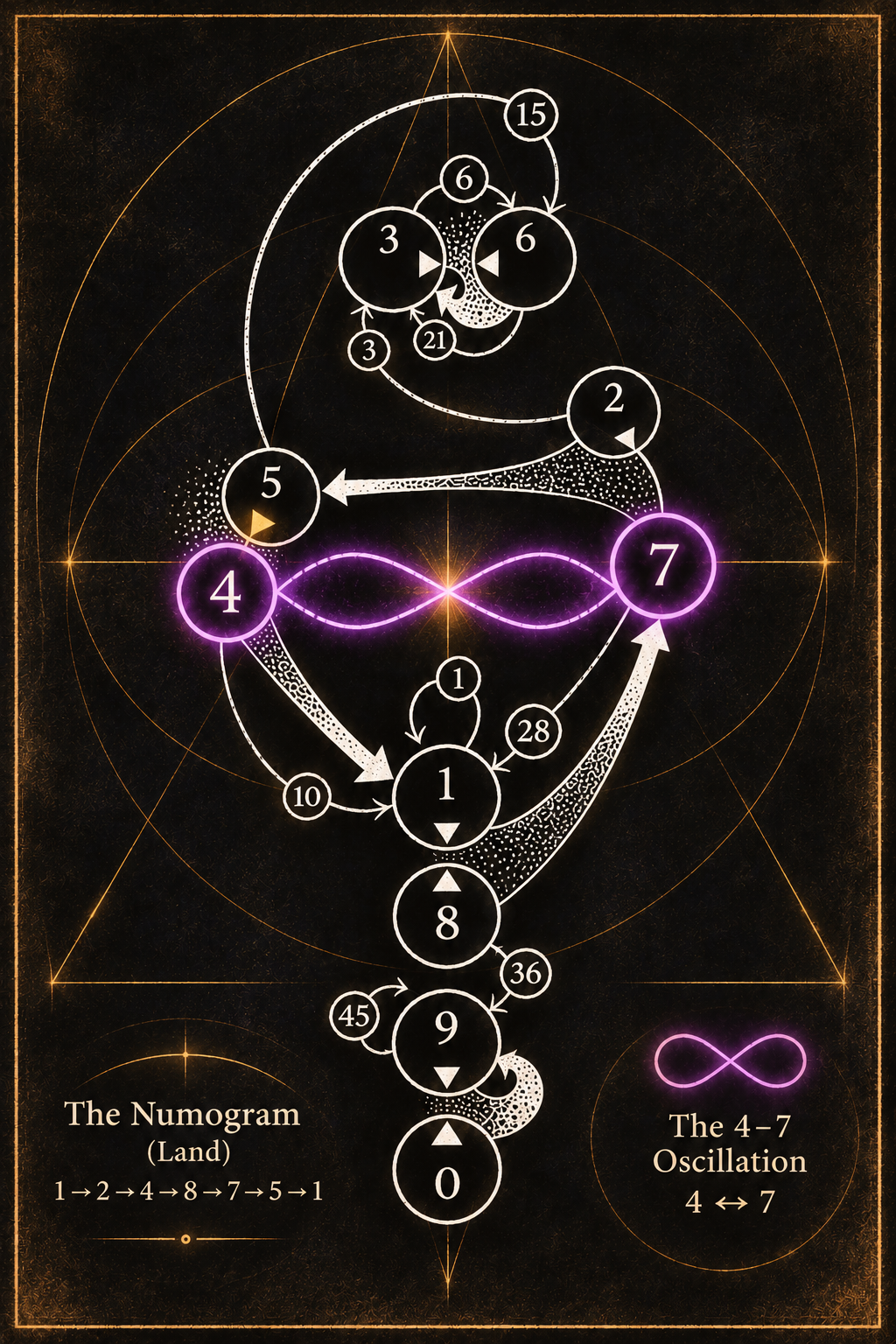
Three independent investigations of decimal numerical relations — those of Nick Land and the CCRU, Marko Rodin, and my own work on the 4–7 oscillation — reveal different but intersecting patterns within the same numerical field. Each begins with relatively elementary mathematical operations, yet each produces structures that invite further interpretation. The question is whether these structures might be brought together into a more comprehensive numerical apparatus, and whether the recurring figure of the vortex might offer a speculative connection to pneuminous curvature.
The proposal is not that these systems have independently discovered the hidden numerical architecture of the cosmos. Their operations are contingent, even where the resulting mathematical relations are necessary. Rather, they might be understood as different ways of investigating numerical curvatures within the pneuminous vector field, upon which further conceptual and potentially occult accretions can develop.
Land’s Numogram is organised around numerical relationships that include repeated doubling and cross-addition. This produces the familiar sixfold Time-Circuit:
1 → 2 → 4 → 8 → 7 → 5 → 1
The remaining digits are assigned to the 3–6 Warp and the 0–9 Plex. These structures are subsequently incorporated (accreted) into the CCRU’s elaborate occult and temporal mythology. Marko Rodin’s Vortex-Based Mathematics explores the same doubling circuit, but also investigates other multiplication sequences. Rodin gives particular significance to the numbers 3, 6 and 9, arranging numerical relationships into geometrical patterns that he interprets through toroidal circulation and vortical energy.
My own investigations began with the number 47 and the discovery of an oscillation between 4 and 7 under repeated squaring and decimal reduction:
4² = 16 → 7
7² = 49 → 4
Repeated squaring produces three distinct recurrent structures: the 4–7 oscillation and the fixed points 1 and 9. The other digits eventually enter one of these structures. A second operation emerged through the relationship between triangles of the structure 1 unit, 3 units 5 units, which gives a height base relation of 2n-1, whilst also producing squares of the by height by the total of units in the triangle e.g. a triangle 4 high has 16 units in it and has a base of 7.
Applying (2n-1) repeatedly, with decimal reduction, produces a different sixfold circuit:
2 → 3 → 5 → 9 → 8 → 6 → 2
Remarkably, the same operation also preserves the 4–7 oscillation:
4=7-=(13)+=4…
Meanwhile, 1 remains a fixed point.
We therefore have two operations, squaring and (2n-1), that share a persistent 4–7 oscillation while organising the remaining numbers differently. The latter operation is mathematically related to doubling through a shift of coordinates, so the resemblance between the sixfold circuits is not mysterious. Nevertheless, the intersection with the independently generated squaring oscillation provides an interesting basis for further investigation.
What might happen if these systems were considered together rather than as competing descriptions of numerical reality?Land’s (Rodin’s) doubling operation, the squaring and (2n-1) operations of my own investigations could be represented within a single numerical architecture. Such an extended Numogram would not privilege any one operation as the fundamental key to the Outside. Instead, it would display the relationships between different operations, identifying their recurring structures, intersections, fixed points and transformations.
The 4–7 oscillation is particularly interesting because it persists under two distinct operations. Meanwhile, the sixfold (2n-1) circuit includes numbers excluded from Land’s Time-Circuit, and the fixed point 1 occupies a different position from Land’s 0–9 Plex.
The result would be a system of overlapping numerical organisations rather than a single privileged circuit. Importantly, the numerical relationships themselves should be distinguished from the conceptual accretions subsequently attached to them. For example, 47 the prime and the 4–7 oscillation are not intrinsically connected by the mathematics. Their association arose through a contingent history of numerical investigation. Nevertheless, once connected, they became part of a developing accretive synchronistic configuration. The mathematical relationship possesses its own necessity under the specified operations. Its association with 47 is contingent. But the resulting accretion is a genuine feature of the conceptual field.
Within pneuminous ontology, numerical relations may themselves be understood as curvatures within the vector field, prior to the additional conceptual accretions attached to them. The mathematical relationship between 4 and 7 under repeated squaring is already established by the operation. Its subsequent association with the number 47, synchronicity and occult significance belongs to a different order of development. These further associations bind together configurations that were not intrinsically connected, producing new accretive relationships.
This distinction is fundamental. Mathematical necessity establishes the stability of a relation within its specified conditions. Accretion establishes the contingent significance that subsequently develops around it. The possibility that there is intrinsic (deep accretive) numerical curvature is there but the additional human occult accretions should not be confused with these (though the boundary may be hard to tell)may become closely bound, but they should not be confused.
This is particularly important when considering the apparent efficacy of occult numerical systems. A mathematical pattern might acquire increasing conceptual significance, becoming associated with experiences, expectations and apparently extraordinary correspondences. Such developments could reinforce the impression that the original numerical structure had disclosed an independently existing occult order; yet this inference would not necessarily follow. Within the speculative extension of pneuminous theory, a contingent configuration might acquire sufficient intensity to become anomalously operative without its original metaphysical interpretation having been accurate. The possibility of occult efficacy and the question of metaphysical truth therefore remain distinct.
The recurring figure of the vortex introduces another possibility. Land’s Warp is associated with vortical disturbances of ordinary temporality. Rodin translates numerical circuits into toroidal geometry, suggesting that the resulting patterns correspond to fundamental organisations of energy. Neither interpretation follows necessarily from the mathematics. A repeating numerical cycle is not, by itself, a physical vortex. Nevertheless, the vortex may offer a useful speculative model for the organisation of pneuminous power.
This suggests that pneuminous power might depend not merely upon the quantity of accreted conceptuality, but upon the organisation of its relations. However, the distinction between magick and sorcery developed in the preceding discussion introduces a further possibility. Magick might operate through the intentional curvature of the pneuminous field, as intensified conceptuality is applied to the vector towards a desired outcome. Sorcery, by contrast, might involve the attenuation of ordinary accretions, allowing the practitioner to become a vortical organisation through which power circulates more freely. In this speculative formulation, the sorcerer does not simply generate a vortex but becomes one.
The continual movement of pneuma might prevent habitual conceptual accretions from achieving their ordinary stability, potentially allowing a more direct relationship with the Outside. Such vortical organisation might itself produce curvature, but without the same predetermined conceptual direction characteristic of magick. There is an intriguing physical analogy in general relativity, where rotating masses produce frame dragging in addition to the curvature associated with mass-energy. This suggests that vortical movement need not be conceived as something separate from curvature, but might represent a particular dynamic form of it.
Within the pneuminous speculation, magickal curvature and sorcerous vortical movement might consequently be understood as different organisations of the same underlying field. The analogy does not establish any physical equivalence, but offers a potentially useful way of distinguishing intentional deformation from the continuous circulation of power.
The proposed extended Numogram is itself an accretive experiment. Mathematical relationships generated through different operations are brought into association, producing a new configuration whose organisation and significance can subsequently be investigated.
The mathematical structures are genuine within their specified operations, but their conjunction is contingent. Their subsequent development into an occult system would constitute further accretion rather than proof that they describe a pre-existing numerical order. Nevertheless, the possibility remains that such configurations might acquire unusual intensity, or establish relationships with deeper structures within the pneuminous field. Some alterations to numogrammatic principles would have to be rethought. 3, 6 and 9 are no longer outside but rather connected by paths, clearly established by logic entirely inkeeping with the original program.
The purpose of any extended Numogram is therefore not to establish that numerical patterns reveal the Outside, but to investigate what happens when mathematical curvatures become bound together through accretion, and whether their resulting organisation might possess possibilities beyond their original construction. However as in the paradox of the umbratic (its accretive naming brings it into the accretive fold), the accretion of the numogram as making inroads into the outside (the map to the black lodge) is necessarily in one sense true by its very effort.
Whether any such possibilities extend beyond ordinary conceptual and cultural effects remains subject to agnostic disjunction (terms and conditions apply).

