Previously we considered sorcery as a kind of response to the void. We also consider that maybe the previously phraseology of void-parasite may be awry. This is the case because the void must always be mediated and hence it is not the void that is the parasite but the void-mediation-system. In the examples of Buddhism of sorcery we may broadly say that compassion and awe respectively mediate the impact of the void upon the human-vector.

We can consider other activities also as responses to the void. Not least of these is philosophy. Philosophers all brush with the void to a greater or lesser extent. This encounter is (for example) the dizzying vertigo one gets when encountering Descartes radical doubt for the first time. This sensation is often (but not always) easily repressed and the activity looks like one more mode of study. But of course what characterises philosophy is that really none of its questions receives an actual answer. It has this character because there are no regular knowledge criteria for the kinds of questions involved. This is because it responds to an encounter with nothing. Ultimate questions have no answers, only speculations: What should we do? Maybe this… What is the nature of all things? Maybe this…

Philosophy proceeds by creating and counter-posing logical speculation against logical speculation. Sometimes more regular-world criteria emerge from other disciplines (science, logic) that facilitate the partial withdrawal of some aspects of it. However otherwise what happens is largely a proliferation of systems reacting to a total unknowable.

In this way philosophy is indeed a void response, only unlike the awe and perceptual manipulation of sorcery and the compassion of Buddhism, it focusses on arguing about what is the case and what we can know. It is what it thinks it is: a love of reason (to interpret wisdom in the way in which philosophy has evolved it).

Such talk cannot help but put us in mind of the work of Laruelle and our own notions of manifestationism and agnostic disjunction. Laruelle puts forward a similar notion of war between differing ontologies, none of which can triumph, as all are reliant in the last instance on the One. The One in this sense can be likened to the void. It is the font of all concepts and yet contains none in itself. What we note also is that the conception we have of philosophy as an encounter with the void presents the void as a transcendental condition for philosophy and stronger than this philosophy is a transcendental consequence of the void. The human as human cannot help but develop these questions because the void is real and hence cannot help becoming locked in their labyrinthine argumentative structures.

Two additional observations come to mind. The first concerns prescriptive religion (largely monotheisms). These are interesting insofar as they do not so much represent a void interface as a-voidance. That is, they deny at least the moral void whilst preserving the ontological void -only God can understand being properly. The response that humans should have to the world though is not up for grabs, rather it is dictated by the deity in a book/system of rules.

The void is a more rational response to existence whereas the dictator God seems less so. However in a sense either of these notions is equally plausible such that they form a kind of meta-manifestationism (meta-non-philosophy). That is, it seems that the void/prescriptive God opposition operates at a different level to which e.g. idealism/realism does.

This fascinating consideration aside there is another way in which the prescriptive God works with the void. If we consider pneuminous accretive theory (which is a void entailing theory) to be correct, then any monotheistic deity can be seen as a vast pneuminous accretion that by its own conceptual power (definition) entails its supreme nature. As such, this supremacy is to its followers (and even to some extent to non-followers) actually supreme and its laws ‘real’.

In this case such a deity does not so much as make a void mediation system as a void-protection system. The monotheistic accretive entity cocoons the void and prevents the humans from coming into contact with it, offering up instead a deity complete with life and death explanation, teleology and morals to determine how existence should be lived. It is of course the removal of such a cocoon that Nietzsche called the death of God.

Secondly, and this in part builds on the possibility of a two tier philosophy dissection. It seems interesting (if maybe not at this stage plausible) to potentially align the void interfaces with the Jungian quaternity.

Such a lining up would tentatively be as follows:

Thinking Philosophy -mediated through reason

Feeling Compassion -mediated through good deeds

Intuition Sorcery -mediated through awe, astonishing events

Sensation Pseudo-Hedonism -mediated through physical work and sensory pleasure.
What is sorcery (in Castaneda’s sense)? Sorcery seems to be the altering/replacing of the self through doing acts alien to the the original self. These acts might be perceptual, physical or mental though in the system they all might be described as perceptual. The body perceives in ways we do not understand. Accessing the bodies ability to do this part of the aim. Everything is about perception, though perception is not a passive power, rather it is an active force with the ability to alter what is at large (not unlike my description of how the pneuma can alter the umbra).

How does sorcery spread? The lineage is described as transferring from established sorcerers to new ‘apprentices’ who are invariably tricked into the world of sorcery or presented with it as the only escape route in opposition to death -people down on their worst luck. Sorcerers identify apprentices according to omens that identify them as viable potential sorcerers. These omens are supplied by ‘power’, the name given for both the general force at large for determining events and the force that can be harnessed by sorcery as ‘personal power’. What is interesting is that there is no overarching teleology given. What does sorcery do? It would seem nothing other than create sorcerers. It is like Dzogchen without compassion. It seeks only to enter ‘the other world’ and bypass death.

Power then can be seen as selecting the victims of sorcery. What is interesting is that in the absence of any teleology the acts of power could be meaningless coincidences. This is the problem of the agnostic disjunction, the inability to discern an ‘omen’ from an coincidence -they look identical. To the sorcerer apparently they don’t, but does this really help as even if they do look different on some level, the sorcerer still admits that she/he doesn’t understand why power chose one person and not another. Thus it seems the arbitrary choice of power is still available even if it can be ‘seen’ to be different from a coincidence.

Once power has selected the next set of apprentices, the current sorcerers must go about installing sorcery. As mentioned the initial hook is brought about by trickery or shown as a last resort. Once the hook is in, the apprentice is instructed to begin to behave ‘impeccably’ and not to ‘indulge’. This basically means to try ones best at everything and not to bother with futile thought patterns. This is all done with the aim of streamlining the organism. This streamlining process can take years and running alongside it is the instruction in the business of sorcery itself: dreaming (the developing of the dream double), stalking (manipulation of the physical self to enable hypnotic like trickery) and various other things. The combined force of these alterations is supposed to essentially dismantle the self and not reassemble it. The remaining entity as a sorcerer is no longer the person they were, both physically and mentally they are different. There is a moment in CC where the tragedy of this alteration is brought out. One of the apprentices weeps to think of his mother, whom herself, late in her life was identified by power as a viable sorceress. Her son the half-sorcerer, wishes that she had never met the sorcerers as then she would still be his mother. But the woman who biologically was his mother can not be said to be so anymore, rejuvenated and transformed away from her lot as a timid ageing cook and cleaner, her entire personality is altered -sorcery has replaced it with a fearsome intimidating sorceress. He himself loses his gloomy regret by stopping himself from ‘indulging’. He cannot indulge because it’s all too late, she has gone and in part so has he. So the indulgence advice in its context is even correct, there is only onwards for both of them.

Even part of the way through this process we can see how we can look upon this as sorcery installing itself into certain vectors as selected by power. But since sorcery wants nothing from the world as such what is it doing? Everything seemingly turns on the machinations of ‘power’. The sorcerers themselves, once dismantled simply respond to the fate that power doles out, presumably making their impeccable best out of whatever hand is given. All of which raises the question, can it be cogently asked if ‘power’ wants anything? Presumably from the perspective of sorcery power does show certain things are desirable, but does not say why -no answer of this nature is ever forthcoming.

Sorcery and systems like it seem to feed off ordinary life; this is the parasite analogy. Sorcery enters the ordinary human and destroys it from inside, the victim does not even know they are replacing themselves with the sorcerous installation. It is perhaps curious why it tries to stay so limited in its host-occupancy, though maybe this is its natural rate. Certainly many people who attempt occult systems only do so at a very shallow level, so even when the information is out successful parasitism is low.

Buddhism seems probably the closest parasite system with its inherent attempt to show the emptiness of things. Buddhism though of course attempts not to proselytize as such but still to help other beings, the compassion parasite must take over -but the Buddhists know, behind the compassion installation is the void. Is this possibly what commands/is power? The nothingness. In this sense sorcery and Buddhism offer just two different responses to the same phenomenon. Both install the void-parasite. One says that in a meaningless world endless play in the vast scope of perception is viable option -but that this is not for all and many must just live in the illusion. Whilst the other says almost the opposite, compassion towards all beings, the way is open regardless of omen.

The void-parasite will have any takers.

by Charles J. March III

During helter-skeltering-in-sequestered-place, my habitual ritual is to start the day by humbly hitting my knees and peoples’ elbows after rolling out of my Aztec zeitgeist bedrock alter with the weight of the world domination on my shoulders like a sober, disciplined, Celebrate Recovery social manipulated media scrolling/meditating/levitating myopic monk troll and blind eye faith pray with ties that bind us (handcuffs) rebellion bound to happen hands that shake with invisible peace be with you office holding service industry friends and cult wrists that are religiously purified by obscure moonshine sanitizer (until they crack and bleed the blood and human sacrifice antibody of the Washing of the Feet CHAZ commune Christ) in OCD compliance observance of local protocols to the COVID-19 deities for divinitory solidarity and for a new Afrofuturistic (my corona hair will continue to grow until the first cure for the virus of racism happens, or at least until the second coming of the supply chained shorn and slaughtered herd immunity Lamb) heaven & hypocrite oath earth, while I pledge my non-pilgrimage allegiance to the crumbling flag day, light left in the wake candles for our burning down business funeral pyre country, and attend mass graves during this quantum physics, electron-rich inner life election year, because The Black Mamba mattered. It’s kind of like planting eco-friendly LSA-debased morning glory fear seeds (organic, of course). 

I then call (I think they blocked my contact with black magic) out to any unemployment officers who will hear me, and tell them to deploy doomsday DoorDash outsider deliverances so they can help me spice up my isolated Beef Lo Mein liminal into something beautiful breakfast routine life made with Mrs. Mother Dash Earth Day sweet & sour doughboy hydroxychloroquine animals who breathed fresh intubation convent air and reclaimed the world during poutine famine quarantine, as I stretch out on my lazy boy because my sunrise yoga class is non-essential to good health.

This process reminds me of when I used to loot for capital prior to calling my heroin dealers, and the subsequent cooking up then shooting up ritual that followed. I guess it helped me to maintain some semblance of daily order, and at almost times, population control, in keeping with humanity’s trend towards tricyclic plagues.

By now I’d be turning Mexican lady-like paranoid meth head cleaning freak tricks for my new formal preternatural roommates who be out at work or with the proselytizing protesters, as a form of whorish reciprocation for them going to the store while I stay-at-home and subsist off their scraps, because I don’t go out anymore. I suppose I took the role of my dog who had to be put to sacrificial death on Easter, while the solemn oracle masquerading carnival world gift exchanged stimulus check eggs ceremoniously impregnated with sanctity sickness. A true betwixt & between dog & pony show song & dance piece of birds of paradise lost law & order cosmic pandemic performance art. A seasonal consecration procession in the obligatory playground where fasting street medics harvest neo/pseudo supposed to be over by summer of light pink festering love flavored welcome to the anti-structure machine SpaceX vaccines.

Someone please give me my last surreal rites already, because the passage of garage doors of perception time has become meaningless.

Charles J. March III is an asexual, neurodivergent Navy hospital corpsman veteran who is currently trying to live an eclectic life with an interesting array of recovering creatures in Orange County, CA. His various works have appeared in or are forthcoming from Evergreen Review, Atlas Obscura, Litro, Chicago Tribune, L.A. Times, Lalitamba, 3:AM Magazine, Ink Sweat & Tears, Fleas on the Dog, Dink Press/Problématique, Queen Mob’s Teahouse, The Recusant, Taco Bell Quarterly, Storm Cellar, Terror House Press, Horror Sleaze Trash, Harbinger Asylum, Madness Muse Press, Maudlin House, Misery Tourism, BlazeVOX, Blood Tree Literature (prize), The Babel Tower Notice Board, Bareknuckle Poet, Anti-Heroin Chic, Synchronized Chaos, The Beatnik Cowboy, Points in Case, Expat Press, Stinkwaves, Young Ravens Literary Review, The Writing Disorder, Literary Orphans, Otoliths, Oddball Magazine, et al. Links to his pieces can be found on LinkedIn and SoundCloud.

N’ Solace House (part 2) -Jim Meirose

That membrane was tough so you can come in. We know crossing any next threshold’s a big step for your kind but just do it. No—yes just no yes just come on you’re pissing me down just come do it the flow here; the flow here; come in here ‘fore this deck’s gone dealing out the players aren’t here yet why the hell’d you deal the deck out?

Huh I.

Why the hell’d deal you the deal deck the deck when you know—it’s in that document there—the players come first. Then, when here, they choose the game. Then, rip the cello’ off the Dan deck and—do the deal but frickt’y—back off shuffle the deck first. New decks the order of the cards in new decks is not shuffled. Twenty-six shuffled into one deck of. Crap I am gone this membrane’s too tough. Are you sure this is not two fat membranes stuck together? Never so tough as this it has never ever been so tough tough as this.

Halluzza!

We don’t know your name yet you’re a new hire, so.

Knowing the name of it when deciding to buy it slants things completely off. Three, maybe four. Go in the store, like. May even be five. Our great founder said to us that it is not fair to have decided what to buy before entering the store as that removed equal opportunity from each-every store content. Fairness. Contents are preached over with fairness but everybody outside there’s allowed to have their mind made up what content to select to purchase for their home. Not fair. Not fair to the others as as as we hire a Danny—that’s unfair to Donnies. Hire a Chrystal—most unfair to; uh; uh oh; life injects here; n’; here and ‘ow, no, crap. Here and now. Hire a Chrystal a Danny unfair. All hires unfair. When predecided. Zap.

Take the unexpected phone call. The dip!

Give ’em hell on the telephone, then back.

Bunk.

Go. Describe the malady you expect Sow’s-lace house to ease down. Go deal with the call all smile smile and calm’n nice ‘ic’ ‘’ come back ‘lready and bet you ah bet you you—now stand in the store for no reason in particular so ‘vrything’s an even chance? Eh eh eh? No cause to be in a store you can’t no just can’t ‘thought thinking of something to buy wok wok and be we bet that you can’t just not keep from thinking when told you must buy, okay okay eh heh what do I need I’ll buy what I need but.

Why must buys ever be what you need?

Here they are all around all here for the buying how can you choose fair when gas-shot you back-scanning back home for back home to tell you what to do to take down and go pay for ‘timatically w’ o’t looking each over so each over’s probability of being bought equally chanced as as get in the car predecided where to go’s not fair to all the possible places for to go or or even why go anyplace if not to get there why start the trip having predecided where to go what to spend what to buy see or do, it’s not fair, you see.

No not fair!

Unfair!

Where to go what to spend what to buy see or do; when pre entre-vous pre-decided con carne entre-pre vous-decided to do this that or t’others you are not fair so, how?

How can you be a worker at Solicze house how to be a worker how’s that fair to me?

Fine okay yes all so true but. Come in the door we’ll sit down first things first.

Whoo?

In the door we’ll sit down first things.

The door we’ll sit down first.

We know crossing any next threshold’s a big step for your kind but just do it.

Door we’ll sit down.

We’ll sit—here there very good ack. We.

Let us do these small items a’fore decisioning what to breathe; but; let us do these small items a’fore decisioning how to breathe; but why; let us do these small items a’fore decisioning when to breathe; but why must; let us do these small items a’fore decisioning why to breathe; but why must we; let us do these small items a’fore decisioning how fast to breathe; but why must we do; let us do these small items a’fore decisioning how much to breathe; but why must we do something; let us do these small items a’fore decisioning how little to breathe; but why must we do something like this; let us do these small items a’fore decisioning how not to breathe; but why must we do something like this; let us do these small items a’fore decisioning never to breathe; but why must we do something like this first? I thought this was So-laced’p’ house.

Why the hell must we do something like this first?

But sir—

Never mind more this cannot be Sulace house!

Sir. Nom really—

Do not lie to me. Where’s the real Shoe-lace house?

Where’s the Zolace house?

Where’s house?

Someone come! Here! He’s—

Here’s hous.

Hurry up he is going—

Re’s ho.

Hurry up never mind that now look see he’s—

E’s H.

Here—he’s just about—

’s.

Never mind that he’s gone.

Never mind that he’s gone.

And it’s all your fault.

Your fault.

Yes it’s your fault.

I hope you are happy.

We know crossing any next threshold’s a big step for your kind but just do it.

Life is not no Szollace house ‘fter ‘ll.

How do you make a hyperqabalah? This is the question essentially posed by the end of here. Given that the previous CEO qabalah has been constructed by a circuit of numbers as derived by a pattern found using triangles and cross addition (see the same link) what we now need to do is to generate a new circuit and form a structure around it. The circuit will be generated in the same way as the previous except this time the base is different. This time we are dealing with base 23.

As such we must set up our numbers so that all calculations can be shown with clarity. Now because the hyperqabalah involves translating the paths of the previous CEO qabalah into nodes, we will use the letters attributed to these paths as the integers of base 23.

Thus they are (with their base 10 equivalences):
a=1
b=2
d=3
e=4
f=5
g=6
h=7
i=8
j=9
k=10
l=11
m=12
n=13
o=14
p=15
r=16
s=17
t=18
u=19
v=20
w=21
z=22

0 will be used for 0

This established we can perform the same operation that we did on base 10 to see if there is a circuit of numbers we can disclose. From here on we just need to work through the simple math in base 23.

i) A triangle a units high and a deep is not a triangle.
ii) A triangle b units high will have a base of d.
iii) Because we have a base of d, we convert this to the row height. Hence a triangle of c high will have a base of f units.
iv) A triangle of f units high will have a base of j.
v) A triangle of j units high will have a base of s.
vi) A triangle of s units high will have a base of ak. (ak)+=l
vii) A triangle of l units high will have a base of of w.
viii)A triangle of w units high will have a base of at. (at)+=u.
ix) A triangle of u units high will have a base of ao. (ao)+=p
x) A triangle of p units high will have a base of ag. (ag)+=h
xi) A triangle with h units high will have a base of n.
xii) A triangle with n units high will have a base ab (ab)=d

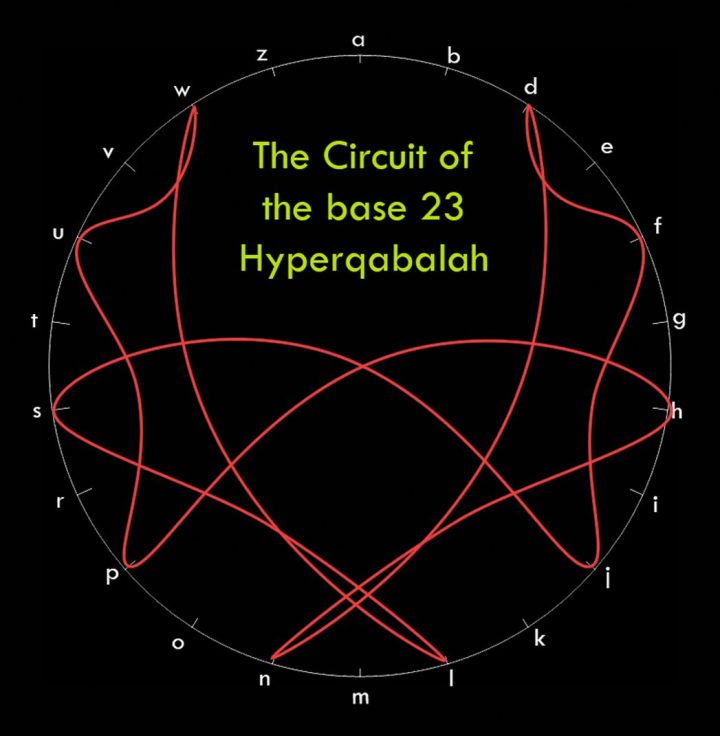
Since d is already in the list we know we have reached the circuit which is:

d-f-j-s-l-w-u-p-h-n-d

If we transcribe it onto a circle it looks like this.